PDFTests Originals

Formación de palabras (prefijos y sufijos) – Ficha 1

B2 Intermedio alto FichaInglés

Esta ficha de nivel B2 practica la formación de palabras con prefijos (un-, dis-, mis-, re-, over-, under-) y sufijos (-tion, -ful, -able, -ment, -ity). El alumnado deduce el significado a partir de las partes de la palabra, usa adjetivos negativos en contexto y forma la palabra correcta para cada oración. Es ideal para estudiantes de B2 y para quienes preparan exámenes con ejercicios de word formation.
ejercicios
38
Tiempo
35 min
PDF
5 páginas
Soluciones
Incluidas
  • 100 % gratis
  • Sin registro
  • PDF A4 listo para imprimir
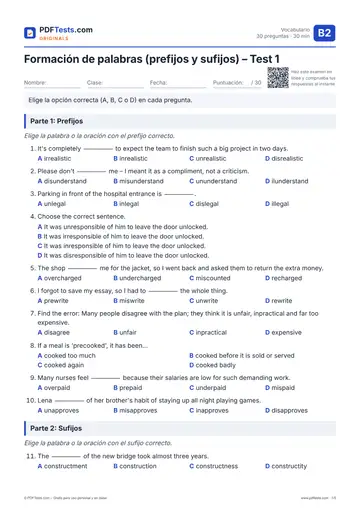
Vista previa de la página 1: Formación de palabras (prefijos y sufijos) – Ficha 1 Abrir PDF

Haz la ficha en línea

Escribe tus respuestas y pulsa «Comprobar respuestas». Se aceptan otras respuestas correctas.

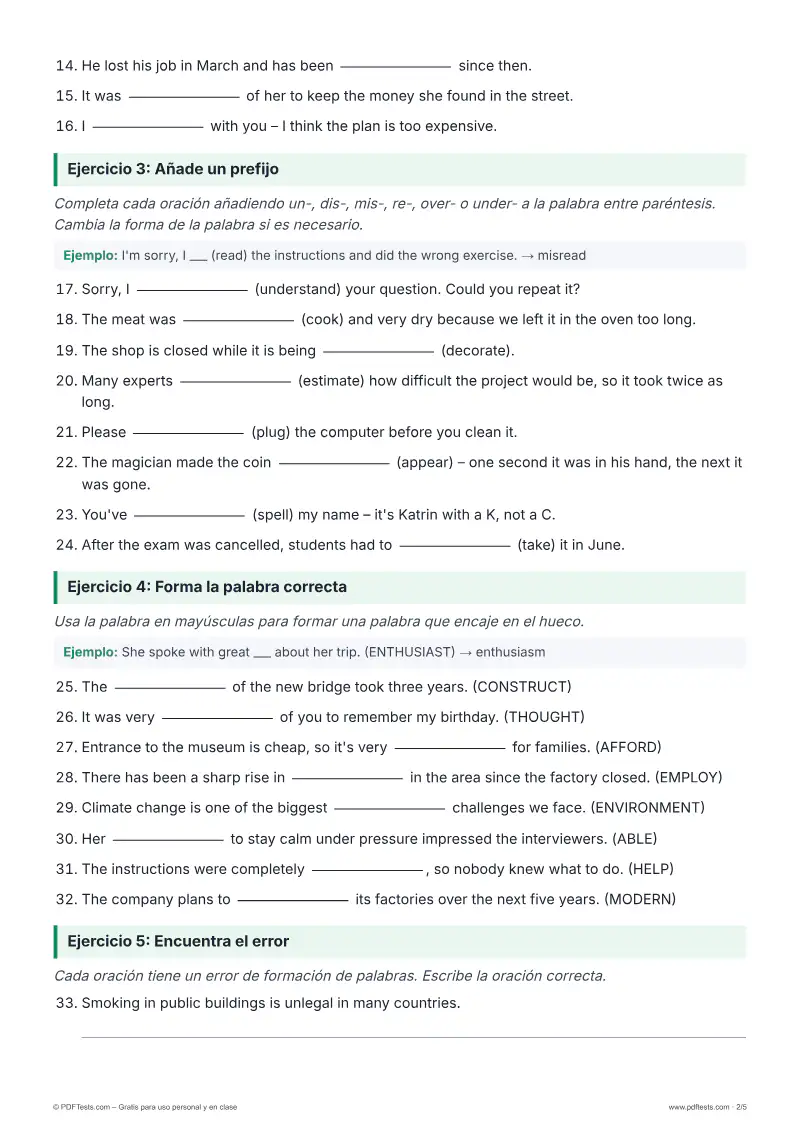
Ejercicio 1: ¿Qué significan los prefijos?

Relaciona cada palabra con su significado del recuadro. Sobran dos significados.

Ejemplo: replay → play something again

Banco de palabras think something is bigger or better than it really iswrite something again in a different waybehave badlynot given enough money for your worka person who starts a company together with someone elsea person you used to work withreserved in advanceable to kill harmful bacteriause something too muchable to be used again

  1. overestimate

  2. rewrite

  3. misbehave

  4. underpaid

  5. co-founder

  6. ex-colleague

  7. pre-booked

  8. antibacterial

Ejercicio 2: Palabras negativas

Completa las oraciones con palabras del recuadro. Sobran dos palabras.

Banco de palabras illegalirresponsibleimpatientunreliableinaccurateunemployeddishonestdisagreeirregularuncomfortable

  1. It's to drive without a licence in most countries.

  2. Leaving a small child alone at home is completely .

  3. Don't be so ! The bus will be here in a minute.

  4. My old car was so that it broke down every month.

  5. The figures in the report were , so we had to check them all again.

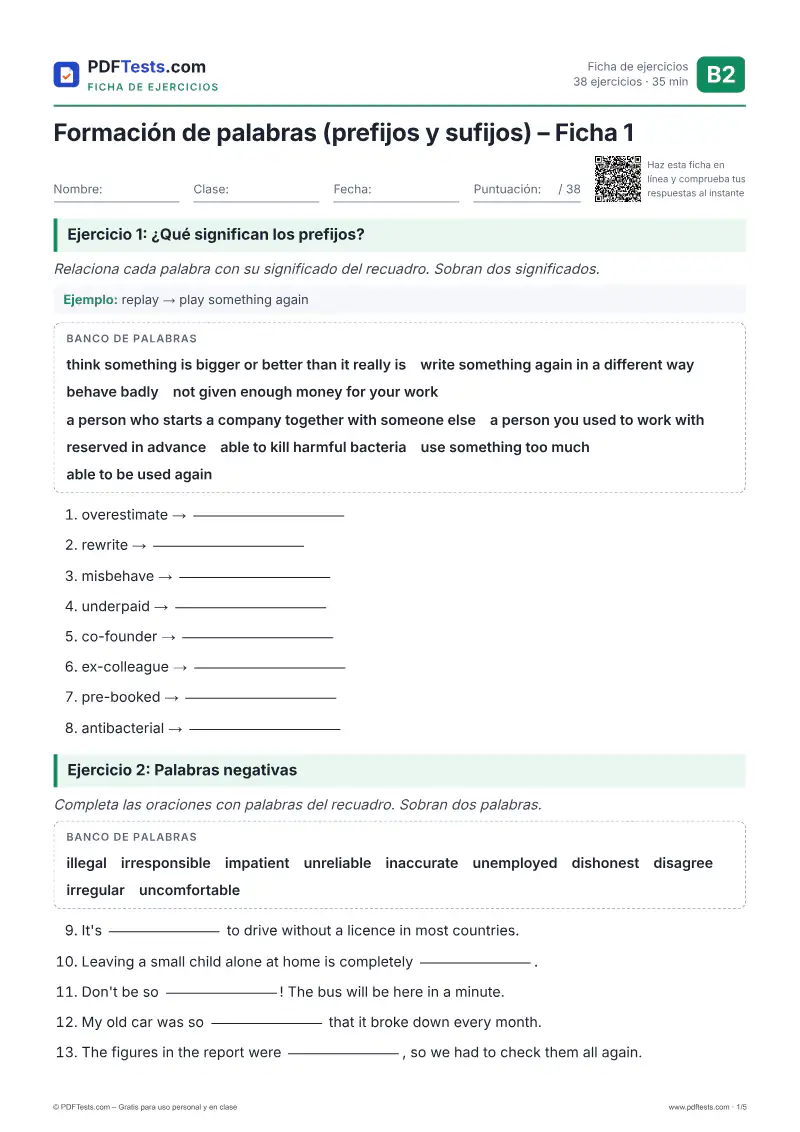
  6. He lost his job in March and has been since then.

  7. It was of her to keep the money she found in the street.

  8. I with you – I think the plan is too expensive.

Ejercicio 3: Añade un prefijo

Completa cada oración añadiendo un-, dis-, mis-, re-, over- o under- a la palabra entre paréntesis. Cambia la forma de la palabra si es necesario.

Ejemplo: I'm sorry, I ___ (read) the instructions and did the wrong exercise. → misread

  1. Sorry, I (understand) your question. Could you repeat it?

  2. The meat was (cook) and very dry because we left it in the oven too long.

  3. The shop is closed while it is being (decorate).

  4. Many experts (estimate) how difficult the project would be, so it took twice as long.

  5. Please (plug) the computer before you clean it.

  6. The magician made the coin (appear) – one second it was in his hand, the next it was gone.

  7. You've (spell) my name – it's Katrin with a K, not a C.

  8. After the exam was cancelled, students had to (take) it in June.

Ejercicio 4: Forma la palabra correcta

Usa la palabra en mayúsculas para formar una palabra que encaje en el hueco.

Ejemplo: She spoke with great ___ about her trip. (ENTHUSIAST) → enthusiasm

  1. The of the new bridge took three years. (CONSTRUCT)

  2. It was very of you to remember my birthday. (THOUGHT)

  3. Entrance to the museum is cheap, so it's very for families. (AFFORD)

  4. There has been a sharp rise in in the area since the factory closed. (EMPLOY)

  5. Climate change is one of the biggest challenges we face. (ENVIRONMENT)

  6. Her to stay calm under pressure impressed the interviewers. (ABLE)

  7. The instructions were completely , so nobody knew what to do. (HELP)

  8. The company plans to its factories over the next five years. (MODERN)

Ejercicio 5: Encuentra el error

Cada oración tiene un error de formación de palabras. Escribe la oración correcta.

  1. Smoking in public buildings is unlegal in many countries.

  2. The weather was so unpredictible that we cancelled the trip.

  3. Thank you for your kindliness during my stay.

  4. She felt very dissatisfy with the service at the hotel.

  5. The new manager is very friendly and approachful.

  6. We were impressed by the beautyful views from the hotel.

¿Te ha resultado útil esta página?

Informar de un error

¿Has visto una respuesta incorrecta, una errata o una explicación poco clara? Avísanos y lo corregiremos.

Vista previa

Sobre este examen

Ficha de inglés B2 en PDF: formación de palabras con prefijos y sufijos. Relacionar, completar huecos y corregir errores. Con soluciones.

Temas

PrefijosSufijosAdjetivos negativosFormación de palabrasSustantivos, adjetivos y verbos

Notas para el profesor

Empiece por el ejercicio 1 para que el alumnado observe cómo los prefijos cambian el significado y pase después a las tareas más parecidas a las de examen. Los errores típicos son elegir un prefijo negativo incorrecto (unlegal, inresponsible), añadir un sufijo equivocado (kindliness, approachful) y escribir mal formas como -ible/-able. Como actividad de ampliación, pida al alumnado que construya familias de palabras (p. ej., employ, employer, employee, unemployed, unemployment) con cinco palabras de la ficha.

Todos los exámenes de Inglés B2 →