PDFTests Originals

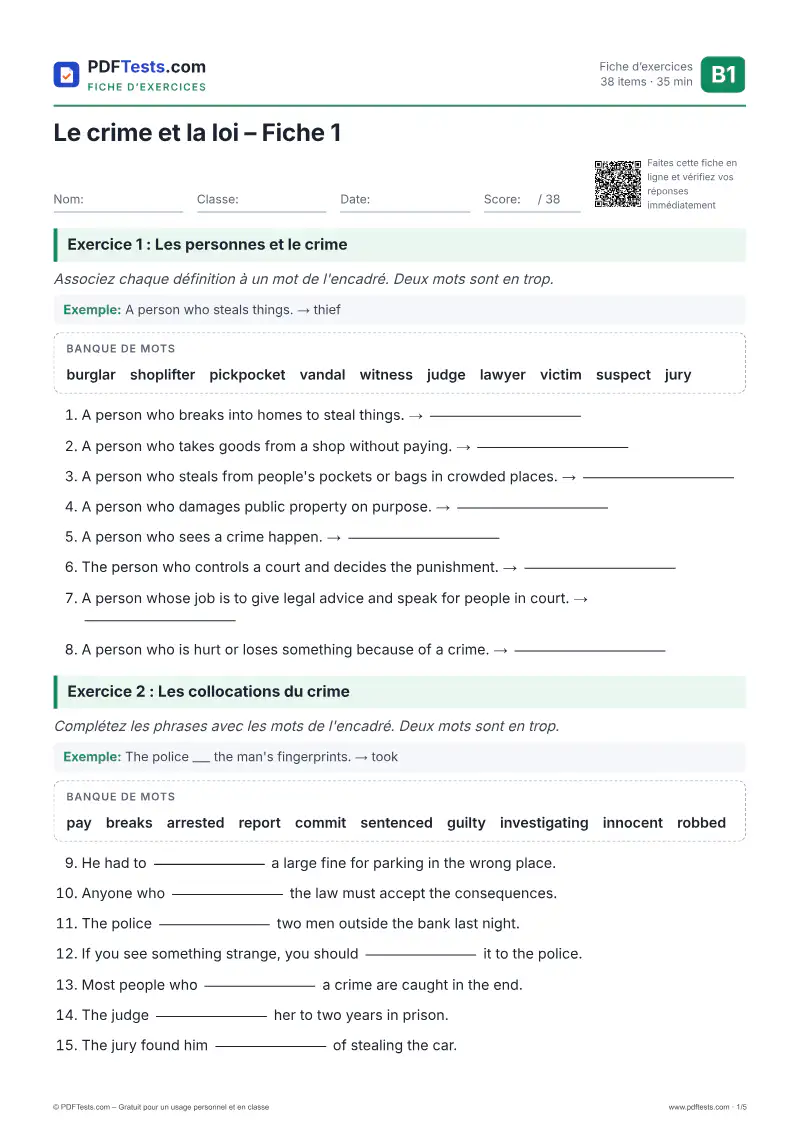
Le crime et la loi – Fiche 1

B1 Intermédiaire FicheAnglais

Cette fiche permet de travailler le vocabulaire essentiel du crime et de la justice au niveau B1 : les types de criminels, les personnes présentes au tribunal, des collocations courantes comme commit a crime et pay a fine, ainsi que des familles de mots comme theft, illegal et evidence. Elle s'adresse aux adolescents et aux adultes qui souhaitent parler et lire de la criminalité avec assurance.
items
38
Durée
35 min
PDF
5 pages
Corrigé
Inclus
  • 100 % gratuit
  • Sans inscription
  • PDF A4 prêt à imprimer
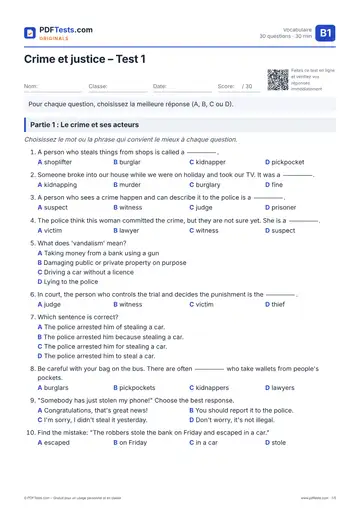
Aperçu de la page 1 : Le crime et la loi – Fiche 1 Ouvrir le PDF

Faire la fiche en ligne

Tapez vos réponses puis cliquez sur « Vérifier mes réponses ». Les autres réponses correctes sont acceptées.

Exercice 1 : Les personnes et le crime

Associez chaque définition à un mot de l'encadré. Deux mots sont en trop.

Exemple: A person who steals things. → thief

Banque de mots burglarshoplifterpickpocketvandalwitnessjudgelawyervictimsuspectjury

  1. A person who breaks into homes to steal things.

  2. A person who takes goods from a shop without paying.

  3. A person who steals from people's pockets or bags in crowded places.

  4. A person who damages public property on purpose.

  5. A person who sees a crime happen.

  6. The person who controls a court and decides the punishment.

  7. A person whose job is to give legal advice and speak for people in court.

  8. A person who is hurt or loses something because of a crime.

Exercice 2 : Les collocations du crime

Complétez les phrases avec les mots de l'encadré. Deux mots sont en trop.

Exemple: The police ___ the man's fingerprints. → took

Banque de mots paybreaksarrestedreportcommitsentencedguiltyinvestigatinginnocentrobbed

  1. He had to a large fine for parking in the wrong place.

  2. Anyone who the law must accept the consequences.

  3. The police two men outside the bank last night.

  4. If you see something strange, you should it to the police.

  5. Most people who a crime are caught in the end.

  6. The judge her to two years in prison.

  7. The jury found him of stealing the car.

  8. Detectives are still the robbery.

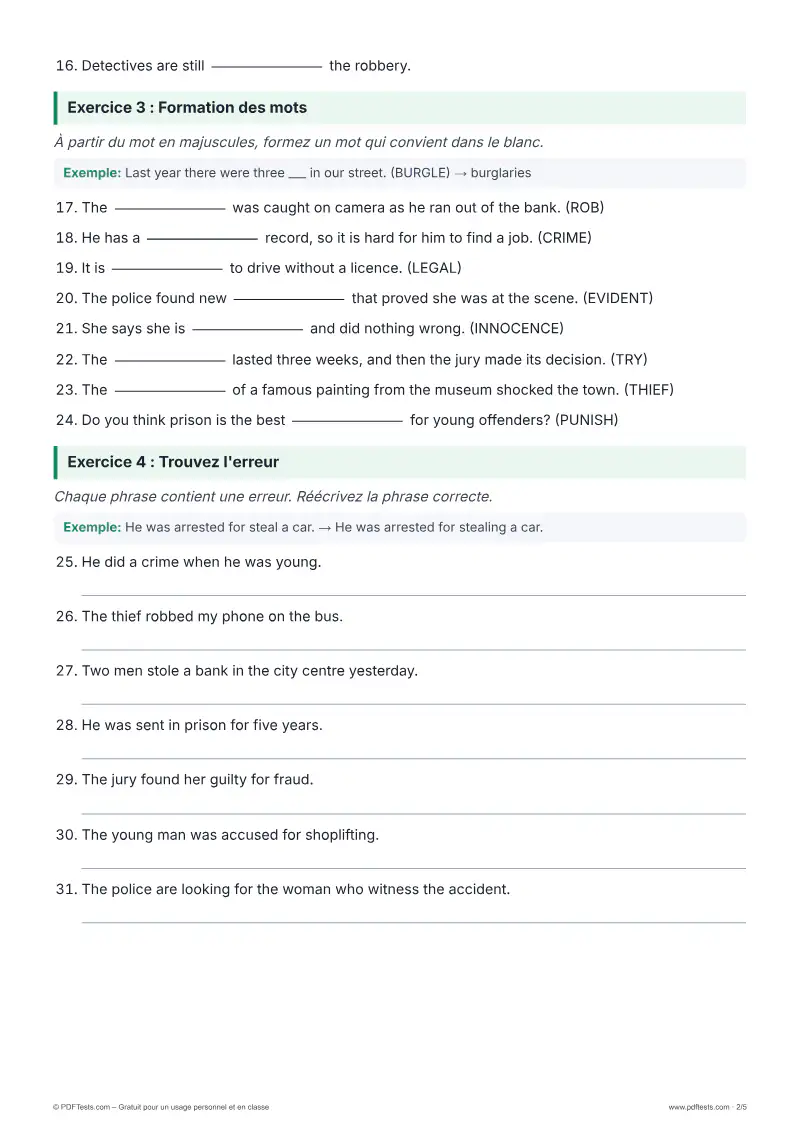
Exercice 3 : Formation des mots

À partir du mot en majuscules, formez un mot qui convient dans le blanc.

Exemple: Last year there were three ___ in our street. (BURGLE) → burglaries

  1. The was caught on camera as he ran out of the bank. (ROB)

  2. He has a record, so it is hard for him to find a job. (CRIME)

  3. It is to drive without a licence. (LEGAL)

  4. The police found new that proved she was at the scene. (EVIDENT)

  5. She says she is and did nothing wrong. (INNOCENCE)

  6. The lasted three weeks, and then the jury made its decision. (TRY)

  7. The of a famous painting from the museum shocked the town. (THIEF)

  8. Do you think prison is the best for young offenders? (PUNISH)

Exercice 4 : Trouvez l'erreur

Chaque phrase contient une erreur. Réécrivez la phrase correcte.

Exemple: He was arrested for steal a car. → He was arrested for stealing a car.

  1. He did a crime when he was young.

  2. The thief robbed my phone on the bus.

  3. Two men stole a bank in the city centre yesterday.

  4. He was sent in prison for five years.

  5. The jury found her guilty for fraud.

  6. The young man was accused for shoplifting.

  7. The police are looking for the woman who witness the accident.

Exercice 5 : Faits divers

Réécrivez chaque phrase au passif. Commencez par les mots entre parenthèses.

Exemple: Someone robbed the shop. (The shop ...) → The shop was robbed.

  1. Someone stole my bike last week. (My bike ...)

  2. The police arrested the suspect at the airport. (The suspect ...)

  3. Someone broke into our house while we were on holiday. (Our house ...)

  4. The judge sentenced him to six months in prison. (He ...)

  5. The police are questioning two witnesses. (Two witnesses ...)

  6. They fined the driver for speeding. (The driver ...)

  7. Vandals damaged the bus shelter. (The bus shelter ...)

Cette page vous a-t-elle été utile ?

Signaler une erreur

Une mauvaise réponse, une faute de frappe ou une explication peu claire ? Dites-le-nous, nous corrigerons.

Aperçu

À propos de ce test

Fiche d'exercices d'anglais B1 en PDF : vocabulaire du crime et de la justice, collocations (commit a crime) et formation des mots. Avec corrigé.

Thèmes abordés

Vocabulaire du crimeLa loi et les tribunauxCollocationsFormation des motsLe passif dans les faits divers

Notes pour l’enseignant

Commencez par l'exercice d'association pour vérifier le sens des mots, puis passez aux collocations et à la formation des mots avant la correction d'erreurs et la transformation au passif. Les apprenants confondent souvent rob et steal (on utilise rob avec une personne ou un lieu, steal avec un objet) et se trompent de préposition dans guilty of, accused of et sent to prison. En prolongement, demandez aux élèves, par deux, de rédiger un court fait divers sur un crime imaginaire en utilisant au moins huit mots de la fiche.

Tous les tests Anglais B1 →