PDFTests Originals

Crime and Law – Worksheet 1

B1 Intermediate WorksheetEnglish

This worksheet practises key crime and law vocabulary at B1 level: types of criminals, people in court, common collocations such as commit a crime and pay a fine, and word forms like theft, illegal and evidence. It suits teenage and adult learners who want to talk and read about crime with confidence.
items
38
Time
35 min
PDF
5 pages
Answer key
Included
  • 100% free
  • No sign-up or email
  • Print-ready A4 PDF
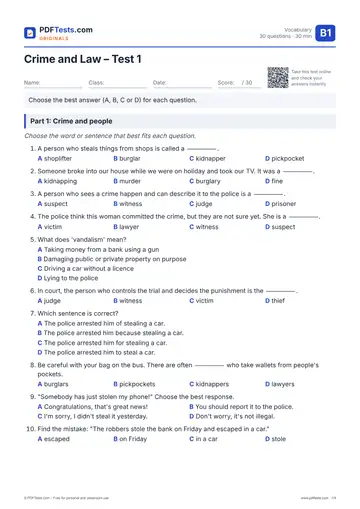
Preview of page 1 of Crime and Law – Worksheet 1 Open PDF

Do the worksheet online

Type your answers, then press “Check my answers”. Alternative correct answers are accepted.

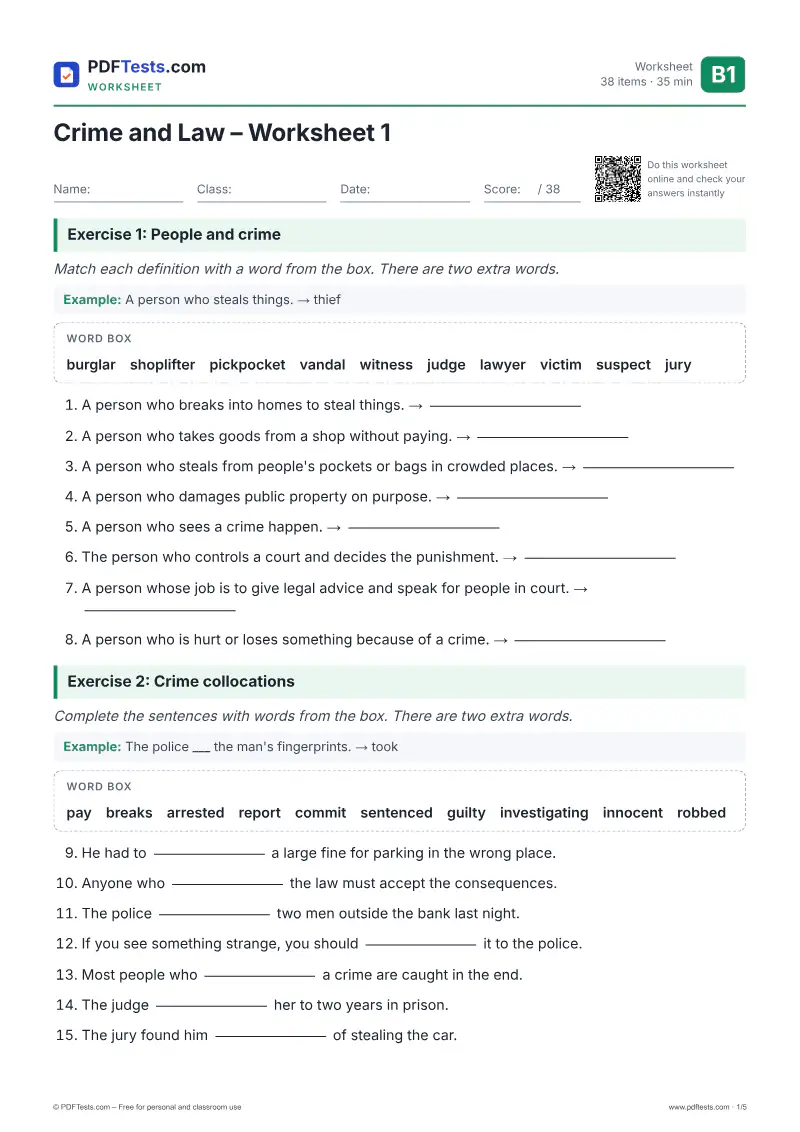
Exercise 1: People and crime

Match each definition with a word from the box. There are two extra words.

Example: A person who steals things. → thief

Word box burglarshoplifterpickpocketvandalwitnessjudgelawyervictimsuspectjury

  1. A person who breaks into homes to steal things.

  2. A person who takes goods from a shop without paying.

  3. A person who steals from people's pockets or bags in crowded places.

  4. A person who damages public property on purpose.

  5. A person who sees a crime happen.

  6. The person who controls a court and decides the punishment.

  7. A person whose job is to give legal advice and speak for people in court.

  8. A person who is hurt or loses something because of a crime.

Exercise 2: Crime collocations

Complete the sentences with words from the box. There are two extra words.

Example: The police ___ the man's fingerprints. → took

Word box paybreaksarrestedreportcommitsentencedguiltyinvestigatinginnocentrobbed

  1. He had to a large fine for parking in the wrong place.

  2. Anyone who the law must accept the consequences.

  3. The police two men outside the bank last night.

  4. If you see something strange, you should it to the police.

  5. Most people who a crime are caught in the end.

  6. The judge her to two years in prison.

  7. The jury found him of stealing the car.

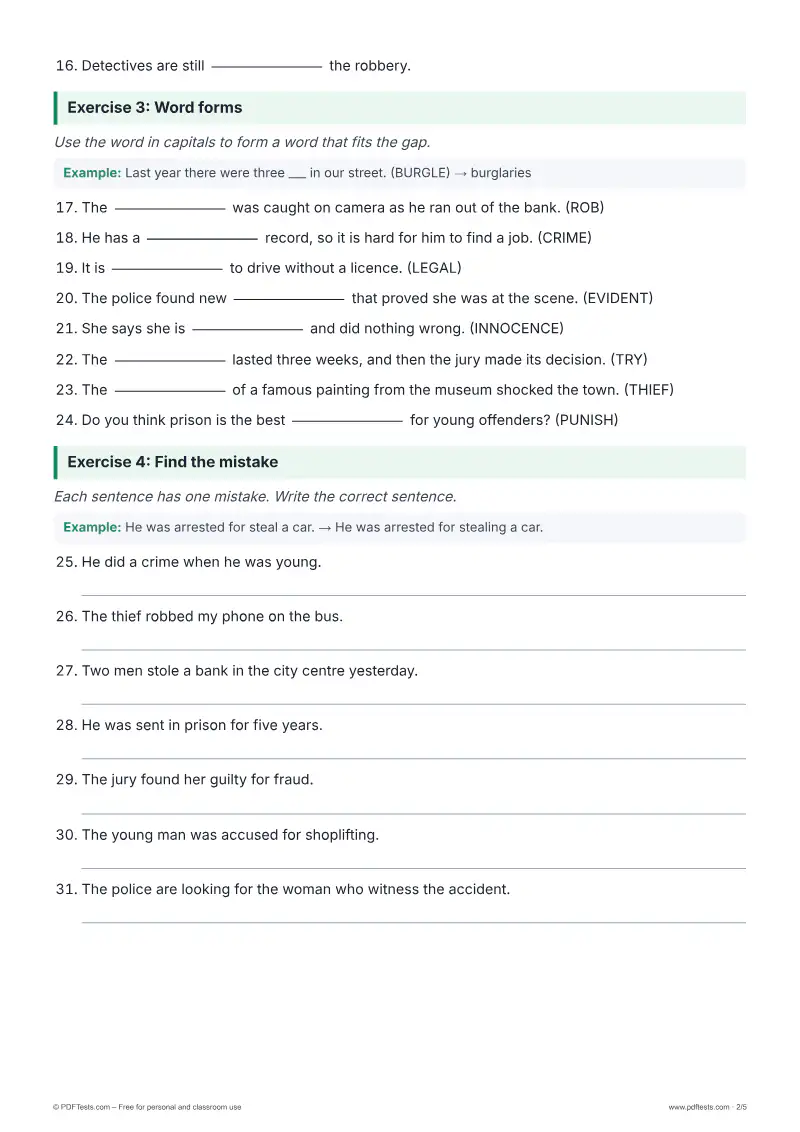
  8. Detectives are still the robbery.

Exercise 3: Word forms

Use the word in capitals to form a word that fits the gap.

Example: Last year there were three ___ in our street. (BURGLE) → burglaries

  1. The was caught on camera as he ran out of the bank. (ROB)

  2. He has a record, so it is hard for him to find a job. (CRIME)

  3. It is to drive without a licence. (LEGAL)

  4. The police found new that proved she was at the scene. (EVIDENT)

  5. She says she is and did nothing wrong. (INNOCENCE)

  6. The lasted three weeks, and then the jury made its decision. (TRY)

  7. The of a famous painting from the museum shocked the town. (THIEF)

  8. Do you think prison is the best for young offenders? (PUNISH)

Exercise 4: Find the mistake

Each sentence has one mistake. Write the correct sentence.

Example: He was arrested for steal a car. → He was arrested for stealing a car.

  1. He did a crime when he was young.

  2. The thief robbed my phone on the bus.

  3. Two men stole a bank in the city centre yesterday.

  4. He was sent in prison for five years.

  5. The jury found her guilty for fraud.

  6. The young man was accused for shoplifting.

  7. The police are looking for the woman who witness the accident.

Exercise 5: Crime reports

Rewrite each sentence in the passive. Start with the words in brackets.

Example: Someone robbed the shop. (The shop ...) → The shop was robbed.

  1. Someone stole my bike last week. (My bike ...)

  2. The police arrested the suspect at the airport. (The suspect ...)

  3. Someone broke into our house while we were on holiday. (Our house ...)

  4. The judge sentenced him to six months in prison. (He ...)

  5. The police are questioning two witnesses. (Two witnesses ...)

  6. They fined the driver for speeding. (The driver ...)

  7. Vandals damaged the bus shelter. (The bus shelter ...)

Was this page helpful?

Report a mistake

Spotted a wrong answer, a typo or an unclear explanation? Tell us and we will fix it.

Preview

About this test

B1 crime and law vocabulary worksheet: criminals, court words, collocations like commit a crime, and word forms. Printable with answers.

Topics covered

Crime vocabularyLaw and courtsCollocationsWord formationPassive in crime reports

Notes for teachers

Start with the matching exercise to check meaning, then move to collocations and word forms before the error correction and passive rewriting. Learners often confuse rob and steal (you rob a person or place, you steal a thing), and use the wrong prepositions in guilty of, accused of and sent to prison. As a follow-up, ask pairs to write a short news report about an invented crime using at least eight words from the worksheet.

All English B1 tests →