PDFTests Originals

Past Perfect (plus-que-parfait) – Test 1

B1 Intermédiaire GrammaireAnglais

Ce test de grammaire anglaise de niveau B1 vérifie si l'apprenant sait former et employer le past perfect (l'équivalent du plus-que-parfait), y compris à la forme négative, interrogative et dans les réponses courtes. Il évalue aussi quand utiliser le past perfect plutôt que le prétérit (past simple) et la capacité à repérer les erreurs typiques. Il convient aux apprenants de niveau intermédiaire, aux révisions en classe comme au travail en autonomie.
Questions
30
Durée
30 min
PDF
4 pages
Corrigé
Inclus
  • 100 % gratuit
  • Sans inscription
  • PDF A4 prêt à imprimer
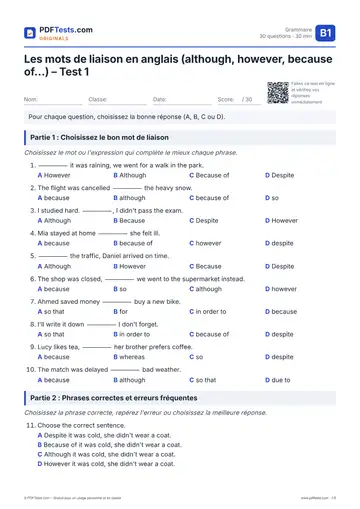
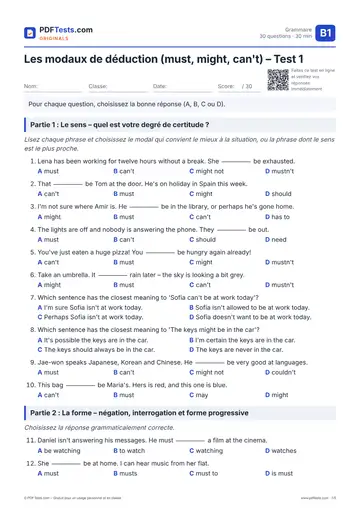
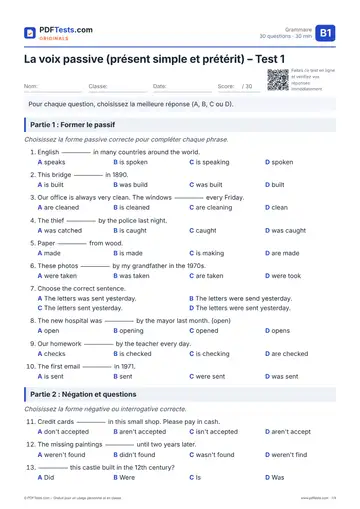
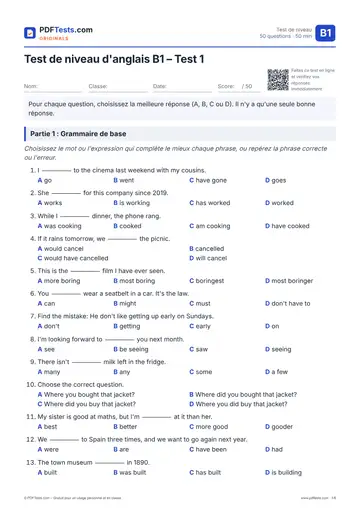
Aperçu de la page 1 : Past Perfect (plus-que-parfait) – Test 1 Ouvrir le PDF

Faire le test en ligne

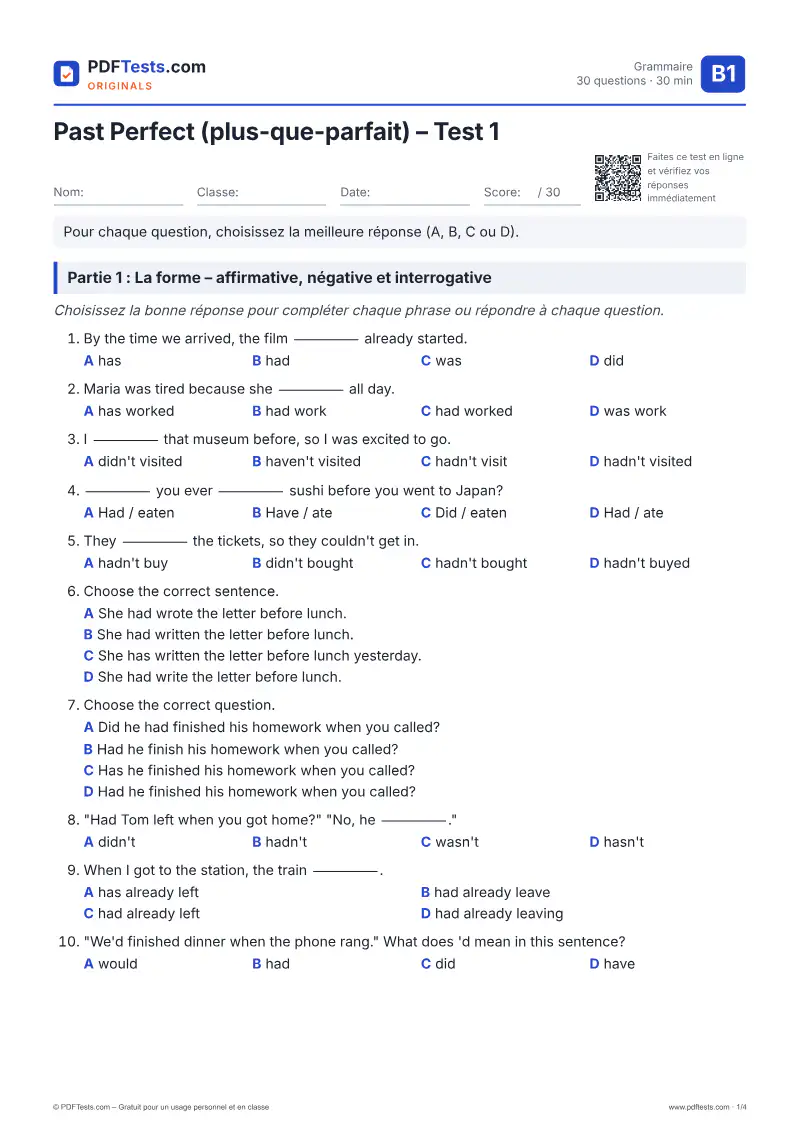
Pour chaque question, choisissez la meilleure réponse (A, B, C ou D). Choisissez vos réponses, puis cliquez sur « Vérifier mes réponses ».

Partie 1 : La forme – affirmative, négative et interrogative

Choisissez la bonne réponse pour compléter chaque phrase ou répondre à chaque question.

  1. By the time we arrived, the film _____ already started.

  2. Maria was tired because she _____ all day.

  3. I _____ that museum before, so I was excited to go.

  4. _____ you ever _____ sushi before you went to Japan?

  5. They _____ the tickets, so they couldn't get in.

  6. Choose the correct sentence.

  7. Choose the correct question.

  8. "Had Tom left when you got home?" "No, he _____."

  9. When I got to the station, the train _____.

  10. "We'd finished dinner when the phone rang." What does 'd mean in this sentence?

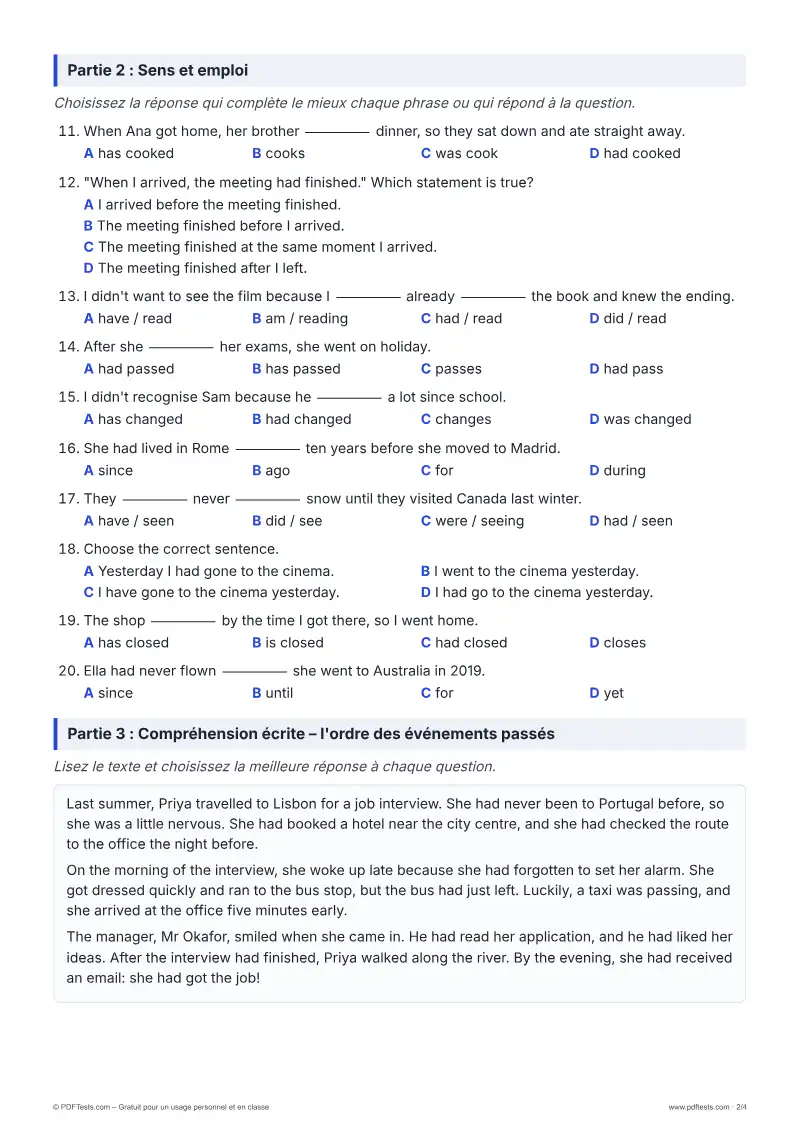
Partie 2 : Sens et emploi

Choisissez la réponse qui complète le mieux chaque phrase ou qui répond à la question.

  1. When Ana got home, her brother _____ dinner, so they sat down and ate straight away.

  2. "When I arrived, the meeting had finished." Which statement is true?

  3. I didn't want to see the film because I _____ already _____ the book and knew the ending.

  4. After she _____ her exams, she went on holiday.

  5. I didn't recognise Sam because he _____ a lot since school.

  6. She had lived in Rome _____ ten years before she moved to Madrid.

  7. They _____ never _____ snow until they visited Canada last winter.

  8. Choose the correct sentence.

  9. The shop _____ by the time I got there, so I went home.

  10. Ella had never flown _____ she went to Australia in 2019.

Partie 3 : Compréhension écrite – l'ordre des événements passés

Lisez le texte et choisissez la meilleure réponse à chaque question.

Last summer, Priya travelled to Lisbon for a job interview. She had never been to Portugal before, so she was a little nervous. She had booked a hotel near the city centre, and she had checked the route to the office the night before.

On the morning of the interview, she woke up late because she had forgotten to set her alarm. She got dressed quickly and ran to the bus stop, but the bus had just left. Luckily, a taxi was passing, and she arrived at the office five minutes early.

The manager, Mr Okafor, smiled when she came in. He had read her application, and he had liked her ideas. After the interview had finished, Priya walked along the river. By the evening, she had received an email: she had got the job!

  1. Why was Priya a little nervous?

  2. Which of these things happened first?

  3. Why did Priya wake up late?

  4. When Priya got to the bus stop, what was the situation?

  5. "He had read her application." When did Mr Okafor read it?

Partie 4 : Trouvez l'erreur

Chaque phrase contient une erreur. Choisissez la partie soulignée qui est fausse.

  1. When we got to the party, most of the guests had went home.

  2. Did the students had finished the test when the bell rang?

  3. She didn't had finished her report when the boss asked for it.

  4. He left for work after he has eaten breakfast.

  5. By 2020, my parents lived in this house for twenty years.

Aperçu

À propos de ce test

Ce test de grammaire anglaise de niveau B1 vérifie si l'apprenant sait former et employer le past perfect (l'équivalent du plus-que-parfait), y compris à la forme négative, interrogative et dans les réponses courtes. Il évalue aussi quand utiliser le past perfect plutôt que le prétérit (past simple) et la capacité à repérer les erreurs typiques. Il convient aux apprenants de niveau intermédiaire, aux révisions en classe comme au travail en autonomie.

Thèmes abordés

Formation du past perfectNégation et questionsPast perfect ou prétérit (past simple)Expressions de temps : already, by the time, before, untilChronologie des événements passésCorrection d'erreurs

Comment utiliser ce test

  1. Téléchargez le PDF et imprimez-le, ou faites le test en ligne ci-dessous.
  2. Répondez à toutes les questions sans dictionnaire et sans vous presser.
  3. Vérifiez vos réponses et notez les points à revoir.

Notes pour l’enseignant

Utilisez ce test après avoir enseigné le past perfect, ou comme test diagnostique avant une révision. Il cible les erreurs fréquentes au niveau B1 : employer la forme du prétérit après « had » (had went), utiliser « did » dans les questions au past perfect, abuser du past perfect pour une action passée unique, et le confondre avec le present perfect. En prolongement, demandez aux apprenants d'écrire une courte histoire sur une mauvaise journée en utilisant au moins cinq verbes au past perfect avec « by the time », « already » et « before ».