PDFTests Originals

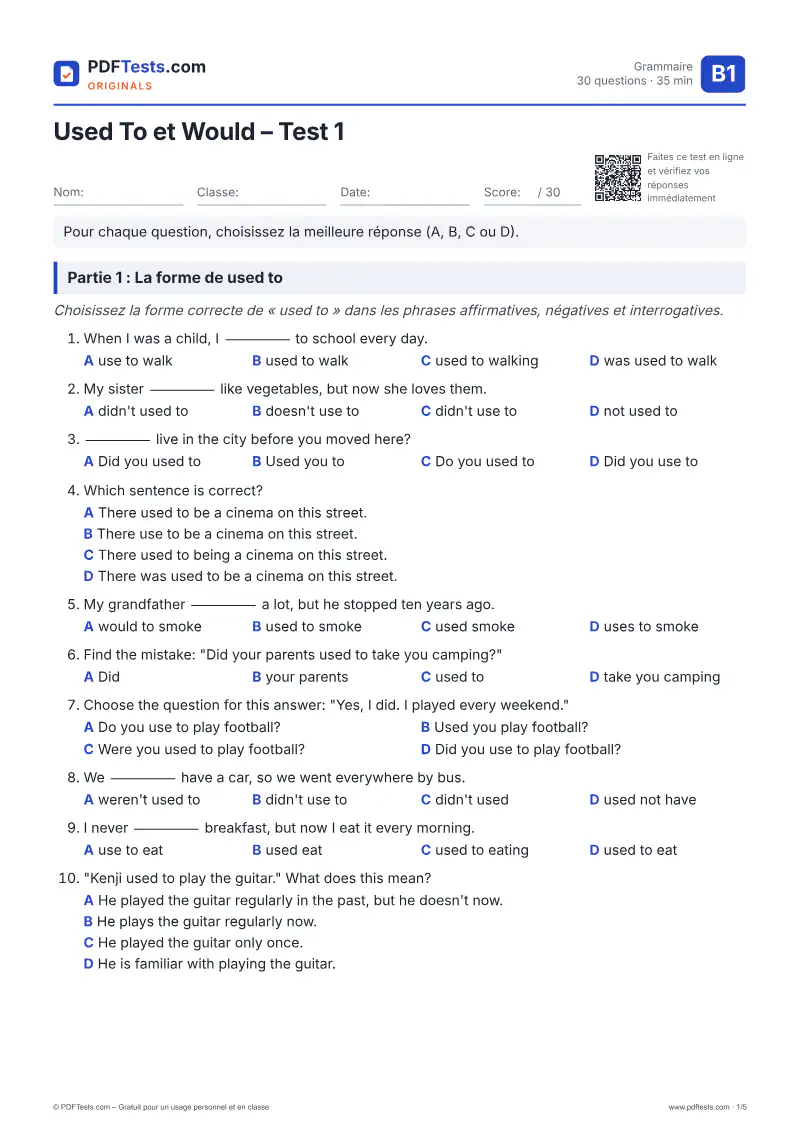
Used To et Would – Test 1

B1 Intermédiaire GrammaireAnglais

Ce test de grammaire anglaise de niveau B1 vérifie si les apprenants savent utiliser « used to » et « would » pour parler d'habitudes et d'états passés. Il aborde les formes affirmative, négative et interrogative, la différence entre « used to » et « would », les cas où il faut employer le prétérit (Past Simple) et la différence avec « be/get used to ». Il convient aux apprenants de niveau intermédiaire, aux révisions en classe comme au travail en autonomie.
Questions
30
Durée
35 min
PDF
5 pages
Corrigé
Inclus
  • 100 % gratuit
  • Sans inscription
  • PDF A4 prêt à imprimer
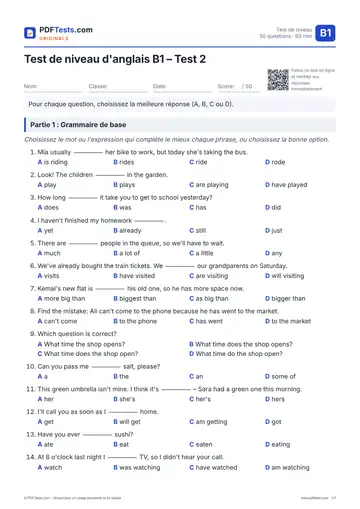
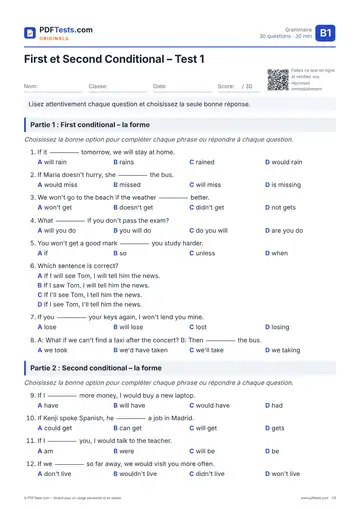
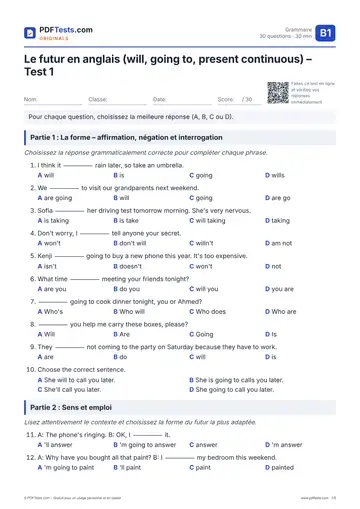
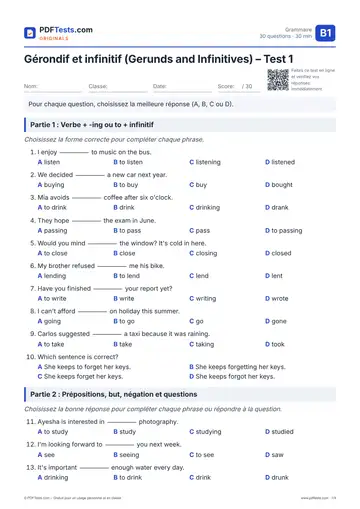
Aperçu de la page 1 : Used To et Would – Test 1 Ouvrir le PDF

Faire le test en ligne

Pour chaque question, choisissez la meilleure réponse (A, B, C ou D). Choisissez vos réponses, puis cliquez sur « Vérifier mes réponses ».

Partie 1 : La forme de used to

Choisissez la forme correcte de « used to » dans les phrases affirmatives, négatives et interrogatives.

  1. When I was a child, I _____ to school every day.

  2. My sister _____ like vegetables, but now she loves them.

  3. _____ live in the city before you moved here?

  4. Which sentence is correct?

  5. My grandfather _____ a lot, but he stopped ten years ago.

  6. Find the mistake: "Did your parents used to take you camping?"

  7. Choose the question for this answer: "Yes, I did. I played every weekend."

  8. We _____ have a car, so we went everywhere by bus.

  9. I never _____ breakfast, but now I eat it every morning.

  10. "Kenji used to play the guitar." What does this mean?

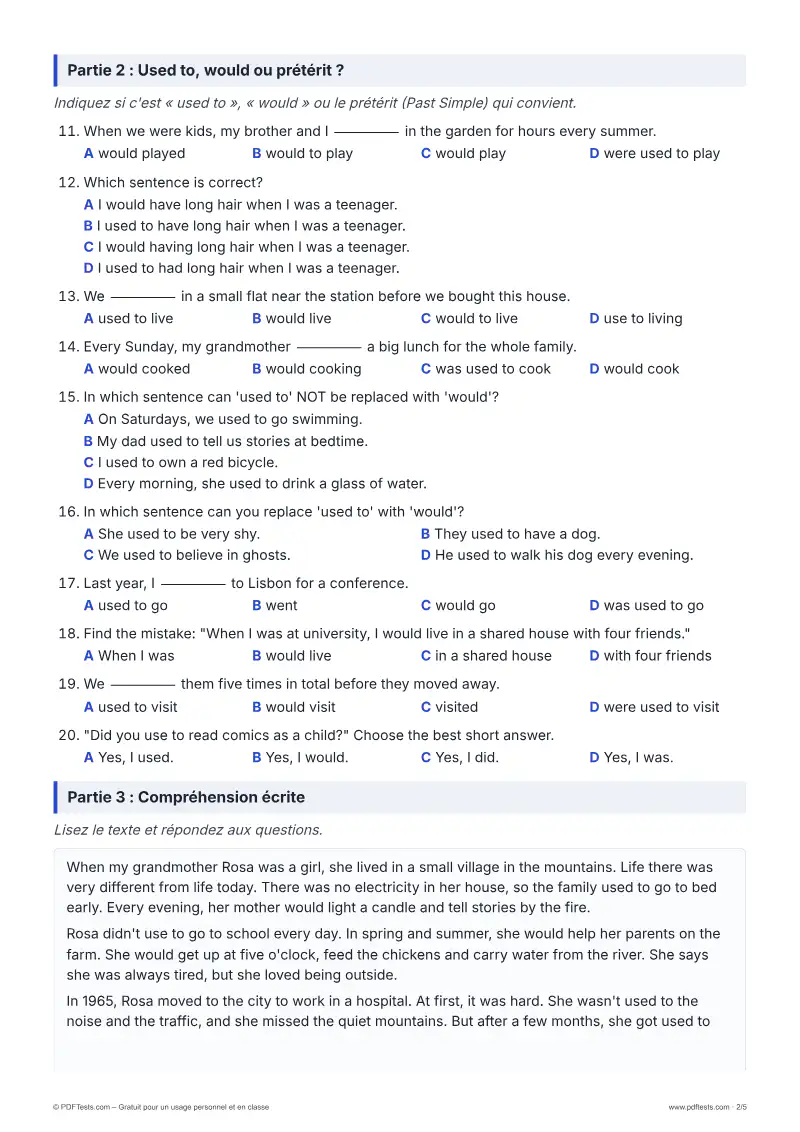
Partie 2 : Used to, would ou prétérit ?

Indiquez si c'est « used to », « would » ou le prétérit (Past Simple) qui convient.

  1. When we were kids, my brother and I _____ in the garden for hours every summer.

  2. Which sentence is correct?

  3. We _____ in a small flat near the station before we bought this house.

  4. Every Sunday, my grandmother _____ a big lunch for the whole family.

  5. In which sentence can 'used to' NOT be replaced with 'would'?

  6. In which sentence can you replace 'used to' with 'would'?

  7. Last year, I _____ to Lisbon for a conference.

  8. Find the mistake: "When I was at university, I would live in a shared house with four friends."

  9. We _____ them five times in total before they moved away.

  10. "Did you use to read comics as a child?" Choose the best short answer.

Partie 3 : Compréhension écrite

Lisez le texte et répondez aux questions.

When my grandmother Rosa was a girl, she lived in a small village in the mountains. Life there was very different from life today. There was no electricity in her house, so the family used to go to bed early. Every evening, her mother would light a candle and tell stories by the fire.

Rosa didn't use to go to school every day. In spring and summer, she would help her parents on the farm. She would get up at five o'clock, feed the chickens and carry water from the river. She says she was always tired, but she loved being outside.

In 1965, Rosa moved to the city to work in a hospital. At first, it was hard. She wasn't used to the noise and the traffic, and she missed the quiet mountains. But after a few months, she got used to her new life. Now she is eighty-two, and she is used to living in a busy city. She still visits the village every summer, but she says, "It isn't the place it used to be. Most of the young people have left."

  1. Why did Rosa's family use to go to bed early?

  2. "Her mother would light a candle and tell stories." What does 'would' show here?

  3. Which of these did Rosa NOT do regularly as a child?

  4. "She wasn't used to the noise and the traffic." What does this mean?

  5. Why does the writer say "In 1965, Rosa moved to the city" and not "Rosa used to move to the city"?

  6. "It isn't the place it used to be." What does Rosa mean?

Partie 4 : Used to, be used to et get used to

Choisissez la bonne réponse. Attention à « used to do », « be used to doing » et « get used to doing ».

  1. I've lived in London for years, so I'm used to _____ on the left side of the road.

  2. When Tom started his new job, it took him a few weeks to _____ early.

  3. Which sentence is correct?

  4. Find the mistake: "My little brother would be afraid of the dark, but now he sleeps without a light."

Aperçu

À propos de ce test

Ce test de grammaire anglaise de niveau B1 vérifie si les apprenants savent utiliser « used to » et « would » pour parler d'habitudes et d'états passés. Il aborde les formes affirmative, négative et interrogative, la différence entre « used to » et « would », les cas où il faut employer le prétérit (Past Simple) et la différence avec « be/get used to ». Il convient aux apprenants de niveau intermédiaire, aux révisions en classe comme au travail en autonomie.

Thèmes abordés

used to : forme affirmativedidn't use to : forme négativeQuestions avec Did you use to...?would pour les actions répétées dans le passéverbes d'état et verbes d'actionprétérit (Past Simple) pour les événements ponctuelsbe used to / get used to

Comment utiliser ce test

  1. Téléchargez le PDF et imprimez-le, ou faites le test en ligne ci-dessous.
  2. Répondez à toutes les questions sans dictionnaire et sans vous presser.
  3. Vérifiez vos réponses et notez les points à revoir.

Notes pour l’enseignant

Utilisez les parties 1 et 2 pour vérifier la forme et l'opposition used to/would avant de passer à la compréhension écrite de la partie 3 et aux questions sur « be/get used to » de la partie 4. Le test cible les erreurs fréquentes au niveau B1 : « didn't used to », « Did you used to », « would » avec des verbes d'état (have, live, be), « use to » pour des habitudes présentes et « used to » pour des événements ponctuels ou un nombre de fois précis. En prolongement, demandez aux apprenants d'écrire un court paragraphe sur leur enfance en utilisant au moins trois exemples de « used to » et trois de « would ».