PDFTests Originals

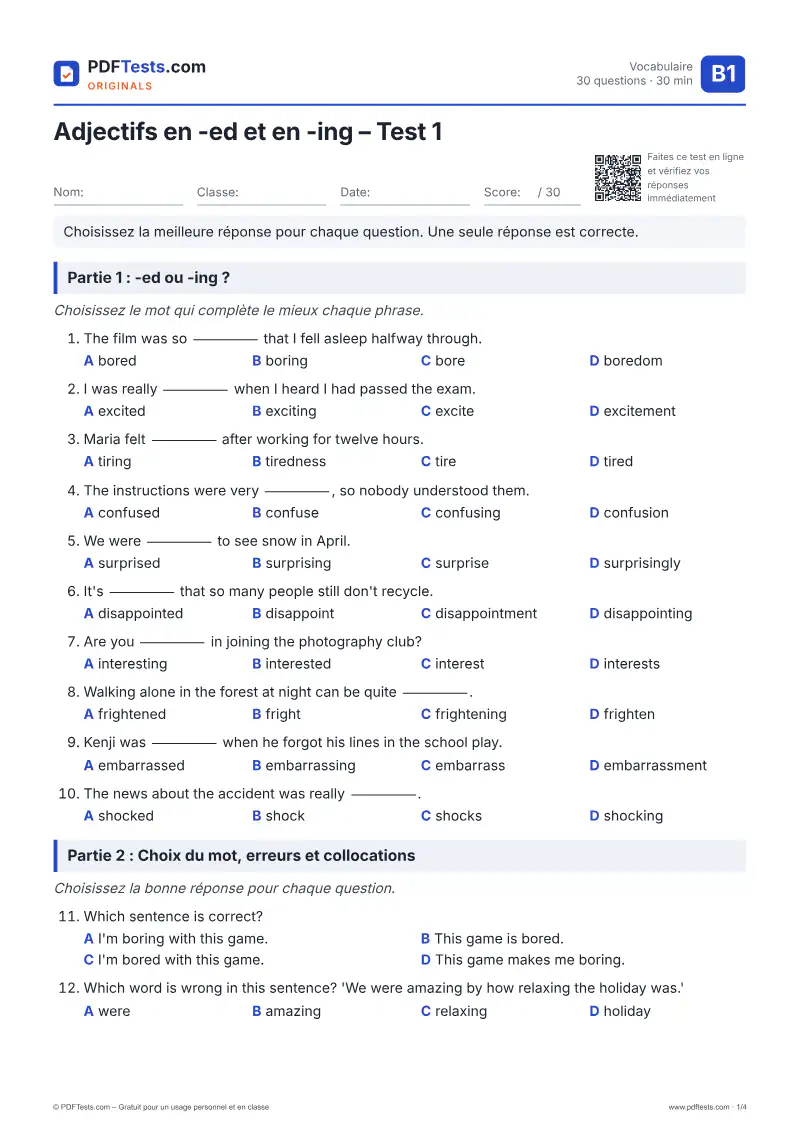
Adjectifs en -ed et en -ing – Test 1

B1 Intermédiaire VocabulaireAnglais

Ce test de vocabulaire B1 travaille la différence entre les adjectifs en -ed (ce que ressent une personne) et les adjectifs en -ing (ce qui provoque le sentiment), comme bored/boring et excited/exciting. Il comprend des phrases à compléter, des erreurs à repérer, des collocations, de la formation des mots et un court texte de lecture. Il convient aux apprenants de niveau intermédiaire, aux révisions en classe comme au travail en autonomie.
Questions
30
Durée
30 min
PDF
4 pages
Corrigé
Inclus
  • 100 % gratuit
  • Sans inscription
  • PDF A4 prêt à imprimer
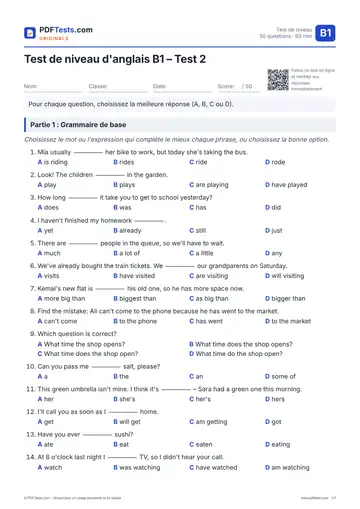
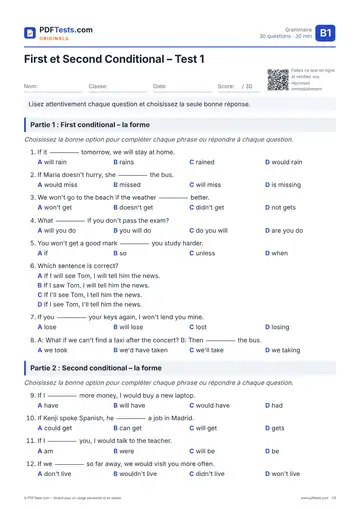
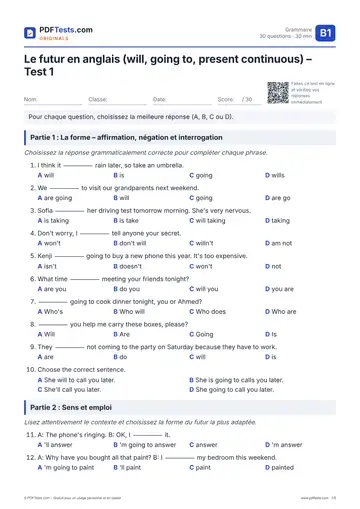
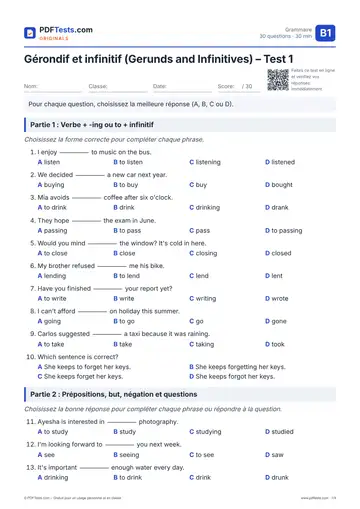
Aperçu de la page 1 : Adjectifs en -ed et en -ing – Test 1 Ouvrir le PDF

Faire le test en ligne

Choisissez la meilleure réponse pour chaque question. Une seule réponse est correcte. Choisissez vos réponses, puis cliquez sur « Vérifier mes réponses ».

Partie 1 : -ed ou -ing ?

Choisissez le mot qui complète le mieux chaque phrase.

  1. The film was so _____ that I fell asleep halfway through.

  2. I was really _____ when I heard I had passed the exam.

  3. Maria felt _____ after working for twelve hours.

  4. The instructions were very _____, so nobody understood them.

  5. We were _____ to see snow in April.

  6. It's _____ that so many people still don't recycle.

  7. Are you _____ in joining the photography club?

  8. Walking alone in the forest at night can be quite _____.

  9. Kenji was _____ when he forgot his lines in the school play.

  10. The news about the accident was really _____.

Partie 2 : Choix du mot, erreurs et collocations

Choisissez la bonne réponse pour chaque question.

  1. Which sentence is correct?

  2. Which word is wrong in this sentence? 'We were amazing by how relaxing the holiday was.'

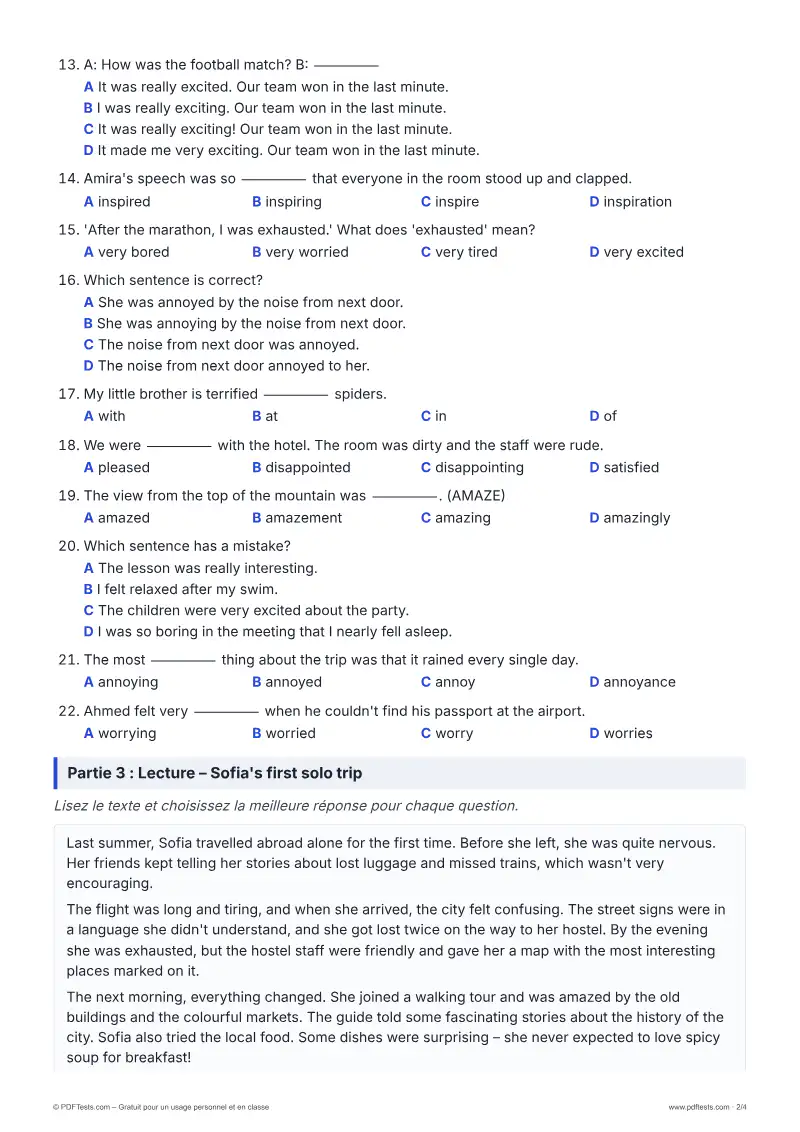
  3. A: How was the football match? B: _____

  4. Amira's speech was so _____ that everyone in the room stood up and clapped.

  5. 'After the marathon, I was exhausted.' What does 'exhausted' mean?

  6. Which sentence is correct?

  7. My little brother is terrified _____ spiders.

  8. We were _____ with the hotel. The room was dirty and the staff were rude.

  9. The view from the top of the mountain was _____. (AMAZE)

  10. Which sentence has a mistake?

  11. The most _____ thing about the trip was that it rained every single day.

  12. Ahmed felt very _____ when he couldn't find his passport at the airport.

Partie 3 : Lecture – Sofia's first solo trip

Lisez le texte et choisissez la meilleure réponse pour chaque question.

Last summer, Sofia travelled abroad alone for the first time. Before she left, she was quite nervous. Her friends kept telling her stories about lost luggage and missed trains, which wasn't very encouraging.

The flight was long and tiring, and when she arrived, the city felt confusing. The street signs were in a language she didn't understand, and she got lost twice on the way to her hostel. By the evening she was exhausted, but the hostel staff were friendly and gave her a map with the most interesting places marked on it.

The next morning, everything changed. She joined a walking tour and was amazed by the old buildings and the colourful markets. The guide told some fascinating stories about the history of the city. Sofia also tried the local food. Some dishes were surprising – she never expected to love spicy soup for breakfast!

The only disappointing part of the trip was the weather on the last day. It rained so much that her boat trip was cancelled. Still, Sofia came home feeling relaxed and proud of herself. 'Travelling alone was a little frightening at first,' she says, 'but it was the most satisfying experience of my life.'

  1. How did her friends' stories make Sofia feel before the trip?

  2. In paragraph 2, 'the city felt confusing' means that _____.

  3. Which word in paragraph 2 means 'extremely tired'?

  4. How did Sofia feel on the walking tour?

  5. The guide's stories were _____.

  6. Why were some dishes 'surprising'?

  7. What was disappointing about the trip?

  8. When Sofia came home, she felt _____.

Aperçu

À propos de ce test

Ce test de vocabulaire B1 travaille la différence entre les adjectifs en -ed (ce que ressent une personne) et les adjectifs en -ing (ce qui provoque le sentiment), comme bored/boring et excited/exciting. Il comprend des phrases à compléter, des erreurs à repérer, des collocations, de la formation des mots et un court texte de lecture. Il convient aux apprenants de niveau intermédiaire, aux révisions en classe comme au travail en autonomie.

Thèmes abordés

Adjectifs en -ed ou en -ingSentiments et émotionsFormation des motsCollocations adjectif + prépositionSens en contexteVocabulaire en compréhension écrite

Comment utiliser ce test

  1. Téléchargez le PDF et imprimez-le, ou faites le test en ligne ci-dessous.
  2. Répondez à toutes les questions sans dictionnaire et sans vous presser.
  3. Vérifiez vos réponses et notez les points à revoir.

Notes pour l’enseignant

Ce test cible une erreur très fréquente chez les apprenants : employer un adjectif en -ing pour exprimer un sentiment (par exemple 'I am boring' au lieu de 'I am bored'). La partie 1 vérifie la forme et le sens de base, la partie 2 ajoute le repérage d'erreurs, les collocations et la formation des mots, et la partie 3 contrôle l'emploi des adjectifs dans un texte plus long. En prolongement, demandez aux élèves d'écrire cinq phrases sur un voyage ou un événement récent, en utilisant dans chaque phrase un adjectif en -ed et un adjectif en -ing de la même famille de mots.