PDFTests Originals

L'environnement – Test 1

B1 Intermédiaire VocabulaireAnglais

Ce test de vocabulaire de niveau B1 porte sur les mots et expressions courants liés à l'environnement, comme la pollution, le recyclage, le changement climatique et la faune sauvage. Il évalue le sens des mots, les collocations fréquentes, le choix du mot juste en contexte et les familles de mots, et comprend un court texte de compréhension écrite. Il convient aux apprenants de niveau intermédiaire ainsi qu'aux enseignants à la recherche d'un test thématique prêt à imprimer.
Questions
30
Durée
35 min
PDF
5 pages
Corrigé
Inclus
  • 100 % gratuit
  • Sans inscription
  • PDF A4 prêt à imprimer
Aperçu de la page 1 : L'environnement – Test 1 Ouvrir le PDF

Faire le test en ligne

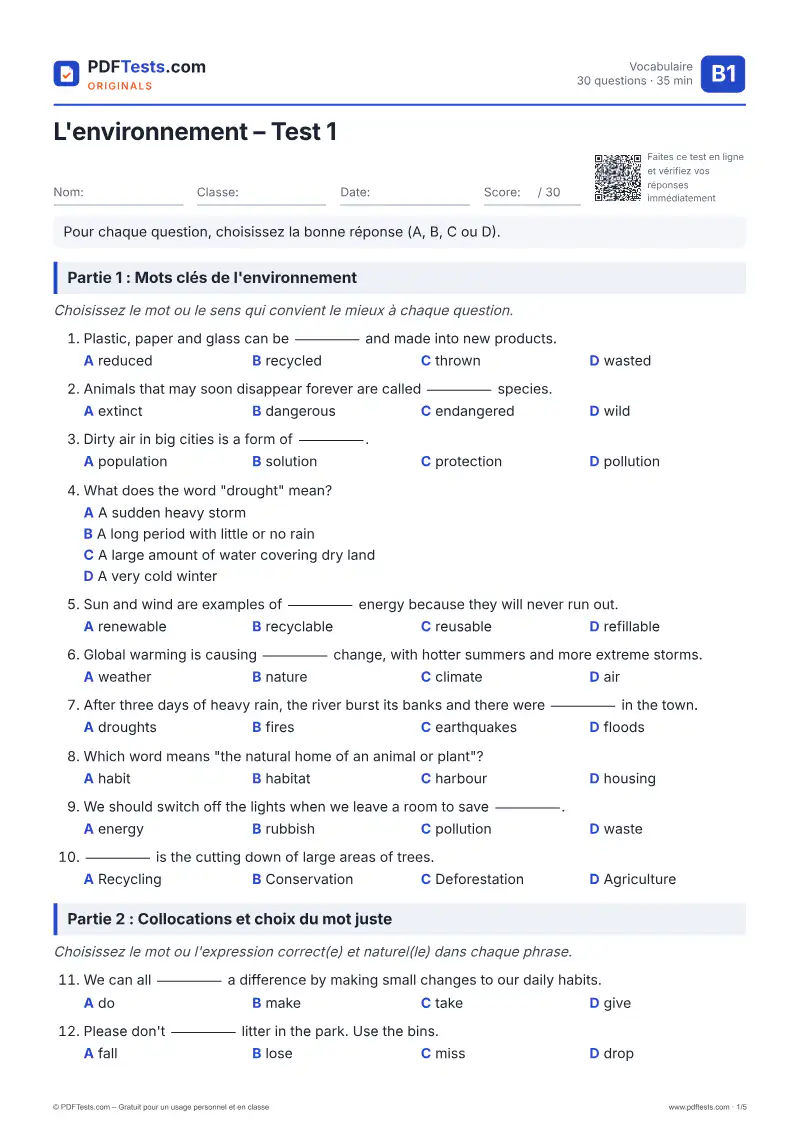
Pour chaque question, choisissez la bonne réponse (A, B, C ou D). Choisissez vos réponses, puis cliquez sur « Vérifier mes réponses ».

Partie 1 : Mots clés de l'environnement

Choisissez le mot ou le sens qui convient le mieux à chaque question.

  1. Plastic, paper and glass can be _____ and made into new products.

  2. Animals that may soon disappear forever are called _____ species.

  3. Dirty air in big cities is a form of _____.

  4. What does the word "drought" mean?

  5. Sun and wind are examples of _____ energy because they will never run out.

  6. Global warming is causing _____ change, with hotter summers and more extreme storms.

  7. After three days of heavy rain, the river burst its banks and there were _____ in the town.

  8. Which word means "the natural home of an animal or plant"?

  9. We should switch off the lights when we leave a room to save _____.

  10. _____ is the cutting down of large areas of trees.

Partie 2 : Collocations et choix du mot juste

Choisissez le mot ou l'expression correct(e) et naturel(le) dans chaque phrase.

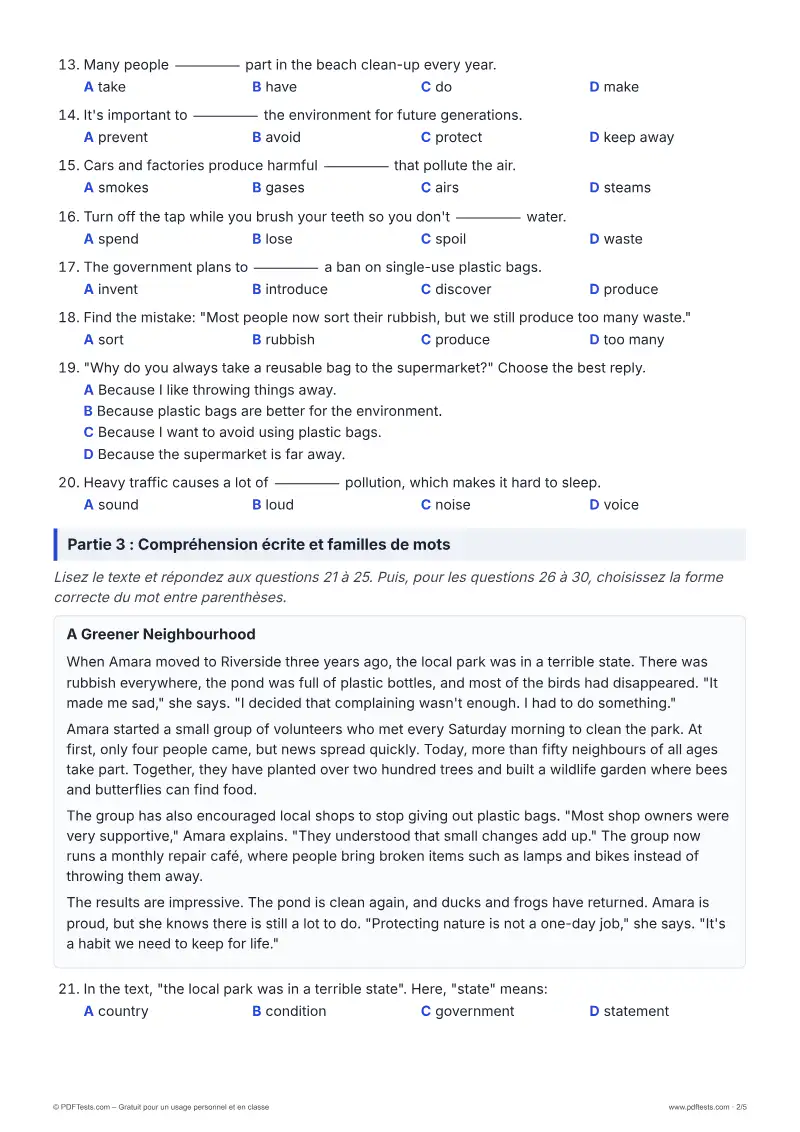
  1. We can all _____ a difference by making small changes to our daily habits.

  2. Please don't _____ litter in the park. Use the bins.

  3. Many people _____ part in the beach clean-up every year.

  4. It's important to _____ the environment for future generations.

  5. Cars and factories produce harmful _____ that pollute the air.

  6. Turn off the tap while you brush your teeth so you don't _____ water.

  7. The government plans to _____ a ban on single-use plastic bags.

  8. Find the mistake: "Most people now sort their rubbish, but we still produce too many waste."

  9. "Why do you always take a reusable bag to the supermarket?" Choose the best reply.

  10. Heavy traffic causes a lot of _____ pollution, which makes it hard to sleep.

Partie 3 : Compréhension écrite et familles de mots

Lisez le texte et répondez aux questions 21 à 25. Puis, pour les questions 26 à 30, choisissez la forme correcte du mot entre parenthèses.

A Greener Neighbourhood

When Amara moved to Riverside three years ago, the local park was in a terrible state. There was rubbish everywhere, the pond was full of plastic bottles, and most of the birds had disappeared. "It made me sad," she says. "I decided that complaining wasn't enough. I had to do something."

Amara started a small group of volunteers who met every Saturday morning to clean the park. At first, only four people came, but news spread quickly. Today, more than fifty neighbours of all ages take part. Together, they have planted over two hundred trees and built a wildlife garden where bees and butterflies can find food.

The group has also encouraged local shops to stop giving out plastic bags. "Most shop owners were very supportive," Amara explains. "They understood that small changes add up." The group now runs a monthly repair café, where people bring broken items such as lamps and bikes instead of throwing them away.

The results are impressive. The pond is clean again, and ducks and frogs have returned. Amara is proud, but she knows there is still a lot to do. "Protecting nature is not a one-day job," she says. "It's a habit we need to keep for life."

  1. In the text, "the local park was in a terrible state". Here, "state" means:

  2. "At first, only four people came, but news spread quickly." This means:

  3. What is a "wildlife garden"?

  4. "Small changes add up" means:

  5. What is the "repair café" in the text?

  6. Many young people feel _____ about the future of the planet. (WORRY)

  7. There has been a big _____ in air quality since the factory closed. (IMPROVE)

  8. Some plastics are _____ to the environment because they take hundreds of years to break down. (HARM)

  9. Solar panels are a good _____ for families who want cheaper and cleaner energy. (CHOOSE)

  10. We need to find more _____ friendly ways to travel, like cycling and walking. (ENVIRONMENT)

Aperçu

À propos de ce test

Ce test de vocabulaire de niveau B1 porte sur les mots et expressions courants liés à l'environnement, comme la pollution, le recyclage, le changement climatique et la faune sauvage. Il évalue le sens des mots, les collocations fréquentes, le choix du mot juste en contexte et les familles de mots, et comprend un court texte de compréhension écrite. Il convient aux apprenants de niveau intermédiaire ainsi qu'aux enseignants à la recherche d'un test thématique prêt à imprimer.

Thèmes abordés

Vocabulaire de l'environnementPollution et recyclageClimat et phénomènes météorologiquesCollocationsFamilles de motsSens en contexte

Comment utiliser ce test

  1. Téléchargez le PDF et imprimez-le, ou faites le test en ligne ci-dessous.
  2. Répondez à toutes les questions sans dictionnaire et sans vous presser.
  3. Vérifiez vos réponses et notez les points à revoir.

Notes pour l’enseignant

Utilisez ce test à la fin d'une séquence sur l'environnement ou comme révision avant un examen de niveau B1. Il cible des erreurs fréquentes chez les apprenants : confusion entre pollution/population, weather/climate et endangered/extinct, mauvaises collocations verbales (do/make a difference, have/take part), noms dénombrables et indénombrables (too many waste) et formes erronées comme 'environmental friendly'. En prolongement, demandez aux élèves de rédiger un court paragraphe sur un projet écologique près de chez eux en utilisant au moins dix mots du test.