PDFTests Originals

Plus-que-parfait – Worksheet 1

B1 Intermediate WorksheetFrench

This worksheet practises the French plus-que-parfait (pluperfect): how to form it with avoir or être, past participle agreement, and how to use it for an action that happened before another past action. It is for B1 learners and also covers negatives, ne … jamais / ne … rien and question forms.
items
37
Time
35 min
PDF
5 pages
Answer key
Included
  • 100% free
  • No sign-up or email
  • Print-ready A4 PDF
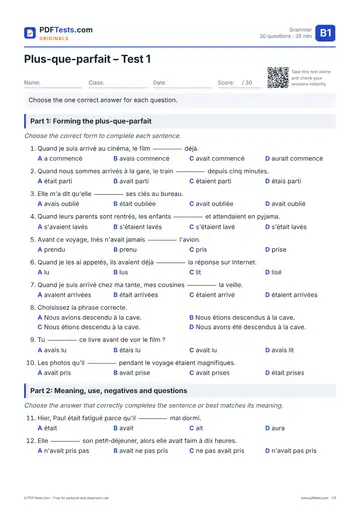
Preview of page 1 of Plus-que-parfait – Worksheet 1 Open PDF
New to this topic? Read the guide first: Plus-que-parfait in French: Form, Uses and Common Mistakes

Do the worksheet online

Type your answers, then press “Check my answers”. Alternative correct answers are accepted.

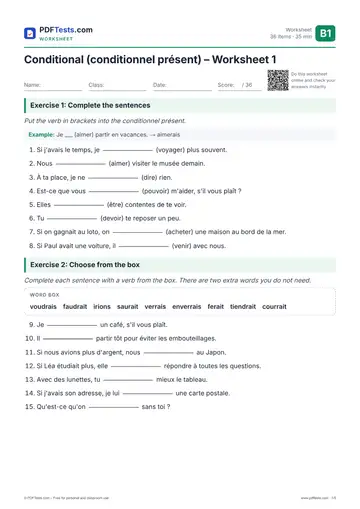
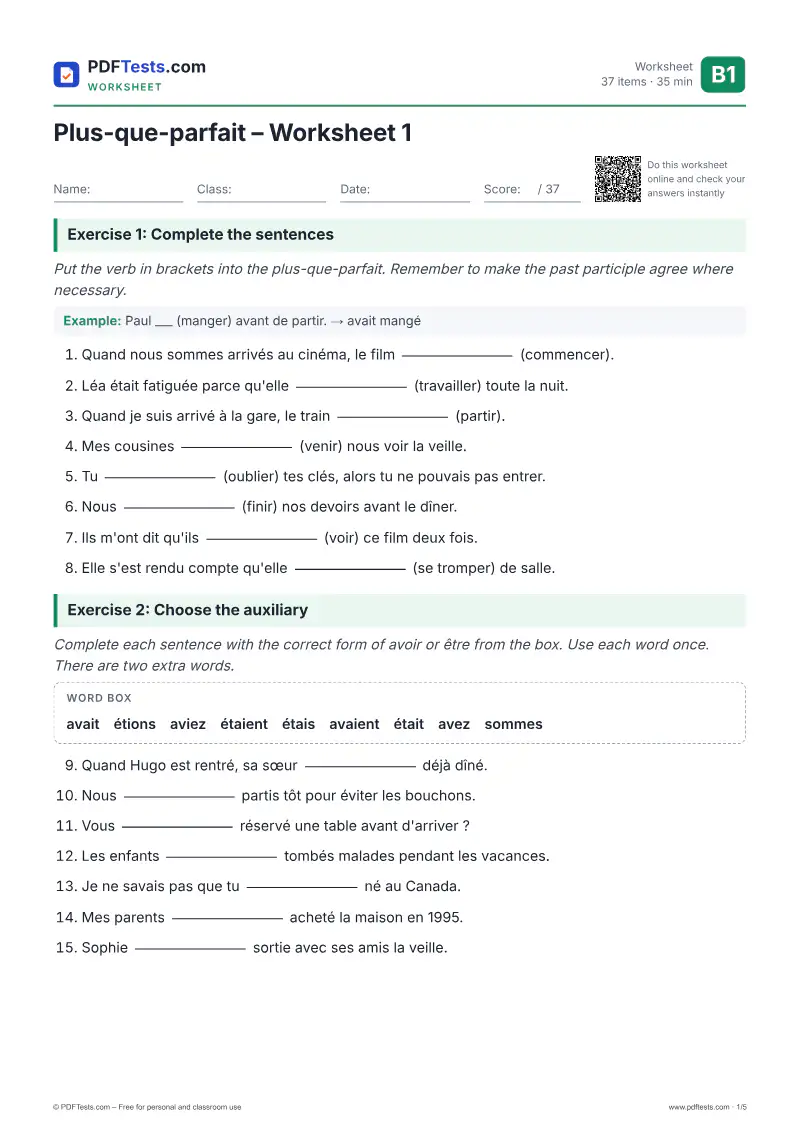
Exercise 1: Complete the sentences

Put the verb in brackets into the plus-que-parfait. Remember to make the past participle agree where necessary.

Example: Paul ___ (manger) avant de partir. → avait mangé

  1. Quand nous sommes arrivés au cinéma, le film (commencer).

  2. Léa était fatiguée parce qu'elle (travailler) toute la nuit.

  3. Quand je suis arrivé à la gare, le train (partir).

  4. Mes cousines (venir) nous voir la veille.

  5. Tu (oublier) tes clés, alors tu ne pouvais pas entrer.

  6. Nous (finir) nos devoirs avant le dîner.

  7. Ils m'ont dit qu'ils (voir) ce film deux fois.

  8. Elle s'est rendu compte qu'elle (se tromper) de salle.

Exercise 2: Choose the auxiliary

Complete each sentence with the correct form of avoir or être from the box. Use each word once. There are two extra words.

Word box avaitétionsaviezétaientétaisavaientétaitavezsommes

  1. Quand Hugo est rentré, sa sœur déjà dîné.

  2. Nous partis tôt pour éviter les bouchons.

  3. Vous réservé une table avant d'arriver ?

  4. Les enfants tombés malades pendant les vacances.

  5. Je ne savais pas que tu né au Canada.

  6. Mes parents acheté la maison en 1995.

  7. Sophie sortie avec ses amis la veille.

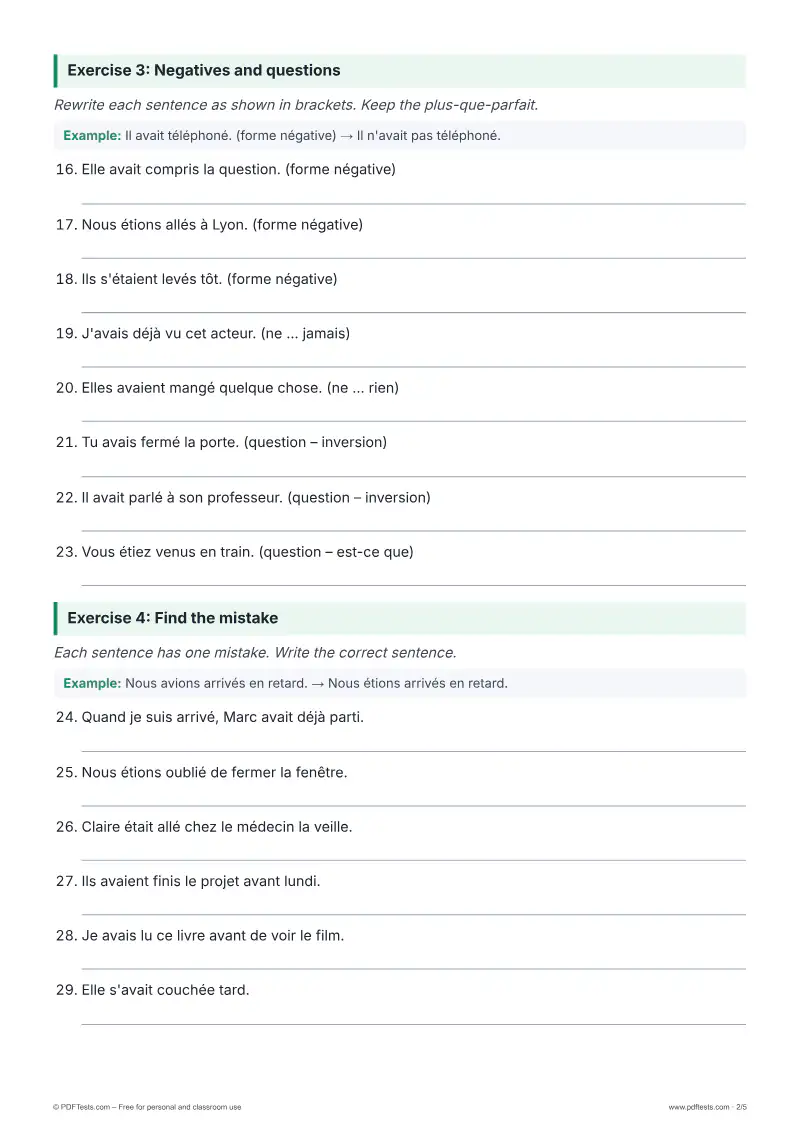
Exercise 3: Negatives and questions

Rewrite each sentence as shown in brackets. Keep the plus-que-parfait.

Example: Il avait téléphoné. (forme négative) → Il n'avait pas téléphoné.

  1. Elle avait compris la question. (forme négative)

  2. Nous étions allés à Lyon. (forme négative)

  3. Ils s'étaient levés tôt. (forme négative)

  4. J'avais déjà vu cet acteur. (ne … jamais)

  5. Elles avaient mangé quelque chose. (ne … rien)

  6. Tu avais fermé la porte. (question – inversion)

  7. Il avait parlé à son professeur. (question – inversion)

  8. Vous étiez venus en train. (question – est-ce que)

Exercise 4: Find the mistake

Each sentence has one mistake. Write the correct sentence.

Example: Nous avions arrivés en retard. → Nous étions arrivés en retard.

  1. Quand je suis arrivé, Marc avait déjà parti.

  2. Nous étions oublié de fermer la fenêtre.

  3. Claire était allé chez le médecin la veille.

  4. Ils avaient finis le projet avant lundi.

  5. Je avais lu ce livre avant de voir le film.

  6. Elle s'avait couchée tard.

  7. Tu ne m'avais dit pas la vérité.

  8. Quand nous sommes arrivés, ils ont déjà mangé.

Exercise 5: Put the words in order

Put the words in the correct order to make a sentence.

Example: avait / Marie / dormi / mal → Marie avait mal dormi.

  1. avait / la / Paul / perdu / clé

  2. n' / pas / nous / avions / compris

  3. déjà / était / partie / elle

  4. aviez-vous / déjà / visité / Rome / ?

  5. jamais / ils / pris / n' / l'avion / avaient

  6. parce qu' / elle / pleurait / perdu / avait / son chat / elle

Was this page helpful?

Report a mistake

Spotted a wrong answer, a typo or an unclear explanation? Tell us and we will fix it.

Preview

About this test

Printable B1 French worksheet on the plus-que-parfait: form, agreement, use, negatives and questions. Includes answers and explanations.

Topics covered

Plus-que-parfaitAvoir or êtrePast participle agreementNegativesQuestions and inversionSequence of past events

Notes for teachers

Start with a timeline on the board showing two past actions, and highlight that the plus-que-parfait marks the earlier one. Learners often use the passé composé instead, choose avoir with verbs of movement, or forget agreement with être and reflexive verbs. They also put pas after the participle. As a follow-up, ask pairs to write a short story beginning 'Quand je suis arrivé(e), ...' using at least five verbs in the plus-que-parfait.

All French B1 tests →