French relative pronouns (qui, que, dont and où) join two ideas into one sentence. They introduce a clause that describes a noun, like who, which, that, whose and where in English.
The noun being described does not decide which pronoun you use. What matters is the pronoun’s job inside its own clause:
- qui for the subject
- que for the direct object
- dont for a complement introduced by de
- où for a place or a time
Overview
| Pronoun | Job in the relative clause | Example |
|---|---|---|
| qui | subject | La fille qui chante est ma sœur. The girl who is singing is my sister. |
| que / qu’ | direct object | Le film que j’ai vu était long. The film (that) I saw was long. |
| dont | replaces de + noun | Le livre dont je parle est célèbre. The book I’m talking about is famous. |
| où | place or time | La ville où j’habite est petite. The town where I live is small. |
Unlike English who and which, qui and que work for both people and things:
- L’homme qui parle. The man who is speaking.
- Le bus qui arrive. The bus that is arriving.
Qui: the subject of the clause
Use qui when the pronoun is the subject of the verb that follows. Think of it as replacing a repeated subject:
- J’ai une amie. Cette amie parle japonais. → J’ai une amie qui parle japonais. I have a friend who speaks Japanese.
- C’est une application qui traduit les menus. It’s an app that translates menus.
- Les gens qui travaillent ici sont sympas. The people who work here are nice.
Qui never shortens before a vowel:
- L’homme qui est assis là-bas. The man who is sitting over there.
The verb after qui agrees with the noun or pronoun that qui refers to:
- C’est moi qui ai raison. I’m the one who’s right.
- C’est nous qui avons payé. We’re the ones who paid.
An object pronoun or ne can come between qui and the verb. Qui is still the subject:
- Le prof qui nous enseigne l’anglais. The teacher who teaches us English.
- Un ami qui ne ment jamais. A friend who never lies.
Qui after a preposition
After a preposition such as avec, pour or à, use qui for people:
- La collègue avec qui je déjeune. The colleague I have lunch with.
- L’ami à qui j’ai prêté ma voiture. The friend I lent my car to.
For things after a preposition, French uses lequel / laquelle / lesquels / lesquelles:
- Le stylo avec lequel j’écris. The pen I write with.
You will study these forms in more detail at B2.
Que: the direct object of the clause
Use que when the pronoun is the direct object. A subject and a verb come after it:
- J’adore ce pull. Tu portes ce pull. → J’adore le pull que tu portes. I love the jumper you’re wearing.
- La chanson que j’écoute en boucle. The song I’m listening to on repeat.
Before a vowel or silent h, que becomes qu’:
- Le gâteau qu’elle a fait. The cake she made.
- Les gens qu’on rencontre en voyage. The people you meet when travelling.
Past participle agreement after que
In the passé composé with avoir, the past participle agrees with a direct object placed before the verb. After que, that object is the noun que refers to:
- Les photos que j’ai prises. The photos I took.
- La robe que j’ai achetée. The dress I bought.
This is easy to forget in writing. Our guide to past participle agreement covers the full rule.
Optional inversion
In written French, a noun subject sometimes comes after the verb following que:
- La maison qu’ont achetée mes parents. The house my parents bought.
You don’t need to produce this yourself, but you should recognise it.
Qui or que? A quick test
Look at what comes directly after the gap:
| What follows | Pronoun | Example |
|---|---|---|
| a verb (or ne / object pronoun + verb) | qui | L’homme qui me regarde. The man who is looking at me. |
| a subject + verb | que | L’homme que je regarde. The man I’m looking at. |
In the first sentence, the man does the looking, so he is the subject. In the second, je is the subject and the man is the object.
Dont: replacing de + noun
Use dont when the verb or expression in the relative clause is followed by de. Common examples:
- parler de (to talk about)
- avoir besoin de (to need)
- se souvenir de (to remember)
- avoir peur de (to be afraid of)
- être fier de (to be proud of)
- rêver de (to dream of)
- s’occuper de (to take care of)
Here is how it works:
- Je t’ai parlé de ce restaurant. → Le restaurant dont je t’ai parlé. The restaurant I told you about.
- C’est l’outil dont j’ai besoin. It’s the tool I need.
- Les vacances dont je me souviens le mieux. The holidays I remember best.
- Un projet dont elle est très fière. A project she is very proud of.
Dont for possession: whose
Dont also translates whose, replacing de + owner:
- La femme dont le fils est pilote. The woman whose son is a pilot.
- Une entreprise dont les bureaux sont à Lyon. A company whose offices are in Lyon.
Keep the normal word order after dont: subject + verb + rest. Use a definite article, not a possessive:
- L’auteur dont j’ai lu tous les livres. The author whose books I’ve all read.
When dont doesn’t work
Dont replaces only a complement with de. If the verb uses à, you need a different structure:
- La personne à qui je pense. The person I’m thinking about. (penser à)
After compound prepositions such as près de or à côté de, French uses duquel, de laquelle and so on:
- Le parc près duquel j’habite. The park I live near.
This is again a B2 point.
Où: place and time
Où refers to a place:
- Le café où on se retrouve. The café where we meet.
- La ville où je suis né. The town where I was born.
- La région d’où il vient. The region he comes from.
It also refers to a time, after nouns like le jour, le moment, l’année, le soir and l’époque:
- Le jour où je l’ai rencontrée. The day (when) I met her.
- À l’époque où on n’avait pas Internet. Back when we didn’t have the internet.
English often uses when or that here. French uses où, never quand.
Ce qui, ce que, ce dont: what
When there is no noun to describe, add ce before the pronoun. It means what or the thing that:
- Ce qui m’intéresse, c’est l’histoire. What interests me is history. (subject)
- Dis-moi ce que tu veux. Tell me what you want. (object)
- Ce dont j’ai besoin, c’est de vacances. What I need is a holiday. (avoir besoin de)
- Tu peux prendre tout ce que tu veux. You can take everything you want.
The same qui/que/dont logic applies. Only the ce is new.
French vs English: never drop the pronoun
English often leaves out that and puts the preposition at the end. French does neither:
- The book I bought → Le livre que j’ai acheté.
- The girl I’m talking about → La fille dont je parle.
- The friend I went with → L’ami avec qui je suis parti.
If you notice a missing that in your English thought, a relative pronoun is needed in French.
Common mistakes
- ✗ Le livre qui j’ai lu → ✓ Le livre que j’ai lu. The book I read. — Je is the subject, so the pronoun is the object: que.
- ✗ La personne que parle → ✓ La personne qui parle. The person who is speaking. — A verb follows directly, so you need the subject pronoun.
- ✗ Le chien qu’est là → ✓ Le chien qui est là. The dog that’s there. — Qui never elides.
- ✗ Le film que je t’ai parlé → ✓ Le film dont je t’ai parlé. The film I told you about. — Parler de takes dont.
- ✗ La fille dont je connais son père → ✓ La fille dont je connais le père. The girl whose father I know. — Dont already shows possession.
- ✗ Le jour quand il est arrivé → ✓ Le jour où il est arrivé. The day he arrived. — Use où after time nouns.
- ✗ C’est moi qui a fini → ✓ C’est moi qui ai fini. I’m the one who finished. — The verb agrees with moi.
- ✗ Je ne sais pas qu’il veut → ✓ Je ne sais pas ce qu’il veut. I don’t know what he wants. — Without a noun, you need ce que.
Quick check
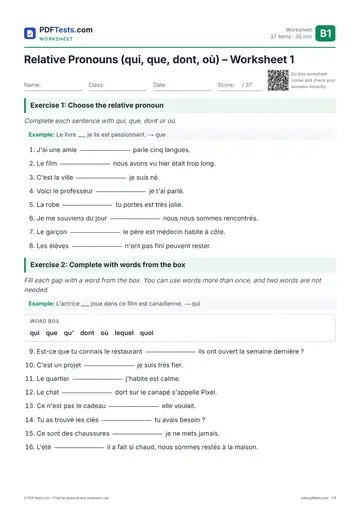
Fill in each gap with qui, que/qu’, dont, où or ce que.
- Le train ___ part à 8 h est complet.
- C’est le cadeau ___ ma sœur m’a offert.
- Voici l’appartement ___ je rêve depuis des années.
- Je me souviens du jour ___ nous nous sommes rencontrés.
- Je ne comprends pas ___ tu dis.
Answers
- qui: the train is the subject of part. The train that leaves at 8 is full.
- que: ma sœur is the subject, and the gift is the object. It’s the present my sister gave me.
- dont: rêver de. Here’s the flat I’ve been dreaming of for years.
- où: a time after le jour. I remember the day we met.
- ce que: there is no noun, and the pronoun is the object of dis. I don’t understand what you’re saying.
Next step
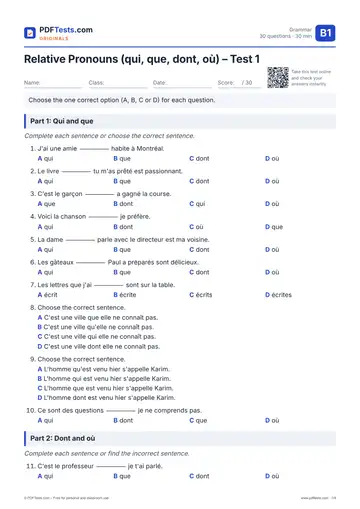
Put the rules into practice with our B1 Relative Pronouns test, which mixes qui, que, dont and où in realistic sentences. If dont feels tricky, compare it with en, which also replaces de + noun, in our guide to object pronouns, y and en. Then explore the other French B1 tests or check your overall progress with the French Level Test B1.
Was this page helpful?
What was the problem?
Thank you for your feedback!