Pronominal verbs (verbes pronominaux) are French verbs used with an extra pronoun such as me, te or se, which refers back to the subject: je me lève (I get up). You use them for actions you do to yourself, for actions people do to each other, and for many everyday expressions. They are essential for describing your daily routine.
What is a pronominal verb?
In a dictionary, a pronominal verb appears with se (or s’ before a vowel) in front of the infinitive: se laver, s’habiller, se coucher.
The pronoun shows that the subject and the person affected by the action are the same:
- Je lave la voiture. — I wash the car. (normal verb: the car is washed)
- Je me lave. — I wash (myself). (pronominal verb: I am washed)
English often drops the word myself or uses a different verb, so many French pronominal verbs do not look reflexive in translation: se réveiller means to wake up, not to wake oneself.
Form in the present tense
The reflexive pronoun changes with the subject and goes directly before the verb. The verb itself is conjugated normally. If you need a refresher on regular endings, see our guide to the present tense of -er verbs.
| Subject | Reflexive pronoun | Se laver | Translation |
|---|---|---|---|
| je | me (m’) | je me lave | I wash |
| tu | te (t’) | tu te laves | you wash |
| il / elle / on | se (s’) | il se lave | he washes |
| nous | nous | nous nous lavons | we wash |
| vous | vous | vous vous lavez | you wash |
| ils / elles | se (s’) | elles se lavent | they wash |
Elision before a vowel or silent h
Me, te and se lose their e before a vowel or a silent h:
- Je m’habille. — I get dressed.
- Tu t’appelles comment ? — What’s your name?
- Elle s’amuse bien. — She is having a good time.
Nous and vous never change, but you pronounce the liaison: nous nous habillons sounds like “nou nou-zabillon”.
Spelling changes to watch
Some common pronominal verbs have stem changes in the present:
- se lever: je me lève, nous nous levons — I get up, we get up
- s’appeler: je m’appelle, nous nous appelons — my name is, our name is
- s’asseoir (irregular): je m’assieds, vous vous asseyez — I sit down, you sit down
When to use pronominal verbs
1. Reflexive actions: the daily routine
This is the use you will meet first. The subject does the action to itself.
| Verb | Meaning | Example |
|---|---|---|
| se réveiller | to wake up | Je me réveille à 6 h 30. — I wake up at 6:30. |
| se lever | to get up | Tu te lèves tôt. — You get up early. |
| se doucher | to shower | Il se douche le soir. — He showers in the evening. |
| se brosser les dents | to brush one’s teeth | Nous nous brossons les dents. — We brush our teeth. |
| s’habiller | to get dressed | Elle s’habille vite. — She gets dressed quickly. |
| se maquiller | to put on make-up | Je ne me maquille pas. — I don’t wear make-up. |
| se raser | to shave | Mon père se rase tous les jours. — My father shaves every day. |
| se dépêcher | to hurry | Dépêche-toi ! — Hurry up! |
| se reposer | to rest | On se repose le dimanche. — We rest on Sundays. |
| se coucher | to go to bed | Ils se couchent à minuit. — They go to bed at midnight. |
| s’endormir | to fall asleep | Je m’endors devant la télé. — I fall asleep in front of the TV. |
Want more routine vocabulary? Try our A1 everyday vocabulary test on family, home and daily routine.
2. Reciprocal actions: each other
With plural subjects (nous, vous, ils, elles, and on meaning we), the pronoun can mean each other:
- Ils s’aiment. — They love each other.
- Nous nous téléphonons le week-end. — We phone each other at the weekend.
- On se voit demain ? — Shall we see each other tomorrow?
3. Idiomatic pronominal verbs
Some verbs are always or usually pronominal, and the pronoun has no clear reflexive meaning. Learn them as vocabulary:
- s’appeler — Je m’appelle Léa. — My name is Léa.
- s’amuser — Les enfants s’amusent au parc. — The children are having fun in the park.
- s’ennuyer — Je m’ennuie en réunion. — I get bored in meetings.
- s’intéresser à — Elle s’intéresse à la musique. — She is interested in music.
- se souvenir de — Tu te souviens de Paul ? — Do you remember Paul?
- se tromper — Pardon, je me suis trompé. — Sorry, I made a mistake.
- se promener — On se promène au bord de la mer. — We go for a walk by the sea.
- se sentir — Je me sens fatigué. — I feel tired.
Negatives
The reflexive pronoun stays glued to the verb. Ne goes before the pronoun, and pas goes after the verb. For the basics of negation, see our guide to negation with ne … pas.
| Affirmative | Negative |
|---|---|
| Je me lève tôt. — I get up early. | Je ne me lève pas tôt. — I don’t get up early. |
| Tu t’ennuies. — You’re bored. | Tu ne t’ennuies pas. — You’re not bored. |
| Nous nous couchons tard. — We go to bed late. | Nous ne nous couchons pas tard. — We don’t go to bed late. |
The same pattern works with jamais and plus: Il ne se rase jamais. — He never shaves.
Questions
You have three ways to ask a question, just as with normal verbs:
| Style | Example | Translation |
|---|---|---|
| Intonation (spoken) | Tu te lèves à quelle heure ? | What time do you get up? |
| Est-ce que | Est-ce que tu te lèves tôt ? | Do you get up early? |
| Inversion (formal) | À quelle heure te lèves-tu ? | What time do you get up? |
With inversion, the pronoun stays in front: Vous vous reposez → Vous reposez-vous ? — Are you resting?
Pronominal verbs in the infinitive
After verbs like aller, vouloir, devoir, pouvoir or aimer, the pronominal verb stays in the infinitive, but the pronoun must match the subject. It does not stay as se.
- Je vais me coucher. — I’m going to go to bed.
- Tu dois te dépêcher. — You have to hurry.
- Nous voulons nous reposer. — We want to rest.
- Ils aiment se promener. — They like going for walks.
In the negative, ne … pas surrounds the conjugated verb: Je ne vais pas me coucher. — I’m not going to go to bed.
The imperative
In affirmative commands, the pronoun goes after the verb with a hyphen, and te becomes toi:
- Lève-toi ! — Get up!
- Asseyez-vous, s’il vous plaît. — Sit down, please.
- Dépêchons-nous ! — Let’s hurry!
In negative commands, the pronoun goes back before the verb and stays te:
- Ne te lève pas ! — Don’t get up!
- Ne vous inquiétez pas. — Don’t worry.
Pronominal verbs in the passé composé
All pronominal verbs use être in the passé composé, never avoir. Because of être, the past participle usually agrees with the subject: add -e for feminine and -s for plural. Our guide to the passé composé covers the other être verbs too.
| Subject | Se lever | Translation |
|---|---|---|
| je | me suis levé(e) | I got up |
| tu | t’es levé(e) | you got up |
| il / elle | s’est levé / s’est levée | he / she got up |
| nous | nous sommes levé(e)s | we got up |
| vous | vous êtes levé(e)(s) | you got up |
| ils / elles | se sont levés / se sont levées | they got up |
In the negative, ne … pas surrounds the pronoun and être:
- Elle ne s’est pas maquillée. — She didn’t put on make-up.
- Nous ne nous sommes pas ennuyés. — We didn’t get bored.
A note on body parts
When a body part comes after the verb, the participle does not agree, because the body part is the direct object:
- Elle s’est lavée. — She washed (herself).
- Elle s’est lavé les mains. — She washed her hands.
You will study this rule in more detail later; at A2, just notice the difference.
Pronominal or not? Comparing the two
Many verbs exist in both forms. The pronominal form means the action affects the subject; the normal form needs another object.
| Normal verb | Pronominal verb |
|---|---|
| Je réveille mon fils. — I wake my son up. | Je me réveille. — I wake up. |
| Elle couche le bébé. — She puts the baby to bed. | Elle se couche. — She goes to bed. |
| Il promène le chien. — He walks the dog. | Il se promène. — He goes for a walk. |
| J’appelle Marc. — I call Marc. | Je m’appelle Marc. — My name is Marc. |
Body parts use the definite article
With pronominal verbs, French uses le, la, les for body parts, not mon, ma, mes. The reflexive pronoun already shows whose body it is.
- Je me brosse les dents. — I brush my teeth.
- Tu te laves les cheveux ? — Are you washing your hair?
Signal words
Pronominal verbs appear constantly when you describe routines, so look out for time and sequence words:
- le matin, le soir, tous les jours, d’habitude — in the morning, in the evening, every day, usually
- d’abord, ensuite, puis, après, enfin — first, next, then, after, finally
D’abord je me réveille, ensuite je me douche, puis je m’habille. — First I wake up, next I shower, then I get dressed.
Common mistakes
- ✗ Je lève à sept heures. → ✓ Je me lève à sept heures. — Without the pronoun, lever means to lift something.
- ✗ Je me appelle Sophie. → ✓ Je **m’**appelle Sophie. — Me becomes m’ before a vowel.
- ✗ Je ne lave me pas. → ✓ Je ne me lave pas. — The pronoun stays directly before the verb, inside ne … pas.
- ✗ Je vais se coucher. → ✓ Je vais me coucher. — In the infinitive, the pronoun still matches the subject.
- ✗ Je me suis brossé mes dents. → ✓ Je me suis brossé les dents. — Use the definite article with body parts.
- ✗ Je me ai levé. → ✓ Je me suis levé. — Pronominal verbs always take être in the passé composé.
- ✗ Marie s’est levé. → ✓ Marie s’est levée. — The participle agrees with a feminine subject.
- ✗ Te lève ! → ✓ Lève-toi ! — In affirmative commands, the pronoun follows the verb and te becomes toi.
Quick check
- Complete: Nous ___ (se lever) à sept heures.
- Make negative: Il se rase le matin.
- Put into the passé composé: Elle s’habille.
- Give the tu command of se dépêcher.
- Complete: Ce soir, je vais ___ coucher tôt.
Answers
- Nous nous levons à sept heures. — We get up at seven.
- Il ne se rase pas le matin. — He doesn’t shave in the morning.
- Elle s’est habillée. — She got dressed.
- Dépêche-toi ! — Hurry up!
- Ce soir, je vais me coucher tôt. — Tonight I’m going to go to bed early.
Next step
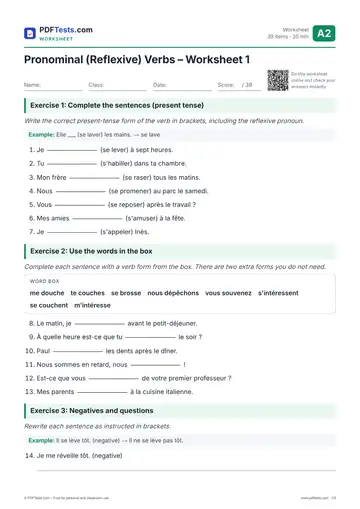
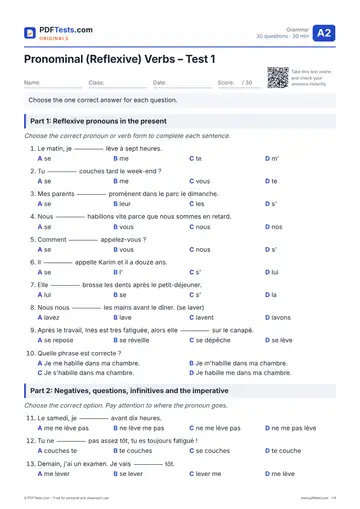
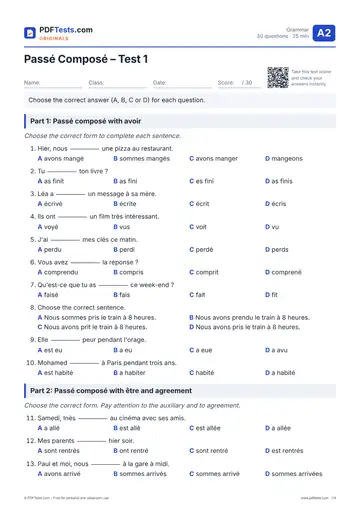
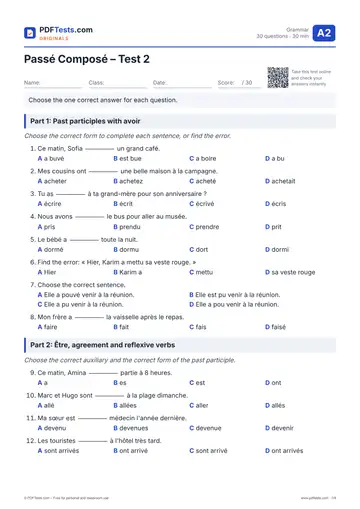
Now put the rules into practice: test yourself with our A2 Pronominal (Reflexive) Verbs test, which mixes present-tense forms, negatives, infinitives and the passé composé with être. Once you score well, describe your own day aloud in five or six sentences using d’abord, ensuite and puis, then move on to the Passé Composé – Test 2 to check that you choose être and avoir correctly.
Was this page helpful?
What was the problem?
Thank you for your feedback!