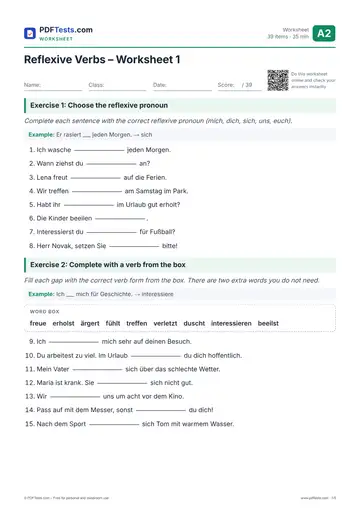
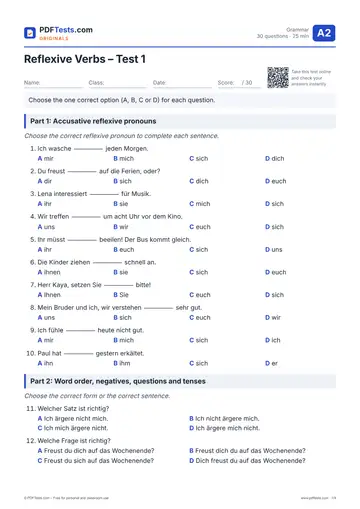
A reflexive verb in German is a verb used with a reflexive pronoun such as mich, dich or sich. The pronoun refers back to the subject: the person does the action to themselves. German uses reflexive verbs for daily routines, feelings and many everyday actions, often where English uses no pronoun at all (sich beeilen = to hurry).
What is a reflexive verb?
In the dictionary, reflexive verbs appear with sich in front: sich waschen, sich freuen, sich setzen. When you use the verb in a sentence, sich changes to match the subject.
- Ich wasche mich. I wash (myself).
- Wir freuen uns. We are happy / looking forward to it.
- Setz dich! Sit down.
Some verbs are reflexive in English too (to enjoy yourself), but many are not. You simply have to learn sich as part of the verb.
Reflexive pronouns
Reflexive pronouns have an accusative form and a dative form. They differ only for ich and du.
| Subject | Accusative | Dative |
|---|---|---|
| ich | mich | mir |
| du | dich | dir |
| er / sie / es | sich | sich |
| wir | uns | uns |
| ihr | euch | euch |
| sie / Sie | sich | sich |
Note that sich is only used for the third person (er, sie, es, sie plural) and for formal Sie. With formal Sie, sich is written in lower case: Setzen Sie sich, bitte. Please sit down.
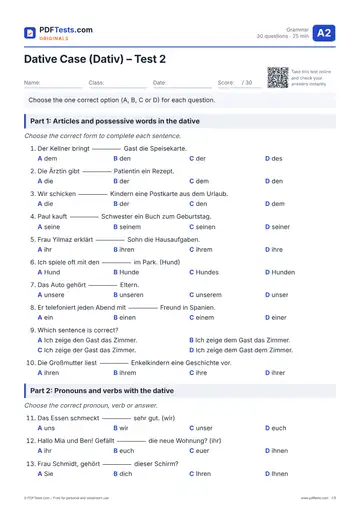
If you need a refresher on the two cases themselves, see our guides to the accusative case and the dative case.
Form: conjugating a reflexive verb
The verb is conjugated exactly like a normal verb in the present tense. You just add the right pronoun. Here is sich freuen (to be happy, to look forward to):
| Affirmative | Negative | Question |
|---|---|---|
| ich freue mich | ich freue mich nicht | Freue ich mich? |
| du freust dich | du freust dich nicht | Freust du dich? |
| er/sie/es freut sich | er freut sich nicht | Freut sie sich? |
| wir freuen uns | wir freuen uns nicht | Freuen wir uns? |
| ihr freut euch | ihr freut euch nicht | Freut ihr euch? |
| sie/Sie freuen sich | sie freuen sich nicht | Freuen Sie sich? |
- Ich freue mich auf den Urlaub. I’m looking forward to the holiday.
- Freust du dich nicht über das Geschenk? Aren’t you happy about the present?
Irregular verbs keep their usual vowel changes: du wäschst dich, er wäscht sich.
Accusative or dative: mich or mir?
Most reflexive verbs take the accusative pronoun. The rule for choosing the dative is simple:
If the sentence already has an accusative object, the reflexive pronoun goes into the dative.
| Accusative (no other object) | Dative (there is another object) |
|---|---|
| Ich wasche mich. I wash. | Ich wasche mir die Hände. I wash my hands. |
| Du ziehst dich an. You get dressed. | Du ziehst dir eine Jacke an. You put on a jacket. |
| Ich kämme mich. I comb my hair. | Ich kämme mir die Haare. I comb my hair. |
Notice that German does not say my hands here. The dative pronoun shows whose hands they are: Er putzt sich die Zähne. He brushes his teeth.
A few common verbs are used with a dative pronoun plus an object:
- Ich wünsche mir ein neues Handy. I’d like a new phone (as a present).
- Ich kaufe mir einen Kaffee. I’m buying myself a coffee.
- Das kann ich mir nicht vorstellen. I can’t imagine that.
Remember: the difference is only visible with ich (mich/mir) and du (dich/dir). With all other persons the form is identical.
Word order
Main clauses
The reflexive pronoun normally comes directly after the conjugated verb.
- Ich dusche mich jeden Morgen. I shower every morning.
When another element comes first and the subject moves after the verb, pay attention to the type of subject:
- Pronoun subject: the pronoun subject comes first, then sich. Heute fühlt er sich besser. He feels better today.
- Noun subject: sich usually comes before the noun. Heute fühlt sich mein Vater besser. My father feels better today.
With modal verbs and in the Perfekt
The pronoun stays near the conjugated verb, and the infinitive or participle goes to the end.
- Wir müssen uns beeilen. We have to hurry.
- Ich habe mich gestern erkältet. I caught a cold yesterday.
Separable verbs
With separable verbs, the prefix goes to the end as usual and the pronoun stays after the verb. More on this in our guide to separable verbs.
- Ich ziehe mich schnell an. I get dressed quickly.
- Am Wochenende ruhe ich mich aus. At the weekend I relax.
Subordinate clauses
In clauses with weil, dass or wenn, the verb goes to the end, and the pronoun usually comes straight after the subject pronoun.
- Ich bleibe zu Hause, weil ich mich nicht gut fühle. I’m staying at home because I don’t feel well.
Imperative
- Beeil dich! Hurry up. (du)
- Beeilt euch! Hurry up. (ihr)
- Beeilen Sie sich! Hurry up. (Sie)
Reflexive verbs in the Perfekt
Reflexive verbs always form the Perfekt with haben, even when they describe a change or movement.
- Sie hat sich in Paris verliebt. She fell in love in Paris.
- Habt ihr euch gut erholt? Did you have a good rest?
- Wir haben uns vor dem Kino getroffen. We met in front of the cinema.
For more on forming participles, see our Perfekt guide.
Common reflexive verbs at A2
Many reflexive verbs are followed by a fixed preposition. Learn the verb, the pronoun and the preposition together.
| Verb | Meaning | Example |
|---|---|---|
| sich freuen auf + Akk. | to look forward to | Ich freue mich auf Samstag. I’m looking forward to Saturday. |
| sich freuen über + Akk. | to be happy about | Sie freut sich über die Blumen. She’s happy about the flowers. |
| sich interessieren für | to be interested in | Interessierst du dich für Musik? Are you interested in music? |
| sich ärgern über | to be annoyed about | Er ärgert sich über den Stau. He’s annoyed about the traffic jam. |
| sich erinnern an | to remember | Ich erinnere mich an den Urlaub. I remember the holiday. |
| sich kümmern um | to look after | Wir kümmern uns um den Hund. We look after the dog. |
| sich treffen mit | to meet | Ich treffe mich mit Lena. I’m meeting Lena. |
| sich beeilen | to hurry | Beeil dich, der Bus kommt. Hurry, the bus is coming. |
| sich setzen | to sit down | Setzen Sie sich. Sit down. |
| sich fühlen | to feel | Ich fühle mich müde. I feel tired. |
| sich anmelden | to register | Ich melde mich für den Kurs an. I’m signing up for the course. |
| sich entschuldigen | to apologise | Er entschuldigt sich bei ihr. He apologises to her. |
| sich vorstellen | to introduce oneself | Darf ich mich vorstellen? May I introduce myself? |
Reflexive or not?
Many verbs can be used with or without a reflexive pronoun. The meaning changes depending on who receives the action.
- Ich wasche das Auto. I wash the car. / Ich wasche mich. I wash (myself).
- Die Mutter zieht das Kind an. The mother dresses the child. / Das Kind zieht sich an. The child gets dressed.
- Der Lärm ärgert mich. The noise annoys me. / Ich ärgere mich. I’m annoyed.
Some verbs are always reflexive, for example sich beeilen, sich erholen (to recover, rest) and sich bedanken (to say thank you). You cannot use them without the pronoun.
Each other
With plural subjects, the reflexive pronoun can also mean each other:
- Wir kennen uns seit der Schule. We’ve known each other since school.
- Anna und Tom sehen sich jeden Tag. Anna and Tom see each other every day.
Common mistakes
- ✗ Ich freue mir. → ✓ Ich freue mich. sich freuen takes the accusative because there is no other object.
- ✗ Ich wasche mich die Hände. → ✓ Ich wasche mir die Hände. There is already an accusative object (die Hände), so the pronoun is dative.
- ✗ Wir treffen sich am Bahnhof. → ✓ Wir treffen uns am Bahnhof. sich is only for er/sie/es, sie and Sie.
- ✗ Ich bin mich beeilt. → ✓ Ich habe mich beeilt. Reflexive verbs always use haben in the Perfekt.
- ✗ Heute fühlt sich er besser. → ✓ Heute fühlt er sich besser. A pronoun subject comes before sich.
- ✗ Ich erinnere an meine Oma. → ✓ Ich erinnere mich an meine Oma. sich erinnern needs the pronoun.
- ✗ Ich interessiere mich in Kunst. → ✓ Ich interessiere mich für Kunst. The fixed preposition is für, not a translation of English in.
- ✗ Setzen Sie Sich. → ✓ Setzen Sie sich. Only the formal Sie is capitalised, never sich.
Quick check
Fill in the gap or correct the sentence.
- Ich freue ___ auf das Wochenende.
- Du putzt ___ die Zähne.
- Wir haben ___ im Park getroffen.
- Er interessiert sich ___ Fußball.
- Correct the word order: Morgen sich er trifft mit Anna.
Answers
- mich – no other object, so accusative.
- dir – die Zähne is the accusative object, so the pronoun is dative.
- uns – pronoun for wir; Perfekt with haben.
- für – sich interessieren für.
- Morgen trifft er sich mit Anna. Tomorrow he’s meeting Anna. Verb in second position, then the pronoun subject, then sich.
Next step
Now put the rules into practice: test yourself with our A2 Reflexive Verbs test, paying special attention to the choice between mich and mir and to word order after the verb. If you keep mixing up accusative and dative forms, review the dative case guide before trying the test again, and keep a list of reflexive verbs with their prepositions to learn as fixed phrases.
Was this page helpful?
What was the problem?
Thank you for your feedback!