German subordinate clauses (Nebensätze) with weil, dass and wenn add extra information to a main clause: a reason, what someone says or thinks, or a condition. The key rule is that in a subordinate clause, the conjugated verb goes to the end. At A2 you use these clauses all the time to explain why, to give your opinion, and to say what happens if or when something is true.
Main clause vs subordinate clause
In a normal German main clause (Hauptsatz), the conjugated verb is in position 2. In a subordinate clause, the conjunction comes first and the conjugated verb moves to the last position.
| Clause type | Example | Translation |
|---|---|---|
| Main clause | Ich bin müde. | I am tired. |
| Subordinate clause | …, weil ich müde bin. | …, because I am tired. |
| Main clause | Er kommt morgen. | He is coming tomorrow. |
| Subordinate clause | …, dass er morgen kommt. | …, that he is coming tomorrow. |
The basic pattern is: conjunction + subject + other information + conjugated verb. In written German, a subordinate clause always belongs to a main clause, and the two are separated by a comma.
Uses of weil, dass and wenn
weil – giving a reason
weil means because. It answers the question Warum? (Why?).
- Ich bleibe heute zu Hause, weil ich krank bin. — I’m staying at home today because I’m ill.
- Wir nehmen das Fahrrad, weil das Wetter so schön ist. — We’re taking the bike because the weather is so nice.
- Warum lernst du Deutsch? – Weil meine Freundin aus Wien kommt. — Why are you learning German? – Because my girlfriend is from Vienna.
In spoken answers to a warum question, a weil clause can stand on its own, as in the last example. The verb still goes to the end.
dass – what someone says, thinks or knows
dass means that. It typically follows verbs such as glauben, denken, wissen, sagen, hoffen, finden and expressions like Es ist wichtig, … or Ich bin sicher, …
- Ich glaube, dass der Film um acht beginnt. — I think (that) the film starts at eight.
- Sie sagt, dass sie keine Zeit hat. — She says (that) she has no time.
- Es ist wichtig, dass du pünktlich bist. — It’s important that you are on time.
In English you can often leave out that. In German you have two correct options: use dass with the verb at the end, or leave out dass and use normal main-clause order.
- Ich glaube, dass er recht hat. — I think that he’s right.
- Ich glaube, er hat recht. — I think he’s right.
Spelling note: dass (with double s) is the conjunction that links two clauses. das (one s) is an article or pronoun: das Buch, das ist gut. If the word introduces a whole new clause after glauben, sagen, wissen, it is almost always dass.
wenn – conditions and repeated events
wenn means if or when(ever). It has three main uses at A2:
- Condition: Wenn es regnet, fahren wir mit dem Bus. — If it rains, we’ll take the bus.
- Repeated events: Wenn ich nach Hause komme, trinke ich immer einen Tee. — Whenever I come home, I always have a cup of tea.
- A single event in the future: Ruf mich an, wenn du in Berlin bist. — Call me when you’re in Berlin.
For a single event in the past, German uses als, not wenn:
- Als ich zehn war, hatte ich einen Hund. — When I was ten, I had a dog.
- Immer wenn wir Oma besucht haben, hat sie Kuchen gebacken. — Whenever we visited Grandma, she baked a cake. (repeated, so wenn)
Form: where the verb goes
The rule is always the same, but it looks different depending on the type of verb.
| Verb type | Rule | Example | Translation |
|---|---|---|---|
| Simple verb | conjugated verb at the end | …, weil er viel arbeitet. | …, because he works a lot. |
| Modal verb | infinitive first, modal verb at the very end | …, weil ich morgen früh aufstehen muss. | …, because I have to get up early tomorrow. |
| Separable verb | prefix and verb join into one word | …, wenn der Zug pünktlich ankommt. | …, if the train arrives on time. |
| Perfect tense | participle first, haben/sein at the very end | …, dass sie gestern angerufen hat. | …, that she called yesterday. |
| Reflexive verb | reflexive pronoun stays near the start | …, weil ich mich für Musik interessiere. | …, because I’m interested in music. |
Notice the separable verb: in a main clause you say Der Zug kommt pünktlich an, but in a subordinate clause the parts come together again: …, wenn der Zug pünktlich ankommt. If you need a refresher, see our guide to German separable verbs.
With modal verbs, the infinitive goes second to last and the modal verb goes last. Our guide to modal verbs explains the main-clause pattern that this builds on.
Affirmative, negative and questions
| Type | Example | Translation |
|---|---|---|
| Affirmative | Ich gehe joggen, wenn ich Zeit habe. | I go jogging when I have time. |
| Negative with nicht | Ich komme mit, weil ich heute nicht arbeiten muss. | I’m coming along because I don’t have to work today. |
| Negative with kein | Sie ist traurig, dass sie keine Karte bekommen hat. | She’s sad that she didn’t get a ticket. |
| Question | Weißt du, dass Tom umgezogen ist? | Do you know that Tom has moved? |
| Question | Kommst du mit, wenn das Wetter gut ist? | Will you come along if the weather is good? |
In a negative subordinate clause, nicht usually comes just before the verb or verbs at the end, and kein goes before the noun. In a question, only the main clause changes its word order; the subordinate clause keeps the verb at the end.
Starting with the subordinate clause
You can also put the subordinate clause first. The whole subordinate clause then counts as position 1, so the main clause starts with its conjugated verb. The result is the typical pattern verb, comma, verb.
| Position 1 (subordinate clause) | Verb | Rest | Translation |
|---|---|---|---|
| Wenn ich Zeit habe, | gehe | ich ins Kino. | When I have time, I go to the cinema. |
| Weil der Bus nicht gekommen ist, | sind | wir zu Fuß gegangen. | Because the bus didn’t come, we walked. |
| Dass du kommst, | freut | mich sehr. | I’m really glad you’re coming. |
This order is very common with wenn. With weil and dass, the subordinate clause usually comes second, but starting with it is also correct.
Comma rules
German always uses a comma between a main clause and a subordinate clause. There are no exceptions for weil, dass or wenn.
- Ich hoffe, dass es morgen nicht regnet. — I hope (that) it doesn’t rain tomorrow.
- Wenn du Hunger hast, mache ich dir ein Brot. — If you’re hungry, I’ll make you a sandwich.
If the subordinate clause sits in the middle of a sentence, it needs a comma on both sides.
weil vs denn
Learners often confuse weil and denn, because both mean because. The difference is word order.
| weil | denn | |
|---|---|---|
| Type | subordinating conjunction | coordinating conjunction |
| Verb position | at the end | position 2, as in a main clause |
| Example | Ich bleibe zu Hause, weil ich müde bin. | Ich bleibe zu Hause, denn ich bin müde. |
| Translation | I’m staying at home because I’m tired. | I’m staying at home because I’m tired. |
| Can start a sentence? | yes | no |
| Can answer Warum? alone? | yes | no |
In casual spoken German you will sometimes hear weil ich bin müde. This is informal speech. In writing and in exams, always put the verb at the end after weil.
Which conjunction? Quick guide
| Meaning | Conjunction | Question it answers | Typical signal words |
|---|---|---|---|
| reason | weil | Warum? | warum, deshalb in the question or context |
| content of speech or thought | dass | Was? | glauben, denken, wissen, sagen, hoffen, finden, es ist wichtig |
| condition or repeated/future time | wenn | Wann? Unter welcher Bedingung? | immer wenn, nur wenn, jedes Mal |
Common mistakes
- ✗ Ich lerne Deutsch, weil ich will in Berlin wohnen. → ✓ Ich lerne Deutsch, weil ich in Berlin wohnen will. — I’m learning German because I want to live in Berlin. The modal verb goes to the very end.
- ✗ Er sagt, dass er kommt morgen. → ✓ Er sagt, dass er morgen kommt. — He says he’s coming tomorrow. The conjugated verb goes after all other information.
- ✗ Wenn ich habe Zeit, ich gehe ins Kino. → ✓ Wenn ich Zeit habe, gehe ich ins Kino. — When I have time, I go to the cinema. Verb at the end of the wenn clause, then verb first in the main clause.
- ✗ …, weil der Zug kommt um acht an. → ✓ …, weil der Zug um acht ankommt. — …, because the train arrives at eight. Separable verbs join together in a subordinate clause.
- ✗ …, weil ich habe den Bus verpasst. → ✓ …, weil ich den Bus verpasst habe. — …, because I missed the bus. In the perfect tense, haben/sein goes last.
- ✗ Ich glaube das er recht hat. → ✓ Ich glaube, dass er recht hat. — I think he’s right. Use dass with double s and always add a comma.
- ✗ Wenn ich ein Kind war, habe ich viel gespielt. → ✓ Als ich ein Kind war, habe ich viel gespielt. — When I was a child, I played a lot. A single period in the past needs als.
- ✗ Ich bleibe hier, denn ich krank bin. → ✓ Ich bleibe hier, denn ich bin krank. — I’m staying here because I’m ill. denn keeps main-clause word order.
Quick check
Join or complete the sentences.
- Ich trinke Kaffee. Ich bin müde. (weil) — I’m drinking coffee. I’m tired.
- Er sagt: Er kommt später. (dass) — He says: he’s coming later.
- Ich habe Zeit. Ich rufe dich an. (Start with Wenn.) — I have time. I’ll call you.
- Ich lerne heute. Ich muss morgen eine Prüfung schreiben. (weil) — I’m studying today. I have to take an exam tomorrow.
- ___ ich ein Kind war, habe ich in Hamburg gewohnt. (wenn or als?) — ___ I was a child, I lived in Hamburg.
Answers
- Ich trinke Kaffee, weil ich müde bin. — I’m drinking coffee because I’m tired.
- Er sagt, dass er später kommt. — He says that he’s coming later.
- Wenn ich Zeit habe, rufe ich dich an. — When I have time, I’ll call you.
- Ich lerne heute, weil ich morgen eine Prüfung schreiben muss. — I’m studying today because I have to take an exam tomorrow.
- Als ich ein Kind war, habe ich in Hamburg gewohnt. — When I was a child, I lived in Hamburg. (a single period in the past)
Next step
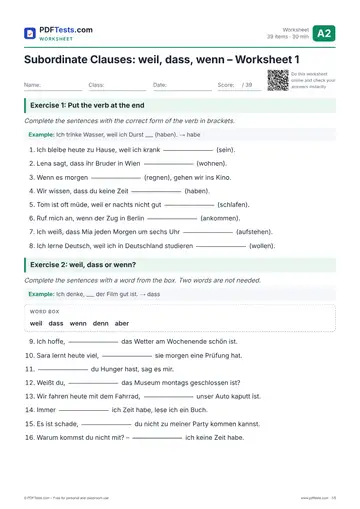
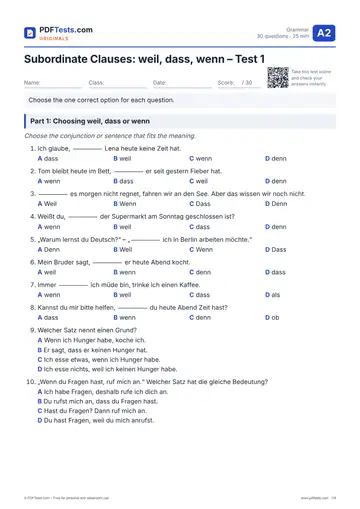
Now put the rules into practice: test yourself with our A2 test on subordinate clauses with weil, dass and wenn and check which word-order patterns still cause problems. If the verb-final position with haben and sein feels shaky, review the Perfekt guide first. Once these clauses feel automatic, you are ready for the next kind of verb-final clause in our guide to German relative clauses.
Was this page helpful?
What was the problem?
Thank you for your feedback!