German has two main words for saying not or no: kein and nicht. Use kein to negate a noun that would normally have ein or no article at all. Use nicht for almost everything else: verbs, adjectives, names, and nouns with der/die/das or mein/dein.
The basic rule
Before you negate, look at the noun.
- Is there ein/eine in front of it, or no article at all? Use kein.
- In all other cases, use nicht.
| Positive | Negative | English |
|---|---|---|
| Ich habe ein Auto. | Ich habe kein Auto. | I don’t have a car. |
| Ich trinke Kaffee. | Ich trinke keinen Kaffee. | I don’t drink coffee. |
| Ich arbeite heute. | Ich arbeite heute nicht. | I’m not working today. |
| Das Hotel ist teuer. | Das Hotel ist nicht teuer. | The hotel isn’t expensive. |
| Ich kenne den Mann. | Ich kenne den Mann nicht. | I don’t know the man. |
Think of kein as not + a or no. It replaces the article. Nicht never replaces anything; it is simply added to the sentence.
When to use kein
Nouns with ein or eine
When the positive sentence has ein or eine, the negative uses kein in the same place.
- Das ist ein Problem. → Das ist kein Problem. – That’s no problem.
- Sie hat eine Katze. → Sie hat keine Katze. – She doesn’t have a cat.
Nouns without an article
Uncountable nouns (water, money, time) and plural nouns often have no article. These are also negated with kein.
- Wir haben Milch. → Wir haben keine Milch. – We don’t have any milk.
- Er hat Geschwister. → Er hat keine Geschwister. – He doesn’t have any brothers or sisters.
Everyday phrases with kein
Many fixed expressions use kein. Learn them as whole phrases:
- Ich habe keine Zeit. – I don’t have time.
- Ich habe keinen Hunger. – I’m not hungry.
- Ich habe keine Lust. – I don’t feel like it.
- Ich habe kein Geld. – I don’t have any money.
- Keine Ahnung. – No idea.
The forms of kein
Kein takes the same endings as ein. The difference is that kein also has a plural form, keine, because ein has no plural.
| Case | Masculine | Feminine | Neuter | Plural |
|---|---|---|---|---|
| Nominative | kein | keine | kein | keine |
| Accusative | keinen | keine | kein | keine |
| Dative | keinem | keiner | keinem | keinen |
At A1 you mainly need the nominative and accusative rows. Notice that only the masculine form changes in the accusative: kein becomes keinen.
- Das ist kein Tisch. – That isn’t a table. (nominative, masculine)
- Ich brauche keinen Tisch. – I don’t need a table. (accusative, masculine)
- Hier gibt es keine Apotheke. – There’s no pharmacy here. (accusative, feminine)
- Wir haben keine Fahrräder. – We don’t have any bikes. (accusative, plural)
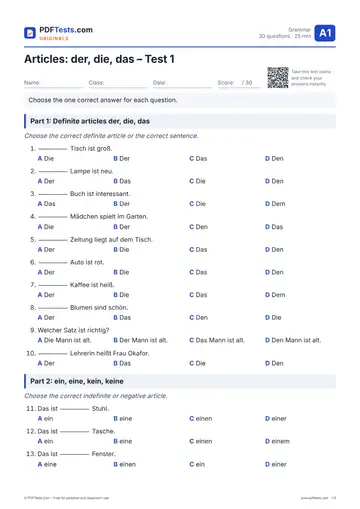
To choose the right ending, you need to know the gender of the noun. If genders are still a problem, review our guide to German articles der, die, das. For more on when ein becomes einen, see the accusative case guide.
When to use nicht
Use nicht to negate:
- Verbs: Ich rauche nicht. – I don’t smoke.
- Adjectives: Der Film ist nicht gut. – The film isn’t good.
- Adverbs: Sie fährt nicht schnell. – She doesn’t drive fast.
- Nouns with der, die, das: Ich finde den Schlüssel nicht. – I can’t find the key.
- Nouns with possessive articles: Das ist nicht mein Handy. – That isn’t my phone.
- Names: Das ist nicht Anna. – That isn’t Anna.
- Places and prepositional phrases: Ich wohne nicht in Berlin. – I don’t live in Berlin.
- Pronouns: Ich kenne ihn nicht. – I don’t know him.
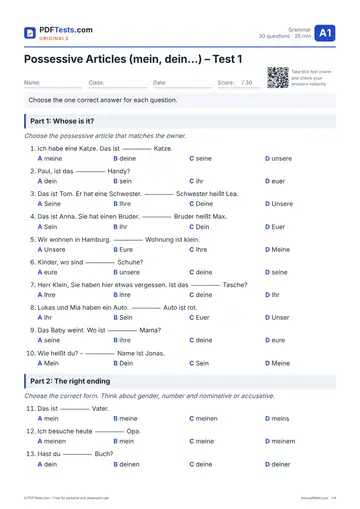
If the noun has mein, dein, sein and so on, always use nicht, never kein. Our guide to possessive articles covers these words in detail.
Where does nicht go?
The position of nicht is the tricky part. Here are the rules you need at A1.
At the end of a simple sentence
When you negate the whole sentence, nicht usually goes at the end, after the object and after time expressions like heute or morgen.
- Ich verstehe das nicht. – I don’t understand that.
- Wir kommen morgen nicht. – We aren’t coming tomorrow.
- Sie liebt ihn nicht. – She doesn’t love him.
Before certain parts of the sentence
Nicht comes before these elements:
| Element | Example | English |
|---|---|---|
| Adjective after sein | Das Essen ist nicht kalt. | The food isn’t cold. |
| Adverb of manner | Er spricht nicht laut. | He doesn’t speak loudly. |
| Place / prepositional phrase | Paul ist nicht zu Hause. | Paul isn’t at home. |
| Infinitive after a modal verb | Ich kann heute nicht kommen. | I can’t come today. |
| Separable prefix | Der Bus kommt nicht an. | The bus isn’t arriving. |
In sentences with two verb parts, nicht stands just before the second part at the end. This applies to modal verbs and separable verbs.
- Ich muss nicht arbeiten. – I don’t have to work.
- Ich rufe dich heute nicht an. – I’m not calling you today.
Negating one specific word
To negate just one part of the sentence, put nicht directly before that part. This often goes with sondern (but rather).
- Ich wohne nicht in Berlin, sondern in Hamburg. – I don’t live in Berlin but in Hamburg.
- Wir fahren nicht am Montag, sondern am Dienstag. – We’re not leaving on Monday but on Tuesday.
Kein works with sondern too:
- Das ist kein Hund, sondern eine Katze. – That’s not a dog, it’s a cat.
kein or nicht: side by side
| kein | nicht | |
|---|---|---|
| Noun with ein | Ich habe kein Fahrrad. I don’t have a bike. | – |
| Noun with no article | Er trinkt keinen Alkohol. He doesn’t drink alcohol. | – |
| Noun with der/die/das | – | Ich sehe das Fahrrad nicht. I don’t see the bike. |
| Noun with mein/dein | – | Das ist nicht mein Fahrrad. That’s not my bike. |
| Verb or adjective | – | Das Fahrrad ist nicht neu. The bike isn’t new. |
Languages and jobs
With languages and professions, both forms are correct, but kein is more common in everyday speech.
- Ich spreche kein Spanisch. / Ich spreche nicht Spanisch. – I don’t speak Spanish.
- Ich bin kein Arzt. / Ich bin nicht Arzt. – I’m not a doctor.
Answering questions: ja, nein and doch
When a question is negative, you cannot answer ja to disagree. Use doch instead.
| Question | Agree with the negative | Disagree with the negative |
|---|---|---|
| Hast du kein Auto? Don’t you have a car? | Nein, ich habe kein Auto. No, I don’t. | Doch, ich habe ein Auto. Yes, I do. |
| Kommst du nicht? Aren’t you coming? | Nein, ich komme nicht. No, I’m not. | Doch, ich komme. Yes, I am. |
For positive questions, use ja and nein as usual:
- Hast du einen Stift? – Nein, ich habe keinen. – Do you have a pen? – No, I don’t.
Useful combinations
- noch nicht – not yet: Der Zug ist noch nicht da. – The train isn’t here yet.
- nicht mehr – not any more: Ich rauche nicht mehr. – I don’t smoke any more.
- kein … mehr – no more: Wir haben keine Milch mehr. – We don’t have any milk left.
- gar nicht – not at all: Das ist gar nicht schwer. – That’s not difficult at all.
- nichts – nothing: Ich verstehe nichts. – I don’t understand anything.
Common mistakes
- ✗ Ich habe nicht ein Auto. → ✓ Ich habe kein Auto. – ein + noun is negated with kein.
- ✗ Ich habe nicht Geschwister. → ✓ Ich habe keine Geschwister. – Nouns without an article take kein.
- ✗ Ich habe kein Zeit. → ✓ Ich habe keine Zeit. – Zeit is feminine, so it needs keine.
- ✗ Ich habe kein Hunger. → ✓ Ich habe keinen Hunger. – der Hunger is masculine accusative here.
- ✗ Das ist kein mein Buch. → ✓ Das ist nicht mein Buch. – Possessive articles take nicht.
- ✗ Das ist kein teuer. → ✓ Das ist nicht teuer. – Adjectives are negated with nicht.
- ✗ Ich nicht verstehe. → ✓ Ich verstehe nicht. – The verb stays in position 2; nicht comes after it.
- ✗ Ich kenne nicht den Lehrer. → ✓ Ich kenne den Lehrer nicht. – To negate the whole sentence, nicht goes after the object.
- ✗ Ich kann nicht heute kommen. → ✓ Ich kann heute nicht kommen. – Nicht goes before the infinitive, after the time word.
- ✗ Bist du nicht müde? – Ja, ich bin müde. → ✓ Doch, ich bin müde. – Use doch to contradict a negative question.
Quick check
- Ich habe ___ Zeit. (kein / keine / nicht)
- Das ist ___ mein Kaffee. (kein / keinen / nicht)
- Er hat ___ Bruder. (kein / keinen / nicht)
- Add nicht: Ich kann heute schwimmen.
- Bist du nicht müde? (You are tired.) – ___, ich bin müde.
Answers
- keine – die Zeit is feminine and has no article.
- nicht – mein is a possessive article.
- keinen – der Bruder is masculine accusative after haben.
- Ich kann heute nicht schwimmen. – I can’t swim today.
- Doch – you are contradicting a negative question.
Next step
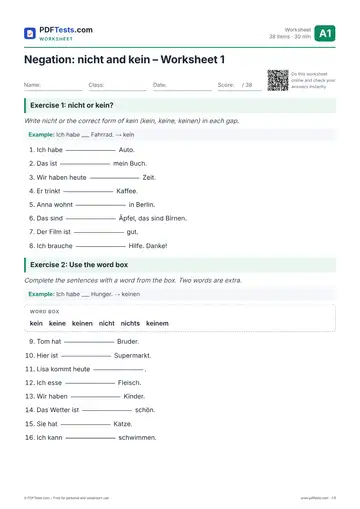
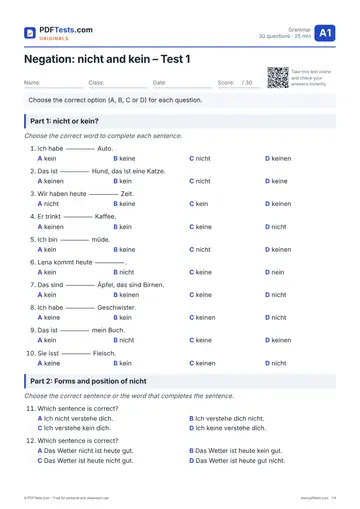
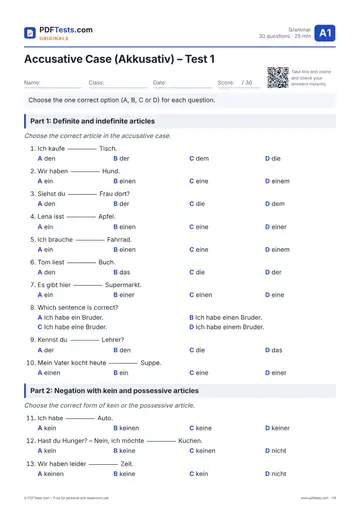
Now put the rules into practice with our A1 nicht and kein test, which mixes article choice, kein endings and the position of nicht. If the keinen forms caused trouble, work through the accusative case guide next, then return to the test. When you feel confident, browse all our German A1 tests to check negation together with other beginner grammar.
Was this page helpful?
What was the problem?
Thank you for your feedback!