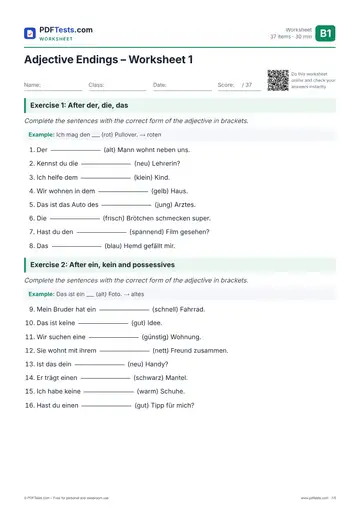
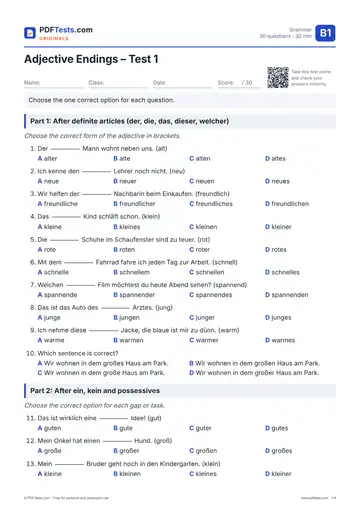
In German, an adjective that stands before a noun takes an ending: der neue Job, ein neuer Job, neuer Schwung. The ending depends on the article (or no article), the gender, the case and whether the noun is singular or plural. Once you see the logic, there are only a few patterns to learn, and most endings are simply -e or -en.
When an adjective needs an ending
An adjective only takes an ending when it comes directly before a noun (attributive use). After verbs like sein, werden and bleiben (predicative use), it has no ending at all.
- Das Auto ist neu. — The car is new.
- Das neue Auto ist rot. — The new car is red.
- Die Suppe wird kalt. — The soup is getting cold.
- Ich mag keine kalte Suppe. — I don’t like cold soup.
Adverbs also have no ending: Sie singt schön. — She sings beautifully.
The key idea: who shows the gender and case?
German wants the gender and case to be visible once in the noun phrase. If the article already shows it clearly, the adjective can relax and take a weak ending (-e or -en). If the article does not show it, or there is no article, the adjective has to do the job itself with a strong ending.
That gives three patterns:
| Pattern | Used after | Example |
|---|---|---|
| Weak | der, die, das, dieser, jeder, welcher, alle | der alte Mann |
| Mixed | ein, kein, mein, dein, sein, ihr, unser, euer | ein alter Mann |
| Strong | no article, numbers, viele, einige, wenige | alter Wein |
the old man – an old man – old wine
If you need a refresher on the article forms themselves, see our guide to der, die, das and the German articles.
Weak endings (after the definite article)
After der/die/das and words that work like them (dieser, jener, jeder, welcher, mancher, alle), the adjective ends in -e or -en.
| Case | Masculine | Feminine | Neuter | Plural |
|---|---|---|---|---|
| Nominative | der alte Mann | die alte Frau | das alte Haus | die alten Häuser |
| Accusative | den alten Mann | die alte Frau | das alte Haus | die alten Häuser |
| Dative | dem alten Mann | der alten Frau | dem alten Haus | den alten Häusern |
| Genitive | des alten Mannes | der alten Frau | des alten Hauses | der alten Häuser |
the old man – the old woman – the old house – the old houses
The rule is short: -e in the five singular boxes of the nominative and in the feminine and neuter accusative; -en everywhere else.
- Dieser schwarze Pullover kostet 40 Euro. — This black jumper costs 40 euros.
- Kennst du den neuen Kollegen? — Do you know the new colleague?
- Alle jungen Leute waren begeistert. — All the young people were thrilled.
Mixed endings (after ein, kein and possessives)
After ein, kein and the possessive articles (mein, dein, sein, ihr, unser, euer, Ihr), the pattern is almost the same as the weak one. The difference is in the three places where the article has no ending: masculine nominative, neuter nominative and neuter accusative. There the adjective takes the strong ending instead.
| Case | Masculine | Feminine | Neuter | Plural |
|---|---|---|---|---|
| Nominative | ein alter Mann | eine alte Frau | ein altes Haus | keine alten Häuser |
| Accusative | einen alten Mann | eine alte Frau | ein altes Haus | keine alten Häuser |
| Dative | einem alten Mann | einer alten Frau | einem alten Haus | keinen alten Häusern |
| Genitive | eines alten Mannes | einer alten Frau | eines alten Hauses | keiner alten Häuser |
an old man – an old woman – an old house – no old houses
Think of it this way: ein alone could be masculine or neuter, so the adjective adds -er or -es to make it clear.
- Mein jüngerer Bruder studiert in Leipzig. — My younger brother is studying in Leipzig.
- Wir haben ein großes Problem. — We have a big problem.
- Sie wohnt mit ihren besten Freundinnen zusammen. — She lives with her best friends.
The possessive articles guide shows all forms of mein, dein, sein and so on, which follow exactly the same pattern as ein and kein.
Strong endings (no article)
When there is no article, the adjective carries the information. Its ending looks like the ending of the definite article: der → -er, das → -es, dem → -em, den → -en.
| Case | Masculine | Feminine | Neuter | Plural |
|---|---|---|---|---|
| Nominative | kalter Kaffee | kalte Milch | kaltes Wasser | kalte Getränke |
| Accusative | kalten Kaffee | kalte Milch | kaltes Wasser | kalte Getränke |
| Dative | kaltem Kaffee | kalter Milch | kaltem Wasser | kalten Getränken |
| Genitive | kalten Kaffees | kalter Milch | kalten Wassers | kalter Getränke |
cold coffee – cold milk – cold water – cold drinks
The only surprise is the masculine and neuter genitive: -en, not -es, because the noun itself already ends in -s.
Strong endings are common with uncountable nouns, plurals and fixed phrases:
- Ich trinke morgens schwarzen Tee. — I drink black tea in the morning.
- Mit freundlichen Grüßen — Kind regards (end of a formal letter)
- Das Brot ist aus frischem Teig. — The bread is made from fresh dough.
Strong endings are also used after numbers and after viele, einige, mehrere, wenige, because these words have no gender ending of their own:
- Wir haben zwei kleine Kinder. — We have two small children.
- Ich habe viele neue Freunde gefunden. — I’ve made lots of new friends.
A three-step method
When you are not sure, ask these questions in order:
- Is there an article? No → use the strong table.
- Is it der/die/das (or dieser, jeder, alle)? Yes → nominative singular and feminine/neuter accusative get -e; everything else -en.
- Is it ein/kein/mein? Then use the weak rule, except where the article has no ending (ein Mann, ein Haus): there use -er (masculine) or -es (neuter).
One useful shortcut: in the dative, the genitive and all plurals with an article, the ending is always -en. You still need to know the case first, so review the accusative and the dative if you hesitate there.
Special cases
Several adjectives
All adjectives before the same noun take the same ending.
- ein großes, helles Zimmer — a big, bright room
- mit den neuen deutschen Kollegen — with the new German colleagues
Adjectives that change their stem
- Adjectives in -el drop the e: dunkel → ein dunkler Raum — a dark room
- Adjectives in -er after au/eu drop the e: teuer → ein teures Hotel — an expensive hotel; sauer → saure Gurken — pickled gherkins
- hoch loses the c: ein hoher Berg — a high mountain
Adjectives with no ending
Some colour words from other languages, such as lila, rosa and beige, normally stay unchanged in standard German: ein lila Kleid — a purple dress. Adjectives formed from city names with -er never change: der Berliner Bahnhof, in einer Wiener Bäckerei — the Berlin station, in a Viennese bakery.
Comparatives and superlatives
Before a noun, comparatives and superlatives take the same endings as any other adjective.
- Ich suche eine größere Wohnung. — I’m looking for a bigger flat.
- Das ist das beste Restaurant der Stadt. — That’s the best restaurant in town.
For the forms themselves, see our guide to the comparative and superlative.
Adjectives used as nouns
Adjectives can become nouns and keep their endings: der Deutsche, ein Deutscher — the German, a German (man). After etwas, nichts, viel, wenig they are neuter with a strong ending: etwas Neues — something new, nichts Besonderes — nothing special.
Common mistakes
- ✗ Das Wetter ist schönes. → ✓ Das Wetter ist schön. — The weather is nice. No ending after sein.
- ✗ Ich habe ein neue Handy. → ✓ Ich habe ein neues Handy. — I have a new phone. Ein does not show the neuter, so the adjective takes -es.
- ✗ Er fährt mit dem neue Auto. → ✓ Er fährt mit dem neuen Auto. — He drives the new car. Dative always needs -en after an article.
- ✗ Ich trinke heiße Kaffee. → ✓ Ich trinke heißen Kaffee. — I drink hot coffee. Masculine accusative without an article is -en.
- ✗ Wir treffen uns mit gute Freunden. → ✓ Wir treffen uns mit guten Freunden. — We meet up with good friends. Dative plural is -en in all three patterns.
- ✗ ein teuerer Laptop → ✓ ein teurer Laptop — an expensive laptop. Teuer drops the e before an ending.
- ✗ ein großer, schönes Garten → ✓ ein großer, schöner Garten — a big, beautiful garden. Parallel adjectives share one ending.
Quick check
Fill in the missing ending.
- Ich wohne in einer klein___ Wohnung. — I live in a small flat.
- Das ist ein interessant___ Buch. — That’s an interesting book.
- Wir trinken heiß___ Tee. — We’re drinking hot tea.
- Der neu___ Kollege kommt aus Wien. — The new colleague is from Vienna.
- Sie hat zwei klug___ Kinder. — She has two clever children.
Answers
- kleinen — dative feminine after einer.
- interessantes — neuter nominative after ein, which shows no gender.
- heißen — masculine accusative, no article (strong).
- neue — masculine nominative after der (weak).
- kluge — plural after a number (strong).
Next step
Adjective endings become automatic only with practice, so work through the tables one pattern at a time and then mix them. When you feel ready, test yourself with our B1 Adjective Endings test, and note which case or pattern causes most of your errors. Go back to that table, write five sentences of your own about your home, your clothes or your job, and repeat the test a few days later.
Practise this topic: German Adjective Endings
Was this page helpful?
What was the problem?
Thank you for your feedback!