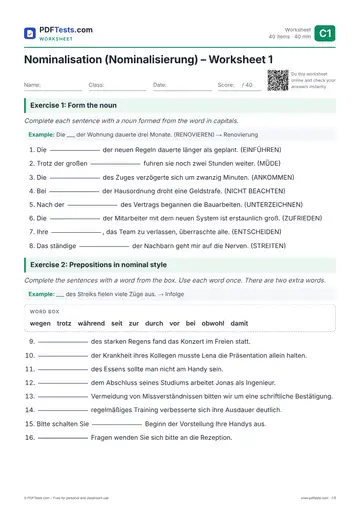
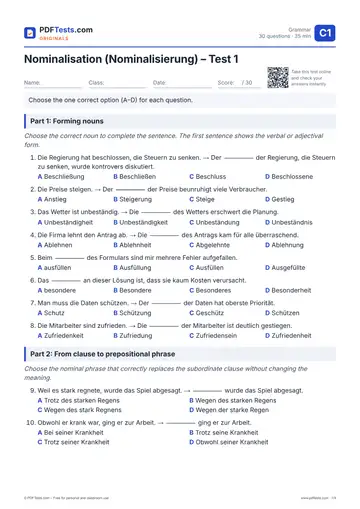
Nominalisation (Nominalisierung) means turning verbs, adjectives or whole clauses into nouns and noun phrases. For example, weil die Preise steigen becomes wegen des Anstiegs der Preise. It is the core of the Nominalstil used in academic, legal, journalistic and official German, and C1 exams regularly ask you to transform sentences between verbal and nominal style.
What nominalisation means
Nominalisation works on two levels:
- Word level: a verb or adjective becomes a noun: entscheiden → die Entscheidung, frei → die Freiheit.
- Sentence level: a subordinate clause becomes a prepositional phrase built around that noun: Nachdem er angekommen war, … → Nach seiner Ankunft …
The second level is what makes German formal texts look so dense. The information stays the same, but the clause, its conjunction and its conjugated verb disappear.
When to use the nominal style
Use the nominal style in:
- academic essays, reports and presentations
- official letters, regulations and contracts
- news reports and headlines
- exam writing tasks and transformation exercises
Wegen Bauarbeiten bleibt die Strecke bis Freitag gesperrt. Due to construction work, the line will remain closed until Friday.
Bei Nichtbeachtung der Hausordnung kann der Mietvertrag gekündigt werden. If the house rules are not observed, the tenancy agreement may be terminated.
In conversation and informal emails, the verbal style (Verbalstil) with clauses sounds more natural. A good C1 writer can move between both.
Forming nouns from verbs and adjectives
There is no single rule for which noun belongs to which verb, so learn these nouns as vocabulary. The patterns below cover most cases.
| Pattern | Example | Gender |
|---|---|---|
| Infinitive as noun | lesen → das Lesen | always neuter |
| Stem + -ung | entwickeln → die Entwicklung | always feminine |
| Bare stem, often with vowel change | steigen → der Anstieg, beschließen → der Beschluss | usually masculine |
| Stem + -e | suchen → die Suche, abreisen → die Abreise | usually feminine |
| Stem + -t / -ft | ankommen → die Ankunft, fahren → die Fahrt | feminine |
| Stem + -nis | ergeben → das Ergebnis, erlauben → die Erlaubnis | neuter or feminine |
| Adjective + -heit / -keit | frei → die Freiheit, möglich → die Möglichkeit | feminine |
| Adjective + -e (often with umlaut) | groß → die Größe, lang → die Länge | feminine |
| Adjective as noun | neu → das Neue, krank → der/die Kranke | depends on meaning |
The nominalised infinitive works with almost any verb. It is useful when no other noun exists or when you want to stress the process:
Das ständige Unterbrechen stört die Konzentration. The constant interrupting disturbs concentration.
Some verbs have more than one noun with different meanings: der Bau (the construction, the building) vs das Bauen (the activity of building).
Turning clauses into noun phrases
The transformation rules
When a clause becomes a noun phrase, every part of the clause changes in a predictable way.
| In the clause | In the noun phrase | Example |
|---|---|---|
| verb | noun | steigen → der Anstieg |
| subject (intransitive verb) | genitive | Die Preise steigen. → der Anstieg der Preise |
| accusative object | genitive | Man baut die Brücke. → der Bau der Brücke |
| subject + object together | object = genitive, subject = durch + Acc. | die Reform des Rentensystems durch die Regierung |
| personal pronoun | possessive article | wenn er ankommt → bei seiner Ankunft |
| adverb | declined adjective | Er reagiert schnell. → seine schnelle Reaktion |
| prepositional object | stays prepositional | Viele beteiligen sich an der Wahl. → die Beteiligung vieler an der Wahl |
| plural noun without article | von + Dat. | Man exportiert Autos. → der Export von Autos |
Two details matter here. First, a genitive needs an article or an adjective to show the case, so der Export Autos is impossible, while der Export deutscher Autos is correct. Second, the preposition can change: sich interessieren für → das Interesse an. Check the noun in a dictionary.
Modal verbs usually turn into a noun or adjective that carries their meaning:
Weil sie gut Englisch kann, bekam sie die Stelle. → Aufgrund ihrer guten Englischkenntnisse bekam sie die Stelle. Because she speaks good English, she got the job.
Weil man in der Innenstadt nicht parken kann, … → Wegen fehlender Parkmöglichkeiten in der Innenstadt … Because you can’t park in the city centre … / Due to a lack of parking in the city centre …
Typical equivalents: können → Möglichkeit, Fähigkeit; müssen → Notwendigkeit, Pflicht; wollen → Wunsch, Absicht; dürfen → Erlaubnis.
From conjunction to preposition
Each subordinating conjunction (see our guide to subordinate clauses with weil, dass and wenn) has a prepositional partner. Note the case each preposition takes.
| Clause | Noun phrase | Case | Example (nominal style) |
|---|---|---|---|
| weil, da | wegen, aufgrund | Gen. | Wegen des starken Regens fiel das Konzert aus. |
| obwohl | trotz | Gen. | Trotz seiner Krankheit ging er zur Arbeit. |
| wenn, als (time) | bei | Dat. | Bei unserer Ankunft war das Hotel schon voll. |
| wenn, falls (condition) | bei, im Falle | Dat. / Gen. | Im Falle eines Brandes den Aufzug nicht benutzen. |
| bevor | vor | Dat. | Vor ihrer Abreise verabschiedete sie sich von allen. |
| nachdem | nach | Dat. | Nach der Unterzeichnung des Vertrags begann die Arbeit. |
| während | während | Gen. | Während seines Studiums arbeitete er in einem Café. |
| seit | seit | Dat. | Seit ihrem Umzug fährt sie mit dem Rad zur Arbeit. |
| bis | bis zu | Dat. | Bis zur Fertigstellung des Gebäudes arbeitet das Team im Altbau. |
| damit, um … zu | zu, für | Dat. / Acc. | Zur Senkung der Kosten wurden Stellen gestrichen. |
| indem | durch | Acc. | Durch das Sparen von Energie senkt man die Rechnung. |
| ohne … zu | ohne | Acc. | Sie unterschrieb den Vertrag ohne Prüfung. |
Translations, in order: The concert was cancelled because of the heavy rain. / Despite his illness he went to work. / When we arrived the hotel was already full. / In case of fire, do not use the lift. / Before her departure she said goodbye to everyone. / After the contract was signed, work began. / During his studies he worked in a café. / Since her move she has cycled to work. / Until the building is completed, the team is working in the old building. / Jobs were cut to reduce costs. / By saving energy you lower the bill. / She signed the contract without checking it.
For the genitive prepositions in this table, review our guide to the genitive case and genitive prepositions.
A worked example
Weil die Mieten in den Großstädten stark gestiegen sind, ziehen viele Familien aufs Land. Because rents in the big cities have risen sharply, many families are moving to the countryside.
- weil → aufgrund (+ genitive)
- steigen → der Anstieg
- subject die Mieten → genitive der Mieten
- adverb stark → adjective der starke Anstieg, here in the genitive: des starken Anstiegs
- in den Großstädten stays as it is
Aufgrund des starken Anstiegs der Mieten in den Großstädten ziehen viele Familien aufs Land. Due to the sharp rise in rents in the big cities, many families are moving to the countryside.
The prepositional phrase now fills position 1, so the conjugated verb ziehen follows directly in position 2. The tense of the original clause disappears; context or words like vor and nach carry the time relation.
From nominal back to verbal style
Exams also test the reverse direction. Work backwards: preposition → conjunction, noun → verb, genitive → subject or object, possessive → pronoun, adjective → adverb.
Nach der Einführung des neuen Systems durch die Firma sanken die Kosten. → Nachdem die Firma das neue System eingeführt hatte, sanken die Kosten. After the company introduced the new system, costs fell.
Wegen seiner Erkrankung konnte er nicht teilnehmen. → Weil er erkrankt war, konnte er nicht teilnehmen. Because he was ill, he couldn’t take part.
Now you must choose a tense again. Nachdem needs the earlier tense: Plusquamperfekt before a Präteritum main clause. If no agent is named, a passive or man is often the best choice: Nach der Einführung des Systems → Nachdem das System eingeführt worden war.
Nominal style vs verbal style
| Verbal style | Nominal style | |
|---|---|---|
| Typical text | speech, emails, stories | reports, academic texts, regulations |
| Structure | main clause + subordinate clause | one clause with a noun phrase |
| Effect | clear, dynamic, personal | compact, objective, impersonal |
| Risk | long chains of clauses | heavy, hard-to-read noun stacks |
Avoid piling up more than two genitives: die Verbesserung der Qualität der Ausbildung der Lehrkräfte is grammatical but tiring to read. In such cases, put one part back into a clause.
Nominal style also relies on fixed noun-verb combinations such as zur Verfügung stellen, in Betracht ziehen or eine Entscheidung treffen. You can practise these with our B2 Noun-Verb Collocations test.
Capitalisation and endings
Nominalised infinitives and adjectives are nouns, so they are capitalised. They often follow contracted prepositions:
Beim Kochen höre ich Podcasts. I listen to podcasts while cooking.
Zum Unterschreiben brauchen Sie einen Ausweis. You need ID to sign.
After etwas, nichts, viel and wenig, nominalised adjectives take strong neuter endings: etwas Neues, nichts Besonderes, mit etwas Neuem. Adverbs that become adjectives must take the correct ending too; revise them in our guide to adjective endings.
Common mistakes
- ✗ Wegen dem starken Regen … (in formal writing) → ✓ Wegen des starken Regens … – formal texts expect the genitive; the dative is colloquial.
- ✗ Trotz er krank war, … → ✓ Trotz seiner Krankheit … / Obwohl er krank war, … – trotz is a preposition and cannot introduce a clause.
- ✗ Nachdem der Unterzeichnung … → ✓ Nach der Unterzeichnung … – nachdem is a conjunction; the preposition is nach.
- ✗ die Anstieg der Preise → ✓ der Anstieg der Preise – nouns from bare stems are usually masculine.
- ✗ bei die Ankunft → ✓ bei der Ankunft – bei always takes the dative.
- ✗ der Export Autos → ✓ der Export von Autos – without an article or adjective, use von + dative.
- ✗ seine schnell Reaktion → ✓ seine schnelle Reaktion – the adverb becomes an adjective and needs an ending.
- ✗ die Teilnahme des Kurses → ✓ die Teilnahme am Kurs – prepositional objects keep their preposition.
- ✗ beim lesen → ✓ beim Lesen – a nominalised infinitive is capitalised.
Quick check
Rewrite in the style indicated.
- Obwohl das Wetter schlecht war, fand das Fest statt. (nominal)
- Bevor der Film beginnt, schalten Sie bitte Ihr Handy aus. (nominal)
- Nachdem sie ihr Studium abgeschlossen hatte, zog sie nach Wien. (nominal)
- Um die Qualität zu verbessern, investiert die Firma in Schulungen. (nominal)
- Bei Nichtbeachtung der Regeln droht ein Bußgeld. (verbal)
Answers
- Trotz des schlechten Wetters fand das Fest statt. – Despite the bad weather, the festival took place.
- Vor (dem) Beginn des Films schalten Sie bitte Ihr Handy aus. – Please switch off your phone before the film starts.
- Nach dem Abschluss ihres Studiums zog sie nach Wien. – After finishing her degree, she moved to Vienna.
- Zur Verbesserung der Qualität investiert die Firma in Schulungen. – To improve quality, the company invests in training.
- Wenn man die Regeln nicht beachtet, droht ein Bußgeld. – If you don’t follow the rules, you face a fine.
Next step
Nominalisation becomes automatic only with practice, so take our C1 Nominalisation test and transform a few sentences from a newspaper article each day in both directions. Because nominal style depends heavily on precise nouns, continue with the C1 Academic and Formal Vocabulary test to build the word stock that formal German requires.
Was this page helpful?
What was the problem?
Thank you for your feedback!