PDFTests Originals

Verbal Periphrases (perífrasis verbales) – Worksheet 1

C1 Advanced WorksheetSpanish

This worksheet practises Spanish verbal periphrases (perífrasis verbales) at C1 level. It covers their form, meaning and use, including negatives and questions. Learners work with aspectual, modal and phase periphrases such as llevar + gerundio, llevar sin + infinitivo, volver a, echarse a, romper a, deber de and tener + participio. It is aimed at advanced learners who want to sound more precise and natural.
items
40
Time
40 min
PDF
5 pages
Answer key
Included
  • 100% free
  • No sign-up or email
  • Print-ready A4 PDF
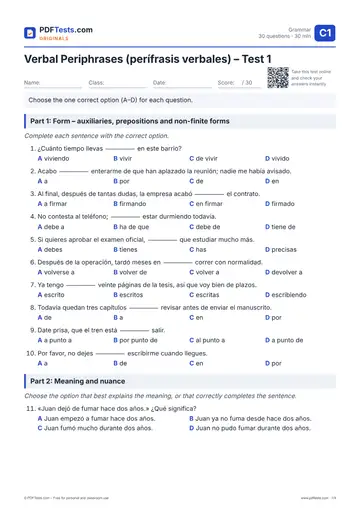
Preview of page 1 of Verbal Periphrases (perífrasis verbales) – Worksheet 1 Open PDF
New to this topic? Read the guide first: Spanish Verbal Periphrases (perífrasis verbales): Uses, Forms and Common Mistakes

Do the worksheet online

Type your answers, then press “Check my answers”. Alternative correct answers are accepted.

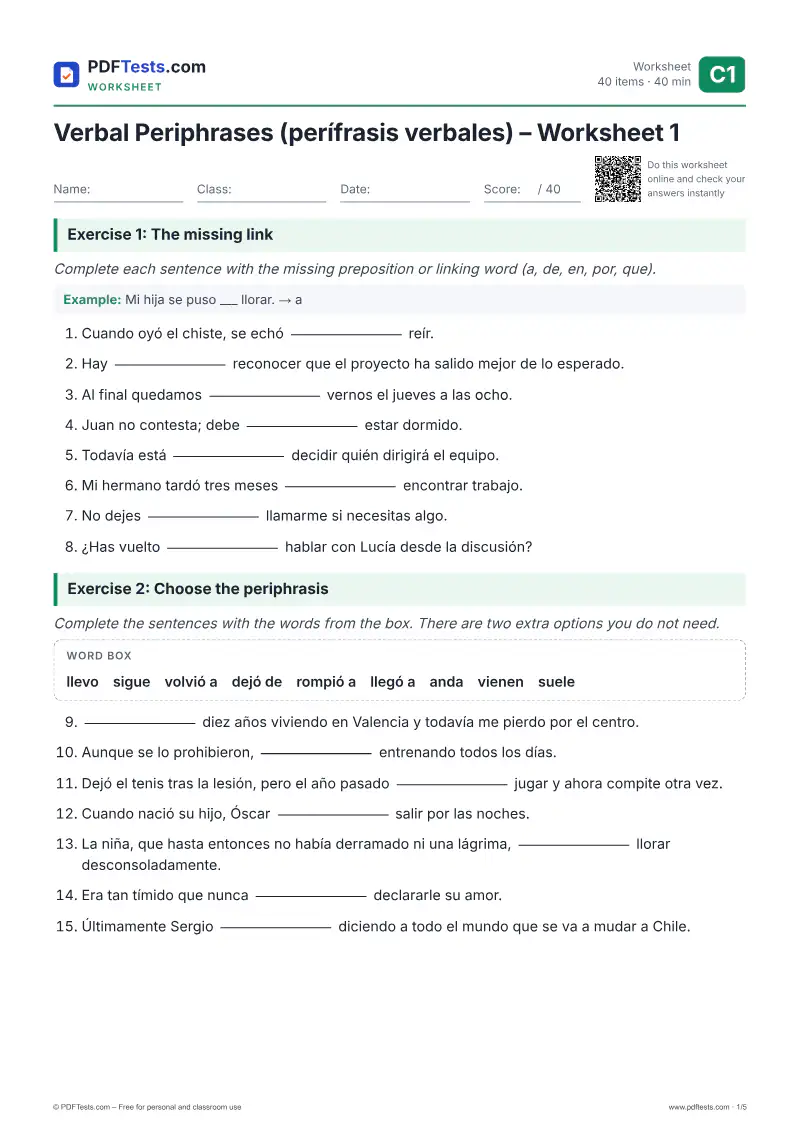
Exercise 1: The missing link

Complete each sentence with the missing preposition or linking word (a, de, en, por, que).

Example: Mi hija se puso ___ llorar. → a

  1. Cuando oyó el chiste, se echó reír.

  2. Hay reconocer que el proyecto ha salido mejor de lo esperado.

  3. Al final quedamos vernos el jueves a las ocho.

  4. Juan no contesta; debe estar dormido.

  5. Todavía está decidir quién dirigirá el equipo.

  6. Mi hermano tardó tres meses encontrar trabajo.

  7. No dejes llamarme si necesitas algo.

  8. ¿Has vuelto hablar con Lucía desde la discusión?

Exercise 2: Choose the periphrasis

Complete the sentences with the words from the box. There are two extra options you do not need.

Word box llevosiguevolvió adejó derompió allegó aandavienensuele

  1. diez años viviendo en Valencia y todavía me pierdo por el centro.

  2. Aunque se lo prohibieron, entrenando todos los días.

  3. Dejó el tenis tras la lesión, pero el año pasado jugar y ahora compite otra vez.

  4. Cuando nació su hijo, Óscar salir por las noches.

  5. La niña, que hasta entonces no había derramado ni una lágrima, llorar desconsoladamente.

  6. Era tan tímido que nunca declararle su amor.

  7. Últimamente Sergio diciendo a todo el mundo que se va a mudar a Chile.

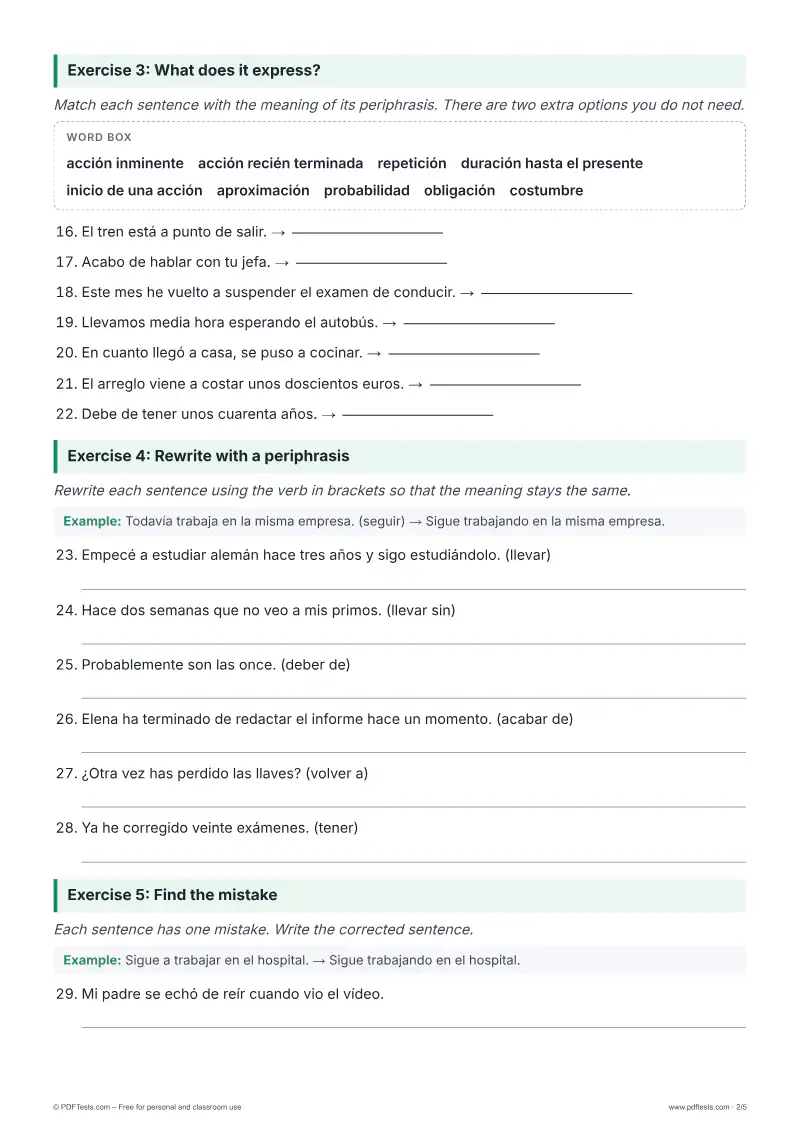
Exercise 3: What does it express?

Match each sentence with the meaning of its periphrasis. There are two extra options you do not need.

Word box acción inminenteacción recién terminadarepeticiónduración hasta el presenteinicio de una acciónaproximaciónprobabilidadobligacióncostumbre

  1. El tren está a punto de salir.

  2. Acabo de hablar con tu jefa.

  3. Este mes he vuelto a suspender el examen de conducir.

  4. Llevamos media hora esperando el autobús.

  5. En cuanto llegó a casa, se puso a cocinar.

  6. El arreglo viene a costar unos doscientos euros.

  7. Debe de tener unos cuarenta años.

Exercise 4: Rewrite with a periphrasis

Rewrite each sentence using the verb in brackets so that the meaning stays the same.

Example: Todavía trabaja en la misma empresa. (seguir) → Sigue trabajando en la misma empresa.

  1. Empecé a estudiar alemán hace tres años y sigo estudiándolo. (llevar)

  2. Hace dos semanas que no veo a mis primos. (llevar sin)

  3. Probablemente son las once. (deber de)

  4. Elena ha terminado de redactar el informe hace un momento. (acabar de)

  5. ¿Otra vez has perdido las llaves? (volver a)

  6. Ya he corregido veinte exámenes. (tener)

Exercise 5: Find the mistake

Each sentence has one mistake. Write the corrected sentence.

Example: Sigue a trabajar en el hospital. → Sigue trabajando en el hospital.

  1. Mi padre se echó de reír cuando vio el vídeo.

  2. Llevamos tres horas esperado en la cola.

  3. No suelo a cenar tan tarde.

  4. Dejó fumar hace dos meses.

  5. ¿Vuelves de llamar a la agencia mañana?

  6. Tengo escrito tres capítulos de la tesis.

Exercise 6: Put the words in order

Put the words in the correct order to make sentences. Add punctuation where needed.

  1. lleva / sin / Carmen / hablar / con su hermana / un mes

  2. a / punto / de / estábamos / cuando / salir / sonó el teléfono

  3. no / de / dejes / practicar / todos los días

  4. qué / vas / a / hacer / este verano

  5. hay / que / los formularios / rellenar / antes del viernes

  6. acabó / aceptando / la propuesta / el director

Was this page helpful?

Report a mistake

Spotted a wrong answer, a typo or an unclear explanation? Tell us and we will fix it.

Preview

About this test

C1 Spanish worksheet on verbal periphrases: llevar + gerundio, volver a, dejar de, deber de, tener + participio and more. Printable with answers.

Topics covered

Verbal periphrasesInfinitive periphrasesGerund periphrasesParticiple periphrasesAspect and modalityPrepositions in periphrases

Notes for teachers

Start by eliciting the meaning of each periphrasis (beginning, repetition, duration, probability, etc.) before learners attempt the controlled exercises. Typical mistakes are wrong or missing prepositions (*soler a, *dejar fumar), and the use of the participle instead of the gerund after llevar. Other frequent errors are forgetting participle agreement with tener + participio (tengo escritos tres capítulos) and confusing deber (obligation) with deber de (probability). As a follow-up, ask learners to write a short paragraph about changes in their life using at least six different periphrases.

All Spanish C1 tests →