PDFTests Originals

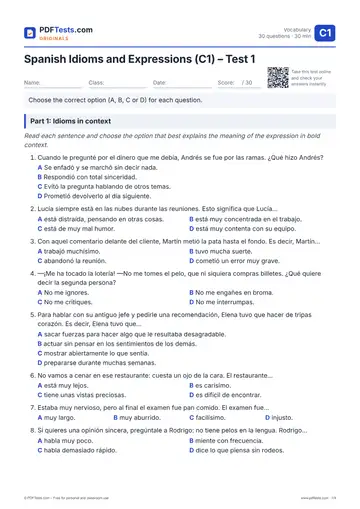
Spanish Idioms and Expressions (C1) – Worksheet 1

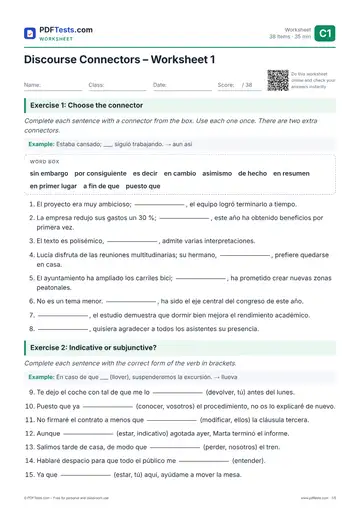
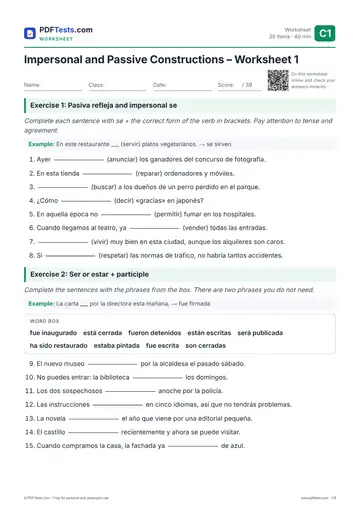
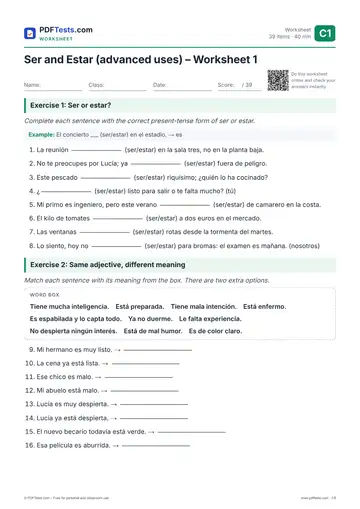
C1 Advanced WorksheetSpanish

This worksheet helps advanced learners of Spanish use common idiomatic expressions such as tomar el pelo, meter la pata and ponerse las pilas in natural contexts. It moves from matching idioms with their meanings to completing, correcting and producing them with accurate verb forms. It is designed for C1 learners in class or for independent study.
items
40
Time
40 min
PDF
5 pages
Answer key
Included
  • 100% free
  • No sign-up or email
  • Print-ready A4 PDF
Preview of page 1 of Spanish Idioms and Expressions (C1) – Worksheet 1 Open PDF

Do the worksheet online

Type your answers, then press “Check my answers”. Alternative correct answers are accepted.

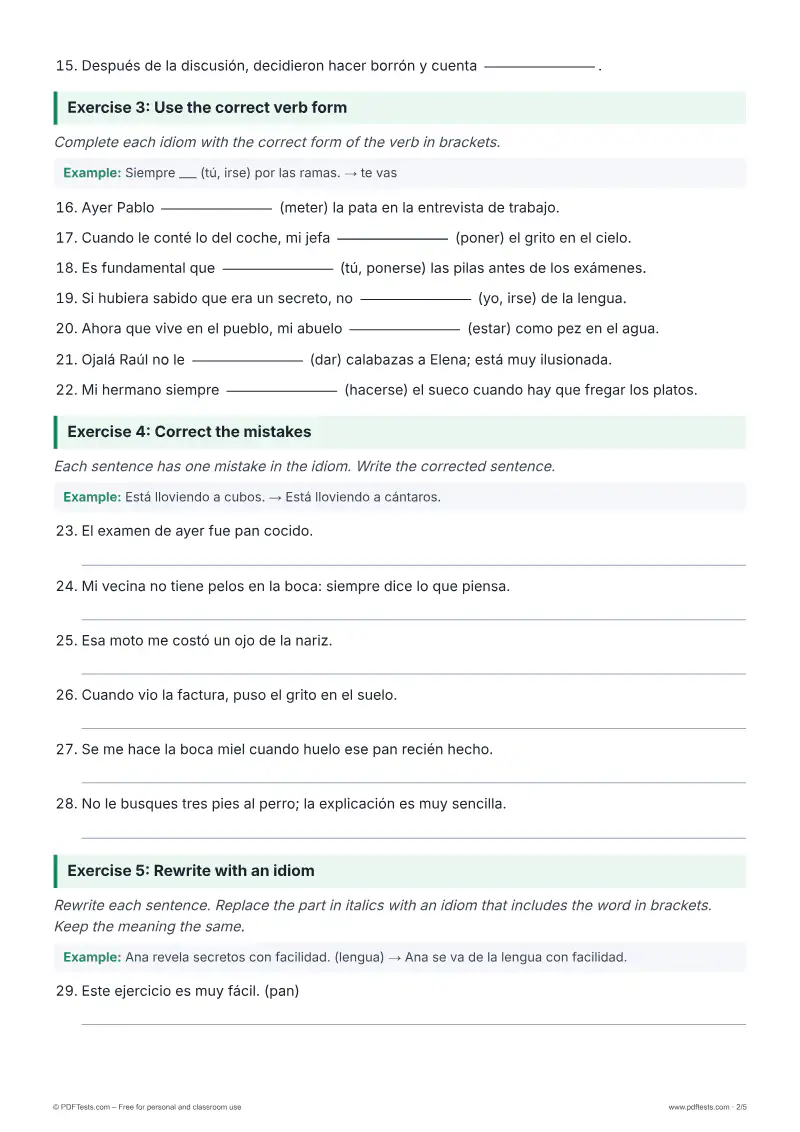
Exercise 1: Match the idioms with their meanings

Match each idiom with its meaning from the box. There is one extra meaning you do not need.

Example: echar una mano → ayudar a alguien

Word box burlarse de alguienestar distraídoser muy carohablar con total franquezacometer un error inoportunoempezar a esforzarse en serioser muy fácilfingir no enterarseestar agotado

  1. tomar el pelo

  2. estar en las nubes

  3. costar un ojo de la cara

  4. no tener pelos en la lengua

  5. meter la pata

  6. ponerse las pilas

  7. ser pan comido

  8. hacerse el sueco

Exercise 2: Complete the idioms

Complete each sentence with a word from the box. There are two extra words.

Example: ¿Me echas una ___ con estas cajas? → mano

Word box pelogranopilaspataojonubesnuevadientecabeza

  1. Lucía, ¿me estás tomando el ? No me creo que hayas ganado la lotería.

  2. Deja de dar rodeos y ve al : ¿qué ha pasado?

  3. Si queréis aprobar en junio, tendréis que poneros las .

  4. Metí la al mencionar la fiesta sorpresa delante de Andrés.

  5. Ese ático en el centro cuesta un de la cara.

  6. Hoy Marcos está en las ; no se ha enterado de nada en la reunión.

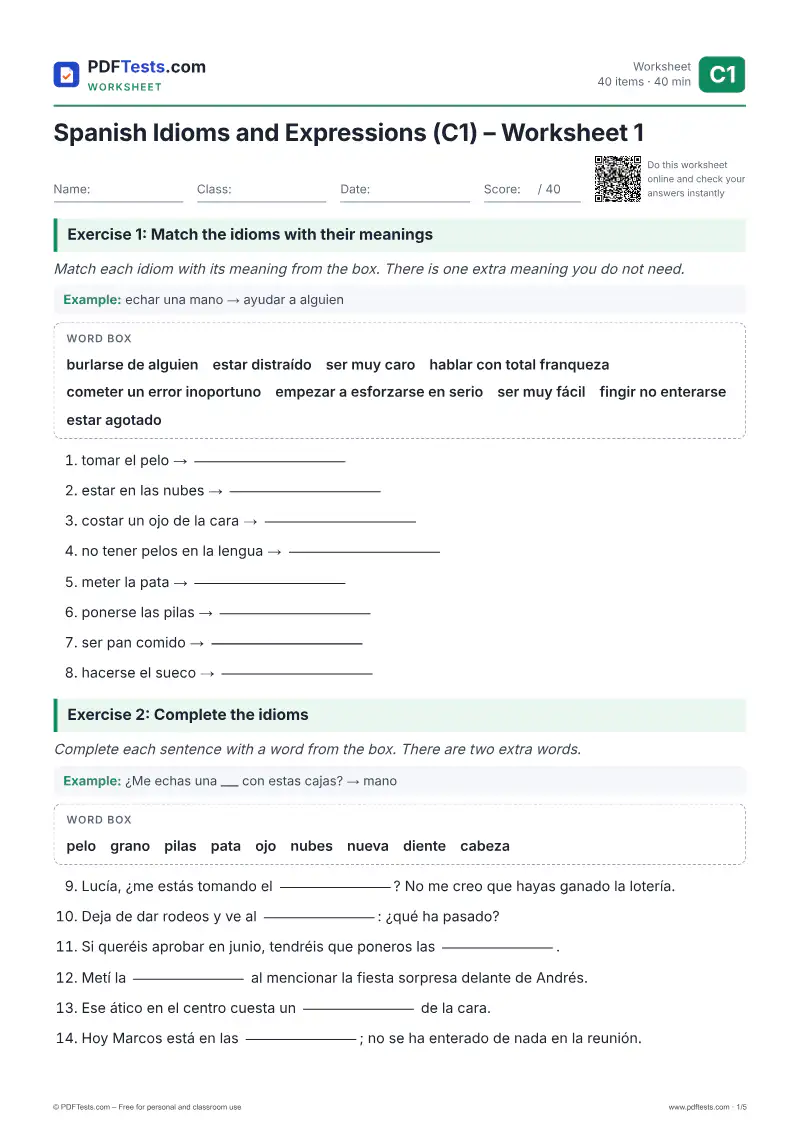
  7. Después de la discusión, decidieron hacer borrón y cuenta .

Exercise 3: Use the correct verb form

Complete each idiom with the correct form of the verb in brackets.

Example: Siempre ___ (tú, irse) por las ramas. → te vas

  1. Ayer Pablo (meter) la pata en la entrevista de trabajo.

  2. Cuando le conté lo del coche, mi jefa (poner) el grito en el cielo.

  3. Es fundamental que (tú, ponerse) las pilas antes de los exámenes.

  4. Si hubiera sabido que era un secreto, no (yo, irse) de la lengua.

  5. Ahora que vive en el pueblo, mi abuelo (estar) como pez en el agua.

  6. Ojalá Raúl no le (dar) calabazas a Elena; está muy ilusionada.

  7. Mi hermano siempre (hacerse) el sueco cuando hay que fregar los platos.

Exercise 4: Correct the mistakes

Each sentence has one mistake in the idiom. Write the corrected sentence.

Example: Está lloviendo a cubos. → Está lloviendo a cántaros.

  1. El examen de ayer fue pan cocido.

  2. Mi vecina no tiene pelos en la boca: siempre dice lo que piensa.

  3. Esa moto me costó un ojo de la nariz.

  4. Cuando vio la factura, puso el grito en el suelo.

  5. Se me hace la boca miel cuando huelo ese pan recién hecho.

  6. No le busques tres pies al perro; la explicación es muy sencilla.

Exercise 5: Rewrite with an idiom

Rewrite each sentence. Replace the part in italics with an idiom that includes the word in brackets. Keep the meaning the same.

Example: Ana revela secretos con facilidad. (lengua) → Ana se va de la lengua con facilidad.

  1. Este ejercicio es muy fácil. (pan)

  2. Tienes que empezar a esforzarte si quieres conseguir el puesto. (pilas)

  3. Diego siempre finge no enterarse cuando le pedimos dinero. (sueco)

  4. Estoy harto de sus excusas. (narices)

  5. Llovía muchísimo cuando salimos del cine. (cántaros)

  6. Carmen se enfadó muchísimo al ver el desorden. (grito)

Exercise 6: Put the words in order

Put the words in the correct order to make a sentence with an idiom.

Example: Iván / por / se / las / va / ramas → Iván se va por las ramas.

  1. está / a / tiro / de / piedra / la estación

  2. no / pelos / en / la / tiene / lengua / Rosa

  3. nos / dar / no / gato / por / liebre / dejemos

  4. agua / boca / la / me / hace / se

  5. siempre / ramas / se / las / por / va / Iván

  6. mano / echarte / puedo / una

Was this page helpful?

Report a mistake

Spotted a wrong answer, a typo or an unclear explanation? Tell us and we will fix it.

Preview

About this test

Printable C1 Spanish worksheet on idioms and expressions: meanings, missing words, verb forms, error correction and rewriting. Answers included.

Topics covered

Spanish idiomsFixed expressionsCollocationsVerb conjugation in idiomsSubjunctive and conditional in context

Notes for teachers

Start with Exercise 1 to check that learners understand the idioms, then ask them to guess where each image comes from (pelo, pata, pilas) before doing the controlled tasks. Learners often change fixed elements, for example saying pan cocido or el grito en el suelo, and they sometimes forget the reflexive pronoun in irse de la lengua or hacerse el sueco. As a follow-up, ask pairs to write a short dialogue using at least five idioms from the worksheet and act it out for the class.

All Spanish C1 tests →