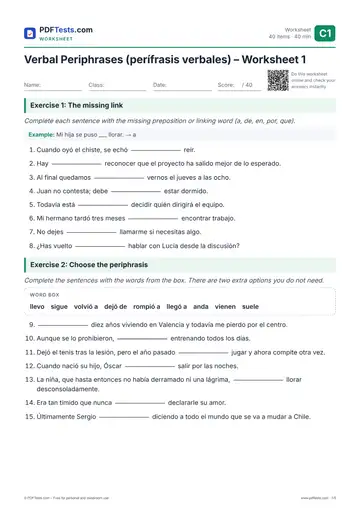
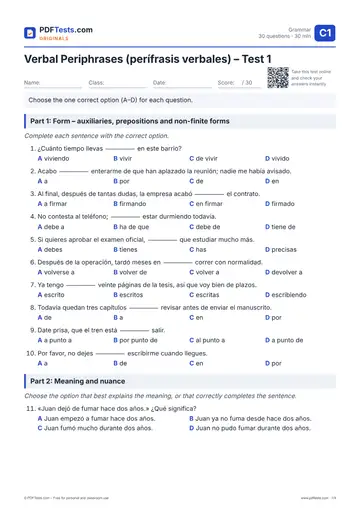
A verbal periphrasis (perífrasis verbal) is a combination of a conjugated auxiliary verb, often a linking word, and a non-finite form: an infinitive, a gerund or a past participle. Together they work as a single verb and express obligation, probability, the start, continuation or end of an action, repetition or an accumulated result. At C1 you are expected to use the full range precisely, especially the pairs that differ by one small word.
What makes a periphrasis
In a true periphrasis the auxiliary partly or fully loses its literal meaning. Compare:
- Vengo a recogerte. — I’m coming to pick you up. (real movement: not a periphrasis)
- El piso viene a costar unos 300.000 euros. — The flat costs roughly 300,000 euros. (no movement: periphrasis of approximation)
The basic pattern is:
| Auxiliary (conjugated) | Link (if any) | Non-finite form |
|---|---|---|
| tengo | que | trabajar |
| dejó | de | fumar |
| llevamos | — | esperando |
| tengo | — | corregidos |
Only the auxiliary changes for person and tense: tenía que trabajar, tendré que trabajar, tuviera que trabajar.
Infinitive periphrases
Modal: obligation, necessity and probability
| Periphrasis | Meaning | Example |
|---|---|---|
| tener que + inf. | personal obligation | Tengo que entregar el informe hoy. — I have to hand in the report today. |
| haber que + inf. | impersonal necessity | Hay que reservar con antelación. — You need to book in advance. |
| deber + inf. | obligation, moral duty | Debes respetar los plazos. — You must respect the deadlines. |
| deber de + inf. | probability, supposition | Deben de ser las tres. — It must be about three o’clock. |
| haber de + inf. | formal obligation or future | Has de saber que no fue culpa tuya. — You should know it wasn’t your fault. |
| poder + inf. | possibility, permission | Puede haber retrasos. — There may be delays. |
Haber que is impersonal: it only appears in the third person singular (hay que, había que, habrá que, habría que) and never has a subject.
Aspectual and phase periphrases
| Periphrasis | Meaning | Example |
|---|---|---|
| empezar / comenzar a + inf. | start | Empezó a llover. — It started to rain. |
| ponerse a + inf. | start (often deliberately) | Me puse a estudiar a las ocho. — I got down to studying at eight. |
| echarse a + inf. | sudden start (emotion, movement) | Se echó a reír. — She burst out laughing. |
| romper a + inf. | sudden start (formal, literary) | El niño rompió a llorar. — The child burst into tears. |
| estar a punto de + inf. | imminence | Estaba a punto de salir. — I was about to leave. |
| ir a + inf. | intention, near future | Voy a cambiar de trabajo. — I’m going to change jobs. |
| acabar de + inf. | very recent past | Acaban de llegar. — They have just arrived. |
| dejar de + inf. | stop | Dejé de fumar hace años. — I stopped smoking years ago. |
| volver a + inf. | repetition | No vuelvas a hacerlo. — Don’t do it again. |
| llegar a + inf. | culmination, extreme point | Llegó a ser ministra. — She went as far as becoming a minister. |
| venir a + inf. | approximation | Viene a tardar una hora. — It takes about an hour. |
| acabar por + inf. | final outcome | Acabó por aceptar. — He ended up accepting. |
| estar por + inf. | pending; inclination | La cocina está por limpiar. — The kitchen is yet to be cleaned. |
Echarse a combines with a small set of verbs: llorar, reír, correr, temblar, dormir. For intentional activities such as studying or cooking, use ponerse a. For more on ir a, see our guide to ir a + infinitive and the future tense.
Gerund periphrases
Gerund periphrases present an action as ongoing, developing or repeated.
| Periphrasis | Meaning | Example |
|---|---|---|
| estar + ger. | action in progress | Estamos revisando el contrato. — We’re reviewing the contract. |
| seguir / continuar + ger. | continuation | Sigue lloviendo. — It’s still raining. |
| llevar + time + ger. | duration up to now | Llevo dos años viviendo aquí. — I’ve been living here for two years. |
| ir + ger. | gradual progress | La situación va mejorando. — The situation is gradually improving. |
| venir + ger. | action repeated from the past to now | Te lo vengo diciendo desde marzo. — I’ve been telling you since March. |
| andar + ger. | repeated, often aimless or disapproved | Anda contando mentiras. — He goes around telling lies. |
| acabar / terminar + ger. | final outcome | Acabamos cenando en casa. — We ended up having dinner at home. |
| quedarse + ger. | remaining in an activity | Se quedó mirando la pantalla. — He sat there staring at the screen. |
Two details matter at this level:
- The negative of llevar + gerund is llevar + time + sin + infinitive: Llevo tres noches sin dormir. — I haven’t slept for three nights.
- Seguir also takes sin + infinitive: Sigue sin contestar. — She still hasn’t answered.
Participle periphrases
Participle periphrases focus on a result. The participle agrees in gender and number with the direct object (or with the subject, for quedar and estar).
| Periphrasis | Meaning | Example |
|---|---|---|
| tener + part. | accumulated result | Tengo corregidos veinte exámenes. — I’ve got twenty exams marked. |
| llevar + part. | result accumulated so far | Llevamos vendidas quinientas entradas. — We’ve sold five hundred tickets so far. |
| dejar + part. | result left by the subject | Dejé preparada la cena. — I left dinner ready. |
| quedar + part. | resulting state | La cuestión quedó resuelta. — The matter was settled. |
| dar por + part. | considering something done | Doy por terminada la reunión. — I consider the meeting closed. |
Compare He corregido veinte exámenes (neutral perfect, invariable participle) with Tengo corregidos veinte exámenes (the marked exams are a result I now have, participle agrees). The estar + participle construction is close to these and is covered in our guide to advanced uses of ser and estar.
Pronoun placement
With infinitive and gerund periphrases, object and reflexive pronouns go either before the conjugated auxiliary or attached to the end of the non-finite form. Both are correct; they must not be split.
- Te lo voy a explicar. / Voy a explicártelo. — I’m going to explain it to you.
- Se están quejando. / Están quejándose. — They are complaining.
When a pronoun is attached, add a written accent if needed to keep the stress: explicártelo, quejándose. With haber que, attach the pronoun: Hay que hacerlo. With participle periphrases the pronoun always goes before the auxiliary: Los tengo corregidos. Review the basics in our guide to direct and indirect object pronouns.
Pairs learners confuse
Deber vs deber de
Normative usage keeps them apart: deber + infinitive for obligation, deber de + infinitive for probability. Using deber alone for probability is accepted, but deber de for obligation is considered incorrect.
- Debes llamarla. — You must call her. (obligation)
- Debe de estar enfadada. — She must be angry. (supposition)
Llevar + gerund vs llevar + participle
The gerund measures duration; the participle counts results.
- Llevo un mes escribiendo la tesis. — I’ve been writing my thesis for a month.
- Llevo escritos tres capítulos. — I’ve written three chapters so far.
Ir + gerund vs venir + gerund
Ir + gerund looks forward from a point (gradual development); venir + gerund looks back from now to the past.
- Poco a poco voy entendiendo el sistema. — Little by little I’m getting to grips with the system.
- Los precios vienen subiendo desde 2021. — Prices have been rising since 2021.
Acabar de vs acabar por / acabar + gerund
- Acabo de firmar. — I’ve just signed. (recent past)
- Acabé firmando. / Acabé por firmar. — I ended up signing. (outcome)
In the negative, no acabar de + infinitive means not quite: No acabo de entenderlo. — I don’t quite understand it.
Volver a + infinitive vs otra vez
Volver a already means again, so adding otra vez is redundant in careful writing: Volvió a fallar. — It failed again.
Common mistakes
- ✗ Debe de estudiar más si quiere aprobar. → ✓ Debe estudiar más si quiere aprobar. — Obligation takes deber without de.
- ✗ Habían que tomar decisiones. → ✓ Había que tomar decisiones. — Haber que is impersonal and always singular.
- ✗ Llevo tres años vivir aquí. → ✓ Llevo tres años viviendo aquí. — Llevar + time requires a gerund.
- ✗ Llevo dos días no durmiendo. → ✓ Llevo dos días sin dormir. — The negative uses sin + infinitive.
- ✗ Tengo escrito tres cartas. → ✓ Tengo escritas tres cartas. — In tener + participle, the participle agrees with the object.
- ✗ Empecé estudiar a las nueve. → ✓ Empecé a estudiar a las nueve. — Empezar needs the link a.
- ✗ Se echó a estudiar. → ✓ Se puso a estudiar. — Echarse a is for sudden reactions such as laughing or running.
- ✗ Estoy explicandoselo. → ✓ Estoy explicándoselo. — Attached pronouns often require a written accent.
- ✗ Voy a te llamar. → ✓ Te voy a llamar. / Voy a llamarte. — The pronoun cannot sit between auxiliary and infinitive.
- ✗ Estoy sabiendo la respuesta. → ✓ Sé la respuesta. — Stative verbs like saber rarely take estar + gerund.
Quick check
- Son las diez y no contesta. ___ estar dormido. (probability with deber)
- Llevamos una hora ___ el autobús. (esperar)
- Ya llevamos ___ quinientas entradas. (vender)
- Cuando oyó el chiste, se ___ a reír. (sudden start)
- Rewrite with the pronouns before the auxiliary: Voy a decírtelo mañana.
Answers
- Debe de (deber de expresses supposition).
- esperando (llevar + time + gerund).
- vendidas (agrees with entradas).
- echó (echarse a reír).
- Te lo voy a decir mañana.
Next step
Periphrases become automatic only through practice with meaning-based contrasts, so test yourself with our C1 Verbal Periphrases test, paying special attention to the deber / deber de and llevar + gerund or participle items. Then move on to the other structures at this level in our Spanish C1 tests, where periphrases appear alongside advanced subjunctive and impersonal constructions.
Was this page helpful?
What was the problem?
Thank you for your feedback!