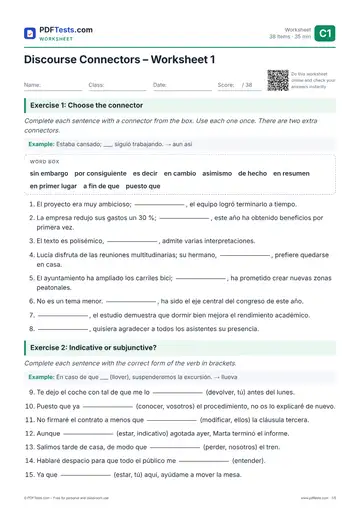
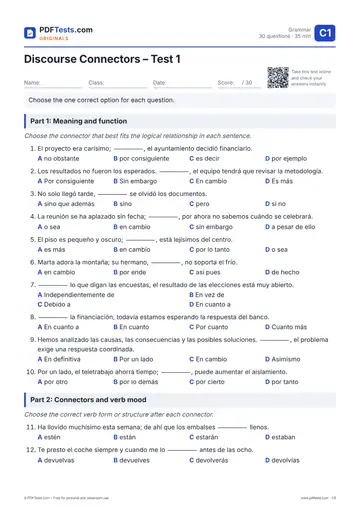
Discourse connectors (conectores or marcadores discursivos) are words and phrases such as sin embargo, por lo tanto, es decir or de ahí que. They link ideas and show how those ideas relate: addition, contrast, cause, consequence or reformulation. At C1 you need them to write structured essays, follow formal arguments and choose the right register. Several of them also affect punctuation or the mood of the verb.
What connectors do
A connector tells the reader how to read the next sentence. Compare:
- Estudió mucho. Suspendió. (no relationship shown)
- Estudió mucho; sin embargo, suspendió. — He studied a lot; however, he failed.
- Estudió mucho; por eso aprobó. — He studied a lot; that’s why he passed.
Most connectors are fixed expressions and do not change form. The challenge is choosing the precise one, punctuating it correctly and matching its register.
Main types of connectors
Addition
| Connector | Register | Example |
|---|---|---|
| además | neutral | Es barato y, además, está muy bien situado. — It’s cheap and, besides, very well located. |
| asimismo | formal | La empresa reducirá costes. Asimismo, invertirá en formación. — The company will cut costs. It will also invest in training. |
| es más | neutral | No me gusta la idea; es más, me parece peligrosa. — I don’t like the idea; in fact, I think it’s dangerous. |
| encima | informal | Llegó tarde y encima sin disculparse. — He arrived late and, on top of that, didn’t apologise. |
| por otra parte | neutral/formal | Por otra parte, hay que tener en cuenta el coste. — Furthermore, the cost must be taken into account. |
Es más introduces a stronger argument than the previous one. Encima usually adds something negative or annoying.
Contrast and counterargument
| Connector | Register | Example |
|---|---|---|
| sin embargo | neutral | Era una buena oferta; sin embargo, la rechazó. — It was a good offer; however, she turned it down. |
| no obstante | formal | Los datos son prometedores. No obstante, conviene ser prudentes. — The data are promising. Nevertheless, caution is advisable. |
| ahora bien | neutral/formal | Puedes ir; ahora bien, vuelve antes de las doce. — You can go; but mind you, be back before midnight. |
| aun así | neutral | Era carísimo; aun así, lo compramos. — It was very expensive; even so, we bought it. |
| en cambio | neutral | Madrid es caro; Valencia, en cambio, es más asequible. — Madrid is expensive; Valencia, on the other hand, is more affordable. |
| por el contrario | neutral/formal | No es tímido; por el contrario, habla con todo el mundo. — He isn’t shy; on the contrary, he talks to everyone. |
Concession
Concessive connectors admit an obstacle that does not prevent the main idea.
| Connector | Example |
|---|---|
| aunque | Aunque llueve, saldremos. — Although it’s raining, we’ll go out. |
| si bien (formal) | Si bien el plan tiene ventajas, también plantea riesgos. — While the plan has advantages, it also poses risks. |
| a pesar de que / pese a que | Pese a que nadie lo esperaba, ganaron. — Even though nobody expected it, they won. |
| por mucho que | Por mucho que insistas, no cambiaré de opinión. — However much you insist, I won’t change my mind. |
| aun cuando (formal) | Aun cuando tuviera tiempo, no lo haría. — Even if I had time, I wouldn’t do it. |
Cause
| Connector | Position and register | Example |
|---|---|---|
| porque | after the main clause | No fui porque estaba enfermo. — I didn’t go because I was ill. |
| como | at the start of the sentence | Como no contestabas, te dejé un mensaje. — As you weren’t answering, I left you a message. |
| ya que / puesto que | either position, neutral/formal | Puesto que nadie se opone, seguimos adelante. — Since nobody objects, we’ll go ahead. |
| dado que | formal | Dado que el plazo ha vencido, no se admitirán más solicitudes. — Given that the deadline has passed, no further applications will be accepted. |
| debido a (que) | formal | El vuelo se canceló debido a la niebla. — The flight was cancelled due to fog. |
Consequence
| Connector | Register | Example |
|---|---|---|
| así que | neutral/informal | Estaba agotado, así que me acosté. — I was exhausted, so I went to bed. |
| por eso | neutral | Perdí el tren; por eso llegué tarde. — I missed the train; that’s why I was late. |
| por lo tanto / por tanto | neutral/formal | El contrato es nulo; por lo tanto, no hay obligación de pago. — The contract is void; therefore, there is no obligation to pay. |
| por consiguiente / en consecuencia | formal | Han subido los tipos; en consecuencia, los préstamos se encarecen. — Rates have risen; consequently, loans are becoming more expensive. |
| de ahí que | formal | Ha habido varios escándalos; de ahí que la gente desconfíe. — There have been several scandals; hence people’s distrust. |
| así pues | formal | Así pues, la propuesta queda aprobada. — Thus, the proposal is approved. |
Reformulation, examples and clarification
- es decir / esto es (formal) / o sea (informal): Es bilingüe, es decir, habla dos lenguas con soltura. — She’s bilingual, that is, she speaks two languages fluently.
- mejor dicho (self-correction): Llegaremos el lunes, mejor dicho, el martes. — We’ll arrive on Monday, or rather, on Tuesday.
- por ejemplo / en concreto: Algunos países, en concreto Portugal y Grecia, mejoraron. — Some countries, specifically Portugal and Greece, improved.
Structuring and concluding
- Ordering: en primer lugar, en segundo lugar, por un lado… por otro (lado), a continuación, por último.
- Introducing a topic: en cuanto a, (con) respecto a, en lo que respecta a: En cuanto al presupuesto, aún no hay acuerdo. — As for the budget, there is still no agreement.
- Concluding: en conclusión, en resumen, en definitiva, en suma (formal), en resumidas cuentas (informal).
- Digression: por cierto, a propósito: Por cierto, ¿has visto a Laura? — By the way, have you seen Laura?
Connectors that affect verb mood
| Connector | Mood | Example |
|---|---|---|
| de ahí que | subjunctive | …de ahí que los precios suban. — …hence prices are rising. |
| aunque / a pesar de que | indicative = known fact; subjunctive = hypothesis or fact you dismiss | Aunque es caro… (it is expensive) / Aunque sea caro… (even if it is / it may be expensive) |
| si bien | indicative | Si bien es cierto que… — While it is true that… |
| por mucho que | usually subjunctive | Por mucho que estudie, no aprobará. — However much he studies, he won’t pass. |
| ya que / puesto que / dado que | indicative | Ya que estás aquí, ayúdame. — Since you’re here, help me. |
| de modo que / de manera que | indicative = consequence; subjunctive = purpose | Habla despacio, de modo que todos te entiendan. — Speak slowly so that everyone understands you. |
| no porque… sino porque | subjunctive after no porque | No lo digo porque esté enfadado, sino porque es verdad. — I’m not saying it because I’m angry, but because it’s true. |
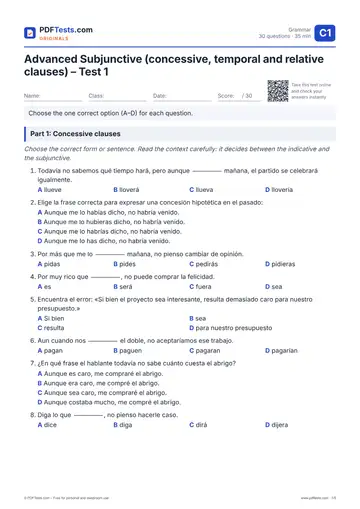
For a full treatment of concessive clauses, see our guide to advanced subjunctive in concessive, temporal and relative clauses. If mood choice in general is still shaky, review subjunctive vs indicative.
Punctuation with connectors
- Parenthetical connectors (sin embargo, no obstante, por lo tanto, es decir, además, en cambio) are followed by a comma. Mid-sentence, they go between commas: Nadie, sin embargo, lo apoyó. — Nobody, however, supported it.
- Linking two independent clauses: put a semicolon or full stop before and a comma after: El proyecto era viable; sin embargo, no obtuvo financiación. — The project was viable; however, it did not get funding.
- Conjunctions (pero, aunque, así que, porque) take a comma before, never directly after: Es caro, pero merece la pena. — It’s expensive, but it’s worth it.
- Como and dado que clauses at the start are followed by a comma before the main clause.
Commonly confused connectors
Sin embargo vs en cambio vs por el contrario
- Sin embargo contradicts an expectation created by the first idea: Tenía fiebre; sin embargo, fue a trabajar. — He had a fever; however, he went to work.
- En cambio contrasts two different subjects or facts side by side: Mi hermano es muy ordenado; yo, en cambio, soy un desastre. — My brother is very tidy; I, on the other hand, am a mess.
- Por el contrario often follows a negative and states the opposite: No bajó el paro; por el contrario, aumentó. — Unemployment didn’t fall; on the contrary, it rose.
Pero vs sino (que)
Sino corrects a negated element and replaces it: No es caro, sino barato. — It isn’t expensive, but cheap. Use sino que before a conjugated verb: No lo arregló, sino que lo empeoró. — He didn’t fix it; instead, he made it worse. Pero adds information without replacing anything: No es caro, pero tampoco es barato. — It isn’t expensive, but it isn’t cheap either.
Como vs porque
Como goes at the start and presents the cause as background; porque usually follows the main clause and answers why. Como hacía frío, cerré la ventana / Cerré la ventana porque hacía frío. — As it was cold, I closed the window / I closed the window because it was cold.
En fin, al final, finalmente
Finalmente and al final mean finally or in the end. En fin is mostly anyway or well, often with a tone of resignation: En fin, ya veremos qué pasa. — Anyway, we’ll see what happens.
Register: speech vs formal writing
| Informal / spoken | Formal / written |
|---|---|
| o sea | es decir, esto es |
| encima | además, asimismo |
| así que | por lo tanto, por consiguiente |
| pero | sin embargo, no obstante |
| aunque | si bien, pese a que |
| en resumidas cuentas | en suma, en definitiva |
In exams and academic essays, vary your connectors and avoid repeating pero and también. Our C1 Academic and Formal Vocabulary test practises the formal vocabulary that typically surrounds them.
Common mistakes
- ✗ No es mi hermano, pero mi primo. → ✓ No es mi hermano, sino mi primo. — Correcting a negated element requires sino.
- ✗ No vino, sino llamó. → ✓ No vino, sino que llamó. — Before a conjugated verb use sino que.
- ✗ Me fui a casa como estaba cansado. → ✓ Como estaba cansado, me fui a casa. — Causal como must open the sentence.
- ✗ De ahí que la gente no confía. → ✓ De ahí que la gente no confíe. — De ahí que always takes the subjunctive.
- ✗ Aún así, lo intentó. → ✓ Aun así, lo intentó. — Aun here means incluso, so it has no accent.
- ✗ El plan era bueno, sin embargo nadie lo apoyó. → ✓ El plan era bueno; sin embargo, nadie lo apoyó. — Semicolon before and comma after when joining two clauses.
- ✗ Es caro pero, merece la pena. → ✓ Es caro, pero merece la pena. — The comma goes before pero, not after it.
- ✗ Debido a que la lluvia, se suspendió. → ✓ Debido a la lluvia, se suspendió. — Debido a + noun; debido a que + clause.
- ✗ Si bien sea cierto… → ✓ Si bien es cierto… — Si bien takes the indicative.
Quick check
- No lo hizo por dinero, ___ por convicción.
- ___ no tenía coche, fue andando. (como / porque)
- Los precios han subido; de ahí que el consumo ___ (bajar).
- Correct the punctuation: El proyecto era viable sin embargo no recibió financiación.
- Mi hermana es muy paciente; yo, ___, me enfado enseguida. (en cambio / sin embargo)
Answers
- sino — it corrects the negated por dinero.
- Como — it opens the sentence.
- haya bajado (or baje) — de ahí que requires the subjunctive.
- El proyecto era viable; sin embargo, no recibió financiación.
- en cambio — two different people are contrasted, not an expectation contradicted.
Next step
Now put these connectors to work: test yourself with our C1 Discourse Connectors test, paying special attention to sino, de ahí que and punctuation. Then read a formal text in our C1 Reading Comprehension test and underline every connector to see how the argument is built. For more practice at this level, browse all our Spanish C1 tests.
Practise this topic: Spanish Discourse Connectors
Was this page helpful?
What was the problem?
Thank you for your feedback!