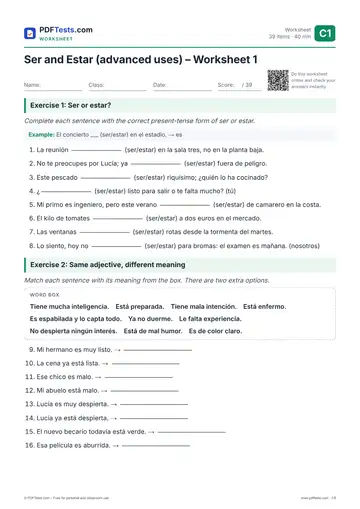
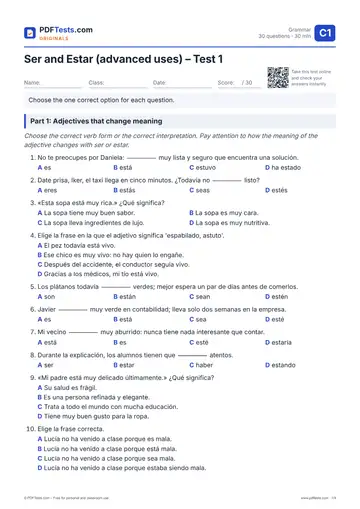
At C1, the choice between ser and estar is not a matter of “permanent versus temporary”. Ser classifies, identifies and defines, and it is also used for events and the action passive. Estar presents a state, a result or a perception that holds at a particular moment. This guide covers the advanced cases that distinguish fluent speakers: adjectives that change meaning, ser vs estar + participle, the location of events, estar siendo, and the many fixed expressions built on estar.
If you need to review the basics first, start with our Ser and Estar guide.
The principle behind the advanced uses
Think of ser as answering the question “What kind of thing is it?” and estar as answering “What condition is it in right now, or how does it strike me?”
- El agua del Cantábrico es fría. The water of the Cantabrian Sea is cold. (a general characteristic)
- Hoy el agua está fría. The water is cold today. (the state at this moment)
This explains several cases that the “permanent/temporary” rule cannot explain. Death is permanent, yet we say está muerto because it is a resulting state. A person’s nationality can change, yet we say es colombiana because it classifies her.
Adjectives that change meaning
Many common adjectives mean something quite different depending on the verb. These appear constantly in exams and in real conversation.
| Adjective | With ser | With estar |
|---|---|---|
| listo | clever, sharp | ready |
| rico | wealthy | delicious |
| malo | bad (character, quality) | ill; gone off (food) |
| bueno | good, kind | tasty; (colloquial) attractive |
| aburrido | boring | bored |
| verde | green (colour) | unripe; inexperienced |
| vivo | quick-witted, lively | alive |
| despierto | alert, bright | awake |
| atento | considerate, polite | paying attention |
| interesado | self-interested, mercenary | interested |
| orgulloso | arrogant, proud (negative) | proud of someone/something |
| delicado | delicate; fussy | in poor health |
| grave | serious (a matter) | seriously ill |
| seguro | safe | sure, certain |
Examples:
- Tu hermano es muy listo, pero nunca está listo a tiempo. Your brother is very clever, but he’s never ready on time.
- Esa familia es rica, aunque la comida de su restaurante no está nada rica. That family is wealthy, although the food at their restaurant isn’t tasty at all.
- El barrio es seguro. The neighbourhood is safe. / ¿Estás seguro? Are you sure?
- Todavía está verde para dirigir el equipo. He’s still too inexperienced to lead the team.
- Estamos muy orgullosos de ti. We’re very proud of you.
Estar for subjective perception
Estar is used when the speaker reacts to how something seems at a given moment, especially when it departs from what they expected.
- ¡Qué alta está tu hija! Your daughter has got so tall! (the speaker notices a change)
- Estás muy joven con ese corte de pelo. You look very young with that haircut.
- La paella está buenísima. The paella is delicious. (this paella, as I taste it)
Compare La paella es un plato valenciano (Paella is a Valencian dish), which classifies it.
The same contrast applies when evaluating experiences:
- La película es genial. The film is great. (my general judgement of the film)
- La película estuvo genial. The film was great. (the experience of watching it that night)
Where things happen: events take ser
To locate people and objects, use estar. To say where or when an event takes place, use ser. Here ser means “to take place”.
- La boda es en una finca a las afueras. The wedding is at an estate on the outskirts.
- El accidente fue en la autopista. The accident happened on the motorway.
- Los novios están en la finca desde las diez. The bride and groom have been at the estate since ten.
A useful test: if you can replace the verb with tener lugar or celebrarse, use ser.
Ser + participle vs estar + participle
This is the most important structural contrast at this level.
| Structure | Meaning | Focus |
|---|---|---|
| ser + participle (+ por agent) | action passive | the action and who did it |
| estar + participle | resultant state | the state after the action |
- El puente fue construido en 1920 por una empresa francesa. The bridge was built in 1920 by a French company.
- El puente está construido en piedra. The bridge is built of stone.
- El contrato fue firmado ayer. The contract was signed yesterday.
- El contrato ya está firmado. The contract is already signed.
Time expressions pointing to a single moment (ayer, en 1920) and agents with por call for ser. Adverbs like ya and todavía often go with estar.
The ser passive is typical of formal writing, journalism and history. In everyday speech, Spanish usually prefers the passive se or an active sentence. For more on this, see our guide to the passive voice and passive se.
Estar siendo: temporary behaviour
Ser + adjective normally describes character. When you want to say someone is behaving in a certain way right now, use estar siendo.
- Normalmente es muy razonable, pero hoy está siendo muy injusto. He’s usually very reasonable, but today he’s being very unfair.
- Estás siendo un poco pesado, ¿no? You’re being a bit of a pain, aren’t you?
Avoid estar siendo + participle as a progressive passive (el caso está siendo investigado) in careful style: it is common in the media, but many style guides find it heavy. Se está investigando el caso (The case is being investigated) is usually more natural.
Fixed expressions with estar
Many high-frequency expressions only work with estar. Several are verbal periphrases; our Verbal Periphrases guide covers them in more depth.
| Expression | Meaning | Example |
|---|---|---|
| estar de + noun | temporary role or situation | Está de camarero este verano. He’s working as a waiter this summer. |
| estar de acuerdo | to agree | No estoy de acuerdo contigo. I don’t agree with you. |
| estar a + date/price/temperature | current date, price or reading | Estamos a 3 de mayo. It’s the 3rd of May. |
| estar para + noun | to be in the mood for | No estoy para bromas. I’m not in the mood for jokes. |
| estar por + infinitive | still to be done; tempted to | Está por ver. It remains to be seen. |
| estar a punto de | to be about to | Estaba a punto de llamarte. I was just about to call you. |
| estar con / sin | to have / lack (temporarily) | Estamos sin luz. We’ve got no electricity. |
Note the contrast with prices and dates:
- ¿Cuánto es? How much is it? (the total you pay)
- ¿A cuánto están los tomates hoy? How much are tomatoes today? (a price that fluctuates)
- Hoy es 12 de octubre. / Estamos a 12 de octubre. Today is the 12th of October.
Ser in impersonal, cleft and quantity constructions
Impersonal expressions
Most evaluative impersonal expressions take ser: es necesario, es lógico, es evidente, es importante, es una pena. A few common ones take estar: está claro, está visto, está bien, está mal.
- Es lógico que estés cansado. It’s natural that you’re tired.
- Está claro que no va a venir. It’s clear he isn’t coming.
Remember: bien and mal are adverbs, so they go with estar; bueno and malo are adjectives and usually go with ser in these expressions: Es bueno que hagas deporte / Está bien que hagas deporte.
Cleft sentences
Ser is used to highlight one part of a sentence:
- Fue Marta quien lo descubrió. It was Marta who found out.
- Es aquí donde nos conocimos. It’s here that we met.
The very common es por eso que is often criticised in prescriptive grammar as a calque; in formal writing, prefer por eso or es por eso por lo que.
Quantity
- Somos cinco en la familia. There are five of us in the family.
- Éramos pocos en la reunión. There weren’t many of us at the meeting.
Marital status and other borderline cases
With casado, soltero, divorciado and viudo, both verbs are possible. Ser classifies civil status (Es soltero, He’s single, as on a form); estar presents the situation (Está casada desde 2015, She’s been married since 2015). In Spain, estar casado is the more common choice in conversation.
Signal words and clues
- Ser: por + agent, single-point time markers with participles (en 1998, ayer), tener lugar meaning, classification (un tipo de, de origen), cleft structures.
- Estar: ya, todavía, aún with participles; hoy, esta mañana, últimamente for a current state; exclamations of surprise (¡qué… estás!); prepositions de, a, para, por, con, sin in fixed expressions.
Common mistakes
- ✗ La reunión está en la sala 4. → ✓ La reunión es en la sala 4. Events take ser for location.
- ✗ El edificio estuvo construido por Gaudí. → ✓ El edificio fue construido por Gaudí. An agent with por requires the ser passive.
- ✗ Mi abuelo es muerto. → ✓ Mi abuelo está muerto. Death is presented as a resulting state.
- ✗ Hoy es a 5 de marzo. → ✓ Estamos a 5 de marzo. The preposition a goes with estar; with ser, omit it.
- ✗ Hoy es siendo muy maleducado. → ✓ Hoy está siendo muy maleducado. Temporary behaviour uses estar siendo.
- ✗ Soy de acuerdo. → ✓ Estoy de acuerdo. A fixed expression with estar.
- ✗ Las manzanas son verdes todavía. → ✓ Las manzanas están verdes todavía. “Unripe” requires estar.
- ✗ Está necesario que firmes. → ✓ Es necesario que firmes. Most evaluative impersonal expressions use ser.
- ✗ Estoy muy interesada en dinero (meaning “I’m mercenary”). → ✓ Soy muy interesada. Ser interesado describes character; estar interesado means “interested”.
Quick check
Choose the correct form of ser or estar.
- La conferencia ___ en el auditorio principal mañana.
- No toques la tarta, todavía no ___ lista.
- El acuerdo ___ firmado ayer por ambas partes.
- Hoy ___ a 12 de octubre.
- Normalmente es muy simpático, pero hoy ___ siendo muy borde.
Answers: 1. es (location of an event) 2. está (listo = ready) 3. fue (action passive with agent and time) 4. estamos (estar a + date) 5. está (estar siendo for temporary behaviour)
Next step
Now put these distinctions under pressure: take our Spanish C1 Ser and Estar (advanced uses) test and note which category gives you the most trouble, whether meaning-changing adjectives, passives or fixed expressions. Then reread that section and try writing three sentences of your own for each contrast. When you feel confident, explore the rest of our Spanish C1 tests to see how ser and estar interact with other advanced structures.
Was this page helpful?
What was the problem?
Thank you for your feedback!