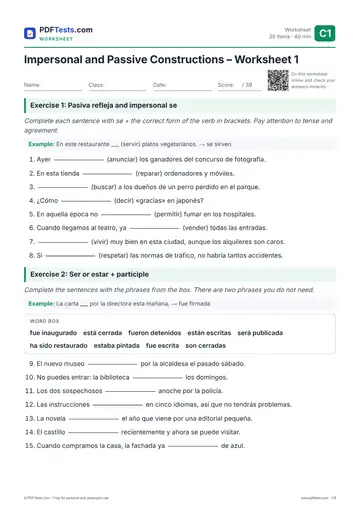
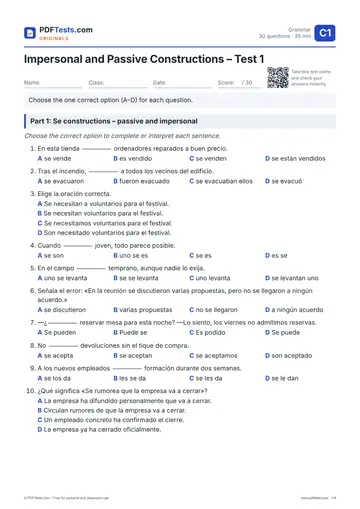
Impersonal and passive constructions let you describe an action without naming who does it, because the agent is unknown, obvious, irrelevant or deliberately hidden. Spanish has several tools for this: the passive with ser + participle, the pasiva refleja (se venden pisos), impersonal se (se vive bien aquí), and generic subjects such as the third-person plural, uno or tú. At C1, the challenge is choosing the right construction for the register and getting agreement right.
If you need a refresher on the basics, start with our Passive Voice and Passive se guide, then come back here for the finer distinctions.
The main constructions at a glance
| Construction | Example | Typical use |
|---|---|---|
| Ser + participle (pasiva perifrástica) | El puente fue inaugurado en 2019. — The bridge was opened in 2019. | News, academic and legal writing |
| Pasiva refleja (se + verb agreeing with the subject) | Se venden pisos. — Flats for sale. | The default passive in most registers |
| Impersonal se (se + 3rd person singular) | Se vive bien en Valencia. — Life is good in Valencia. | General statements with no grammatical subject |
| Third-person plural | Dicen que va a nevar. — They say it’s going to snow. | Unknown agents, speaker excluded |
| Uno / una | Uno nunca sabe. — You never know. | Generic statements, speaker included |
| Generic tú | Si estudias, apruebas. — If you study, you pass. | Informal speech |
| Impersonal verbs | Hubo varios heridos. — There were several injured. | Existence, time, weather |
The passive with ser + participle
Form
Ser carries the tense and mood; the participle agrees in gender and number with the subject. The agent, when mentioned, is introduced by por.
| Tense | Example |
|---|---|
| Present | Los premios son entregados cada año por el rey. — The awards are presented every year by the king. |
| Preterite | La ley fue aprobada por el Congreso. — The law was passed by Congress. |
| Present perfect | Han sido detenidas tres personas. — Three people have been arrested. |
| Future | Las obras serán financiadas por la UE. — The works will be funded by the EU. |
| Pluperfect | El edificio había sido abandonado. — The building had been abandoned. |
| Present subjunctive | Es necesario que el informe sea revisado. — The report needs to be reviewed. |
When it sounds natural
The ser passive is far less frequent in Spanish than the passive in English. It fits best in:
- journalism: El acusado fue condenado a seis años. — The defendant was sentenced to six years.
- academic and legal texts: Los datos fueron analizados por un equipo independiente. — The data were analysed by an independent team.
- any context where you want to name the agent: La novela fue escrita por una autora desconocida. — The novel was written by an unknown author.
Restrictions
- Only verbs with a direct object can be passivised. Indirect objects never become passive subjects, unlike in English: Me dieron un regalo. — I was given a present.
- In the present and imperfect, the ser passive often sounds stilted for a single ongoing action. Instead of La casa es pintada, say Están pintando la casa or Se está pintando la casa. — The house is being painted.
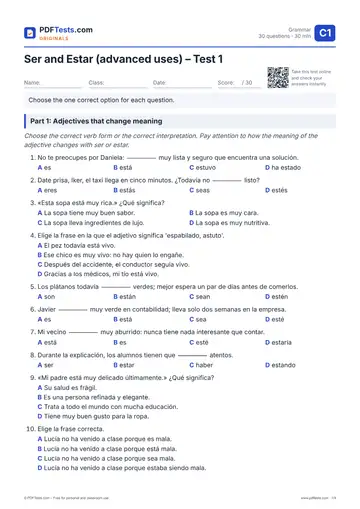
Ser + participle vs estar + participle
Ser + participle presents an action; estar + participle presents the resulting state.
- La tienda fue cerrada a las nueve por la policía. — The shop was closed at nine by the police. (action)
- La tienda estaba cerrada. — The shop was closed. (state)
Estar + participle normally does not take a por agent of a specific action.
The pasiva refleja
Form
Se + a verb in the third person that agrees with the grammatical subject. The subject usually follows the verb.
| Singular subject | Plural subject |
|---|---|
| Se alquila apartamento. — Apartment for rent. | Se alquilan apartamentos. — Apartments for rent. |
| Se ha descubierto un error. — An error has been found. | Se han descubierto varios errores. — Several errors have been found. |
| Se publicará la lista mañana. — The list will be published tomorrow. | Se publicarán los resultados mañana. — The results will be published tomorrow. |
Key points
- The subject is usually inanimate or non-specific: Se necesitan voluntarios. — Volunteers needed.
- The agent is normally left out. A phrase like Se firmó el acuerdo por los ministros is avoided in careful Spanish; use El acuerdo fue firmado por los ministros. — The agreement was signed by the ministers.
- When the subject is an infinitive or a clause, the verb is singular: Se prohíbe fumar. — Smoking is prohibited. Se espera que los precios bajen. — Prices are expected to fall.
- With modal verbs, the conjugated verb usually agrees with the noun: Se deben tomar medidas. — Measures must be taken. The singular (se debe tomar medidas) is also heard, but agreement is the recommended option in formal writing.
Impersonal se
Impersonal se has no grammatical subject at all, so the verb is always third-person singular. It appears in four main contexts.
- Intransitive verbs: Se trabaja mucho en esta empresa. — People work hard at this company.
- Copular verbs: Cuando se es joven, todo parece posible. — When you’re young, everything seems possible.
- Specific human direct objects with personal a: Se detuvo a los sospechosos. — The suspects were arrested. Se busca a dos testigos. — Two witnesses are being sought.
- With an object pronoun: Se les entregó un diploma. — They were given a diploma. With a direct object, le/les is very common here, especially in Spain: Se le vio salir del hotel. — He was seen leaving the hotel. To review pronoun choice, see our guide to direct and indirect object pronouns.
Pasiva refleja or impersonal se with people
When the object is a person, the choice depends on specificity:
- Se contrataron dos ingenieros. — Two engineers were hired. (indefinite, pasiva refleja)
- Se contrató a los dos ingenieros. — The two engineers were hired. (specific, impersonal se + a)
The impersonal option also avoids ambiguity. Se mataron dos soldados can mean Two soldiers killed themselves or Two soldiers were killed; Se mató a dos soldados can only mean Two soldiers were killed.
No double se
Verbs that are already pronominal, such as levantarse, quejarse or acostumbrarse, cannot take impersonal se. Use uno/una or la gente instead: Uno se acostumbra a todo. — You get used to anything. For more on these verbs, see our guide to reflexive verbs.
Other ways to hide the agent
Third-person plural
The agent is unknown and the speaker is excluded. It can refer to a single person:
- Llaman a la puerta. — Someone’s at the door.
- Me han robado la cartera. — My wallet has been stolen.
Uno / una
The speaker is included. Women often use una: Una ya no tiene edad para eso. — I’m not young enough for that any more.
Generic tú and la gente
Generic tú is typical of conversation: Aquí pagas y te atienden enseguida. — Here you pay and they serve you straight away. La gente and todo el mundo make generalisations explicit: La gente ya no lee periódicos. — People don’t read newspapers any more.
Impersonal verbs: haber, hacer and weather verbs
- Existential haber has no subject, so it is always singular in every tense: Había muchas personas. — There were a lot of people. Ha habido cambios. — There have been changes. Va a haber problemas. — There are going to be problems.
- Hacer for time and weather is also singular: Hace dos años que vivo aquí. — I’ve been living here for two years. Hace frío. — It’s cold.
- Weather verbs: Llovió toda la noche. — It rained all night.
Choosing by register
The same information can be expressed at different levels of formality:
| Register | Example |
|---|---|
| Formal written | Los resultados serán publicados el lunes. — The results will be published on Monday. |
| Neutral | Se publicarán los resultados el lunes. — The results will be published on Monday. |
| Informal | Publican los resultados el lunes. — They’re publishing the results on Monday. |
Typical signals for the ser passive are formal contexts and a por agent; signs, adverts and instructions favour the pasiva refleja (se vende, se ruega, se prohíbe). Building the formal vocabulary that goes with these structures is the focus of our C1 Academic and Formal Vocabulary test.
Common mistakes
- ✗ Se vende pisos. → ✓ Se venden pisos. (Flats for sale.) — In the pasiva refleja, the verb agrees with the plural subject.
- ✗ Se buscan a los responsables. → ✓ Se busca a los responsables. (Those responsible are being sought.) — Personal a makes it impersonal, so the verb stays singular.
- ✗ Habían muchos problemas. → ✓ Había muchos problemas. (There were a lot of problems.) — Existential haber is always singular.
- ✗ Hacen tres años que no la veo. → ✓ Hace tres años que no la veo. (I haven’t seen her for three years.) — Time hacer has no subject.
- ✗ Se se queja mucho. → ✓ La gente se queja mucho. (People complain a lot.) — Pronominal verbs cannot take impersonal se.
- ✗ Yo fui dicho que… → ✓ Me dijeron que… (I was told that…) — Indirect objects cannot become passive subjects.
- ✗ La reunión se canceló por el director. → ✓ La reunión fue cancelada por el director. (The meeting was cancelled by the director.) — To name the agent, use the ser passive.
- ✗ Las ventanas fueron rotos. → ✓ Las ventanas fueron rotas. (The windows were broken.) — The participle agrees with the subject.
Quick check
- Complete: ___ (alquilar) habitaciones en el centro.
- Complete: Se entrevistó ___ los candidatos.
- Correct the error: Habían varios testigos.
- Rewrite with ser + participle: La policía detuvo a los sospechosos.
- Complete with a generic subject: ___ se levanta temprano en el campo.
Answers
- Se alquilan habitaciones en el centro. — Rooms for rent in the centre.
- Se entrevistó a los candidatos. — The candidates were interviewed.
- Había varios testigos. — There were several witnesses.
- Los sospechosos fueron detenidos por la policía. — The suspects were arrested by the police.
- Uno se levanta temprano en el campo. — You get up early in the countryside.
Next step
Put these distinctions into practice with our C1 Impersonal and Passive Constructions test, paying close attention to verb agreement and personal a. If the pasiva refleja still causes trouble, consolidate it first with the B2 Passive Voice and Passive se test, then return to the C1 test and aim for full marks.
Was this page helpful?
What was the problem?
Thank you for your feedback!