At C1, the subjunctive is less about memorising triggers and more about how you present information. In concessive clauses (aunque), temporal clauses (cuando) and relative clauses (que), Spanish uses the indicative for what the speaker treats as real, known or experienced. It uses the subjunctive for what is pending, hypothetical, unknown or deliberately dismissed as irrelevant. This guide shows how that single idea works in all three clause types.
The core principle
Compare these two sentences:
- Aunque es tarde, me quedo. Although it’s late, I’m staying. (I state that it is late.)
- Aunque sea tarde, me quedo. Even if it’s late, I’m staying. (Whether it’s late or not doesn’t matter.)
The indicative asserts information. The subjunctive does not assert it: the information is not yet real, not known, or not relevant to the speaker’s decision. If you need a refresher on the basic contrast, see our guide to subjunctive vs indicative.
| Indicative | Subjunctive |
|---|---|
| facts presented as new information | hypotheses and possibilities |
| habits | future or pending actions |
| completed past events | unknown or non-existent people and things |
| specific, identified people and things | known facts treated as irrelevant |
Concessive clauses
Concessive clauses introduce an obstacle that does not prevent the main action.
Aunque: four options
| Form | Meaning | Example |
|---|---|---|
| aunque + indicative | real fact, new information | Aunque tengo prisa, te ayudo. Although I’m in a hurry, I’ll help you. |
| aunque + present subjunctive | possibility, or a known fact treated as irrelevant | Aunque tenga prisa, te ayudo. Even if I’m in a hurry, I’ll help you. |
| aunque + imperfect subjunctive | unlikely or contrary to fact (present/future) | Aunque tuviera dinero, no me compraría ese coche. Even if I had the money, I wouldn’t buy that car. |
| aunque + pluperfect subjunctive | contrary to fact in the past | Aunque me lo hubieras pedido, no habría ido. Even if you had asked me, I wouldn’t have gone. |
The second row holds the key C1 nuance. The present subjunctive does not always mean ‘maybe’. In a reply, it often concedes something both speakers already know:
— Ese hotel es carísimo. That hotel is really expensive.
— Ya, pero aunque sea caro, merece la pena. I know, but even though it’s expensive, it’s worth it.
The price is accepted as true, but the speaker refuses to let it count. Using es here would sound as if the speaker were announcing the price as news.
Other concessive connectors
| Connector | Mood | Example |
|---|---|---|
| a pesar de que | like aunque | A pesar de que lo sabía, no dijo nada. Even though she knew, she said nothing. |
| aun cuando (formal) | like aunque | Aun cuando lo intentáramos, no llegaríamos a tiempo. Even if we tried, we wouldn’t make it in time. |
| por mucho / por más que | usually subjunctive | Por mucho que insistas, no voy a cambiar de idea. However much you insist, I’m not going to change my mind. |
| por (muy) + adjective/adverb + que | subjunctive | Por muy lista que sea, no puede saberlo todo. However clever she is, she can’t know everything. |
| así (formal; common in Latin America) | subjunctive | No se lo perdono así me lo pida de rodillas. I won’t forgive him even if he begs me on his knees. |
| si bien (formal) | indicative | Si bien el plan es ambicioso, es viable. While the plan is ambitious, it is feasible. |
| y eso que (colloquial) | indicative | Suspendió, y eso que estudió mucho. He failed, even though he studied a lot. |
Por mucho que takes the indicative when you present the effort as an established fact: Por mucho que trabaja, nunca le llega el dinero. However much he works (and he does work a lot), he never has enough money. For more ways to link ideas in formal writing, see our guide to discourse connectors.
Reduplicated structures
A common C1 pattern repeats the same verb in the subjunctive around a relative word. It means ‘whatever’, ‘wherever’, ‘no matter how’:
- Pase lo que pase, estaré contigo. Whatever happens, I’ll be with you.
- Digan lo que digan, yo confío en ella. Whatever they say, I trust her.
- Lo vamos a terminar, cueste lo que cueste. We’re going to finish it, whatever it costs.
- Vayas donde vayas, llévate el pasaporte. Wherever you go, take your passport.
- Quieras o no, tendrás que hablar con él. Like it or not, you’ll have to talk to him.
- Sea como sea, hay que decidir hoy. One way or another, we have to decide today.
In past contexts, use the imperfect subjunctive: Hiciera lo que hiciera, nada le salía bien. Whatever he did, nothing went right for him.
Temporal clauses
The rule is consistent: use the subjunctive when the action in the time clause is still pending relative to the main clause. Use the indicative for habits and past events.
| Time reference | Mood | Example |
|---|---|---|
| habitual | indicative | Cuando llego a casa, me ducho. When I get home, I have a shower. |
| past | indicative | Cuando llegué a casa, me duché. When I got home, I had a shower. |
| future | present subjunctive | Cuando llegue a casa, me ducharé. When I get home, I’ll have a shower. |
| future seen from the past | imperfect subjunctive | Dijo que se ducharía cuando llegara a casa. He said he’d have a shower when he got home. |
The same rule applies to en cuanto, tan pronto como, apenas, hasta que, una vez que, cada vez que and después de que:
- Avísame en cuanto sepas algo. Let me know as soon as you hear anything.
- No me iré hasta que me des una respuesta. I won’t leave until you give me an answer.
- Una vez que firmes el contrato, no podrás echarte atrás. Once you sign the contract, you won’t be able to back out.
- Tan pronto como terminó la reunión, se fue. As soon as the meeting ended, she left.
Note that interrogative cuándo (with an accent) is not a time conjunction: ¿Cuándo vendrás? When will you come? / No sé cuándo vendrá. I don’t know when he’ll come.
Antes de que: always subjunctive
The action after antes de que is always later than the main action, so it is always pending from that point of view, even when it really happened:
- Vámonos antes de que empiece a llover. Let’s go before it starts raining.
- Se fue antes de que llegáramos. She left before we arrived.
Same subject: use the infinitive
When both clauses share the same subject, use antes de, después de, hasta or al + infinitive:
- Antes de salir, apaga las luces. Before you go out, turn off the lights.
- Después de comer, dimos un paseo. After eating, we went for a walk.
Después de que with past events
For completed past events, the indicative is the logical choice, but the imperfect subjunctive is also accepted and very frequent in journalism and formal writing:
- El precio subió después de que el Gobierno anunció / anunciara la medida. The price went up after the government announced the measure.
Mientras and siempre que: time or condition
These conjunctions change meaning with mood. Temporal meaning follows the normal rule; conditional meaning always takes the subjunctive.
- Mientras cocinas, pongo la mesa. While you cook, I’ll set the table.
- Mientras no me pagues, no te devuelvo el libro. As long as you don’t pay me, I’m not giving the book back.
- Siempre que viene, trae flores. Whenever she comes, she brings flowers.
- Te lo presto siempre que me lo devuelvas mañana. I’ll lend it to you provided you give it back tomorrow.
Relative clauses
In defining relative clauses, the mood depends on the antecedent: is it a specific, identified entity or an unidentified, hypothetical or non-existent one?
| Antecedent | Mood | Example |
|---|---|---|
| specific, known to exist | indicative | Busco a una profesora que habla japonés. I’m looking for a (particular) teacher who speaks Japanese. |
| unspecified (any that fits) | subjunctive | Busco una profesora que hable japonés. I’m looking for a teacher who speaks Japanese (any one). |
| non-existent or negated | subjunctive | Aquí no hay nadie que hable japonés. There’s nobody here who speaks Japanese. |
| existence questioned | subjunctive | ¿Conoces a alguien que hable japonés? Do you know anyone who speaks Japanese? |
Notice the personal a: it usually appears with a specific person (a una profesora que habla) and is often dropped when the person is unspecified (una profesora que hable). Alguien and nadie always take a as direct objects.
Open-ended or future reference
- Los que lleguen tarde no podrán entrar. Anyone who arrives late won’t be allowed in.
- Los que llegaron tarde no pudieron entrar. Those who arrived late couldn’t get in.
- Haz lo que quieras. Do whatever you like.
- Siempre hace lo que quiere. He always does what he wants.
Relative adverbs follow the same logic:
- Lo pondremos donde tú digas. We’ll put it wherever you say.
- Hazlo como te parezca mejor. Do it however you think best.
Superlatives, el único and pocos
After superlatives, el único or pocos, the indicative is neutral; the subjunctive adds a subjective or emphatic tone, typical of careful style:
- Es la mejor novela que he leído. It’s the best novel I’ve read.
- Es la mejor novela que haya leído nunca. It’s the best novel I have ever read.
- Hay pocas personas que lo entiendan. There are few people who would understand it.
Non-defining clauses
Clauses between commas add information about a known antecedent, so they take the indicative: Mi jefe, que vive en Sevilla, viene mañana. My boss, who lives in Seville, is coming tomorrow. For the choice between que, quien, el cual and cuyo, see our guide to relative pronouns.
Sequence of tenses
| Main clause | Subjunctive clause |
|---|---|
| present, future, imperative | present or present perfect subjunctive |
| past tenses, conditional | imperfect or pluperfect subjunctive |
- Necesitamos a alguien que sepa programar. We need someone who can code.
- Necesitábamos a alguien que supiera programar. We needed someone who could code.
The -ra and -se forms (supiera / supiese) are interchangeable in these clauses. Review the forms in our imperfect subjunctive guide.
Common mistakes
- ✗ Cuando llegarás, llámame. → ✓ Cuando llegues, llámame. — Never use the future after temporal cuando.
- ✗ Antes de que salimos, cerramos. → ✓ Antes de salir, cerramos. — Same subject needs the infinitive; different subjects need the subjunctive.
- ✗ Se fue antes de que llegamos. → ✓ Se fue antes de que llegáramos. — Antes de que always takes the subjunctive.
- ✗ Por muy cansado que estás, termina. → ✓ Por muy cansado que estés, termina. — Por muy + adjective + que takes the subjunctive.
- ✗ No hay nadie que puede ayudarte. → ✓ No hay nadie que pueda ayudarte. — A negated antecedent requires the subjunctive.
- ✗ Si bien sea caro, lo compraré. → ✓ Si bien es caro, lo compraré. — Si bien only takes the indicative.
- ✗ Pase lo que pasa, iré. → ✓ Pase lo que pase, iré. — Both verbs in reduplicated structures are subjunctive.
- ✗ Me pidió que lo llamara en cuanto llego. → ✓ Me pidió que lo llamara en cuanto llegara. — A pending action in a past context takes the imperfect subjunctive.
Quick check
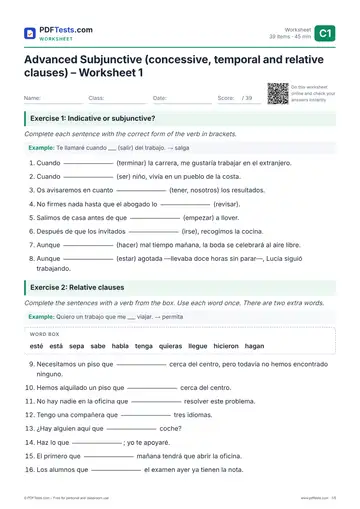
Put the verb in the correct form.
- Te llamaré en cuanto ___ (saber) algo.
- No hay ningún restaurante por aquí que ___ (abrir) los lunes.
- ___ (decir) lo que ___ (decir), no pienso cambiar de opinión.
- Aunque ya ___ (saber, tú) la noticia, ayer no dijiste nada.
- Salimos antes de que ___ (empezar) a llover.
Answers
- sepa — future, pending action after en cuanto.
- abra — non-existent antecedent.
- Digan lo que digan — reduplicated concessive structure.
- sabías — a past fact presented as true.
- empezara / empezase — antes de que + past main clause.
Next step
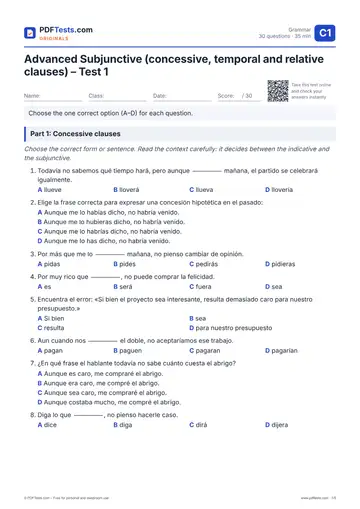
The best way to make these choices automatic is to practise them in context, where meaning decides the mood. Test yourself with our Spanish C1 Advanced Subjunctive test, and for every answer you get wrong, ask whether the clause states a fact or leaves it open. That question resolves almost every case in this guide.
Practise this topic: Advanced Spanish Subjunctive
Was this page helpful?
What was the problem?
Thank you for your feedback!