Irregular verbs in the Spanish present tense are verbs that do not follow the normal pattern of hablar, comer and vivir. Many of the most common verbs, such as ser, ir, tener and querer, are irregular, so you need them from your first week of Spanish. The good news is that most irregular verbs still use the regular endings and change in predictable ways.
If you are not yet sure about the regular endings, read our guide to the present tense of regular verbs first.
When you use the present tense
Irregular verbs have exactly the same uses as regular verbs in the present tense:
- Habits and routines: Voy al gimnasio los lunes. I go to the gym on Mondays.
- Facts and descriptions: Madrid tiene muchos museos. Madrid has a lot of museums.
- What is happening now: ¿Qué haces? – Hago la cena. What are you doing? – I’m making dinner.
- Near future plans: Mañana salgo con mis amigos. Tomorrow I’m going out with my friends.
The four types of irregular verbs
At A1, it helps to sort irregular verbs into four groups:
- Completely irregular verbs: ser, estar, ir.
- Verbs irregular only in the yo form: hacer → hago, saber → sé.
- Stem-changing verbs: the vowel in the stem changes, e.g. querer → quiero, poder → puedo.
- Mixed verbs: an irregular yo form plus a stem change, e.g. tener → tengo, tienes.
Completely irregular verbs: ser, estar, ir
These three verbs are very frequent and must be learned by heart.
| Pronoun | ser (to be) | estar (to be) | ir (to go) |
|---|---|---|---|
| yo | soy | estoy | voy |
| tú | eres | estás | vas |
| él / ella / usted | es | está | va |
| nosotros/as | somos | estamos | vamos |
| vosotros/as | sois | estáis | vais |
| ellos / ellas / ustedes | son | están | van |
- Soy estudiante y estoy en Barcelona. I’m a student and I’m in Barcelona.
- ¿Vas a clase hoy? Are you going to class today?
- Mis padres son de México. My parents are from Mexico.
Spanish has two verbs for “to be”. To learn when to use each one, see our guide to ser and estar.
Note: in Latin America, vosotros is not used. People say ustedes for “you” (plural) in all situations: Ustedes son muy amables. You are very kind.
Verbs irregular only in the yo form
Some verbs are irregular only in the first person singular. All the other forms are regular.
The “yo-go” verbs
These verbs end in -go in the yo form.
| Infinitive | yo | tú | él/ella | nosotros |
|---|---|---|---|---|
| hacer (to do, make) | hago | haces | hace | hacemos |
| poner (to put) | pongo | pones | pone | ponemos |
| salir (to go out, leave) | salgo | sales | sale | salimos |
| traer (to bring) | traigo | traes | trae | traemos |
- Hago los deberes después de cenar. I do my homework after dinner.
- Salgo de casa a las ocho. I leave home at eight.
Other irregular yo forms
| Infinitive | yo | tú | él/ella |
|---|---|---|---|
| saber (to know a fact) | sé | sabes | sabe |
| conocer (to know a person or place) | conozco | conoces | conoce |
| dar (to give) | doy | das | da |
| ver (to see, watch) | veo | ves | ve |
- No sé dónde está la estación. I don’t know where the station is.
- Conozco a tu hermana. I know your sister.
- Veo la tele por la noche. I watch TV in the evening.
Stem-changing verbs
In stem-changing verbs, the last vowel of the stem changes when it is stressed. The endings stay regular. The change happens in all forms except nosotros and vosotros. If you draw a line around the changed forms in the table, it looks like a boot, so teachers often call them “boot verbs”.
e → ie
| Pronoun | querer (to want, love) | pensar (to think) | preferir (to prefer) |
|---|---|---|---|
| yo | quiero | pienso | prefiero |
| tú | quieres | piensas | prefieres |
| él / ella / usted | quiere | piensa | prefiere |
| nosotros/as | queremos | pensamos | preferimos |
| vosotros/as | queréis | pensáis | preferís |
| ellos / ellas / ustedes | quieren | piensan | prefieren |
Other common verbs: empezar (to start), cerrar (to close), entender (to understand).
- La clase empieza a las nueve. The class starts at nine.
- ¿Entiendes la pregunta? Do you understand the question?
o → ue
| Pronoun | poder (can, to be able) | dormir (to sleep) | volver (to return) |
|---|---|---|---|
| yo | puedo | duermo | vuelvo |
| tú | puedes | duermes | vuelves |
| él / ella / usted | puede | duerme | vuelve |
| nosotros/as | podemos | dormimos | volvemos |
| vosotros/as | podéis | dormís | volvéis |
| ellos / ellas / ustedes | pueden | duermen | vuelven |
Other common verbs: encontrar (to find), costar (to cost), recordar (to remember).
- ¿Cuánto cuesta este libro? How much does this book cost?
- Duermo ocho horas. I sleep eight hours.
Jugar (to play) is a special case: it changes u → ue. Juego al tenis con mi padre. I play tennis with my dad.
e → i
This group contains only -ir verbs.
| Pronoun | pedir (to ask for, order) | repetir (to repeat) |
|---|---|---|
| yo | pido | repito |
| tú | pides | repites |
| él / ella / usted | pide | repite |
| nosotros/as | pedimos | repetimos |
| vosotros/as | pedís | repetís |
| ellos / ellas / ustedes | piden | repiten |
- Siempre pido una pizza margarita. I always order a margherita pizza.
Mixed verbs: tener, venir, decir
These verbs have a -go yo form and a stem change in the other boot forms.
| Pronoun | tener (to have) | venir (to come) | decir (to say, tell) |
|---|---|---|---|
| yo | tengo | vengo | digo |
| tú | tienes | vienes | dices |
| él / ella / usted | tiene | viene | dice |
| nosotros/as | tenemos | venimos | decimos |
| vosotros/as | tenéis | venís | decís |
| ellos / ellas / ustedes | tienen | vienen | dicen |
- Tengo dos hermanos. I have two brothers.
- ¿Vienes a la fiesta? Are you coming to the party?
- Tengo hambre. I’m hungry. (Spanish uses tener for hunger, thirst and age: Tengo veinte años. I’m twenty.)
Negatives and questions
Irregular verbs form negatives and questions in the same way as regular verbs. There is no helper verb like “do”.
| Type | Rule | Example |
|---|---|---|
| Affirmative | subject + verb | Ella tiene coche. She has a car. |
| Negative | no + verb | Ella no tiene coche. She doesn’t have a car. |
| Question | rising intonation or verb before subject | ¿Tiene coche? / ¿Tiene ella coche? Does she have a car? |
The subject pronoun is usually left out, because the verb ending already shows who is doing the action: Quiero un café. I want a coffee.
Signal words
These time expressions often appear with the present tense:
- siempre (always), normalmente (normally), a veces (sometimes), nunca (never)
- todos los días (every day), los fines de semana (at weekends), los lunes (on Mondays)
- ahora (now), hoy (today)
Los fines de semana duermo mucho. At weekends I sleep a lot.
Nunca hago deporte. I never do sport.
Regular or irregular? How to compare
Learners often think irregular verbs have completely different endings. In most cases they do not. Compare:
| hablar (regular) | querer (stem change) | hacer (irregular yo) | |
|---|---|---|---|
| yo | hablo | quiero | hago |
| tú | hablas | quieres | haces |
| nosotros | hablamos | queremos | hacemos |
The endings -o, -es/-as, -emos/-amos are the same. Only the stem changes. So the best strategy is: learn the yo form and the infinitive, and you can usually work out the rest.
Common mistakes
- ✗ Yo teno un perro. → ✓ Yo tengo un perro. I have a dog. – Tener is a yo-go verb.
- ✗ Nosotros puedemos ir. → ✓ Nosotros podemos ir. We can go. – No stem change in the nosotros form.
- ✗ Tú dormes mucho. → ✓ Tú duermes mucho. You sleep a lot. – Dormir changes o → ue.
- ✗ Yo sabo nadar. → ✓ Yo sé nadar. I can swim. – The yo form of saber is sé, with an accent.
- ✗ Yo conoco Madrid. → ✓ Yo conozco Madrid. I know Madrid. – Conocer has the yo form conozco.
- ✗ Yo hace la comida. → ✓ Yo hago la comida. I make lunch. – Hace is the él/ella form, not yo.
- ✗ Él jugar al fútbol. → ✓ Él juega al fútbol. He plays football. – Always conjugate the verb; jugar changes u → ue.
Quick check
Complete the sentences with the correct present tense form.
- Yo ___ (hacer) los deberes por la tarde. I do my homework in the afternoon.
- Nosotros no ___ (poder) venir hoy. We can’t come today.
- ¿Tú ___ (querer) un café? Do you want a coffee?
- Mi hermano ___ (jugar) al fútbol los sábados. My brother plays football on Saturdays.
- Yo no ___ (saber) su número. I don’t know his number.
Answers
- hago
- podemos (no stem change in nosotros)
- quieres
- juega
- sé
Next step
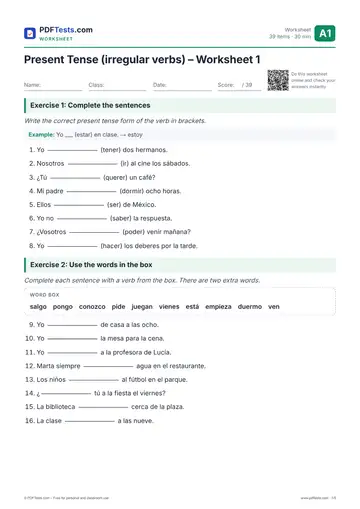
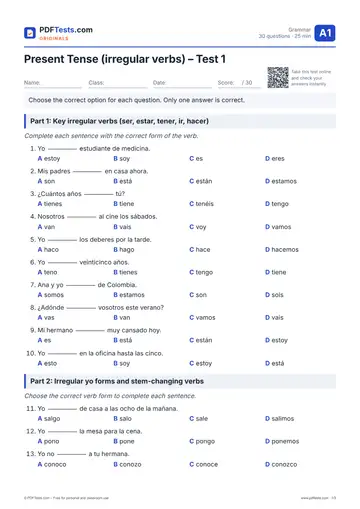
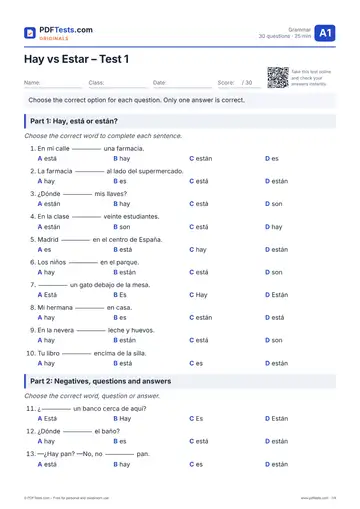
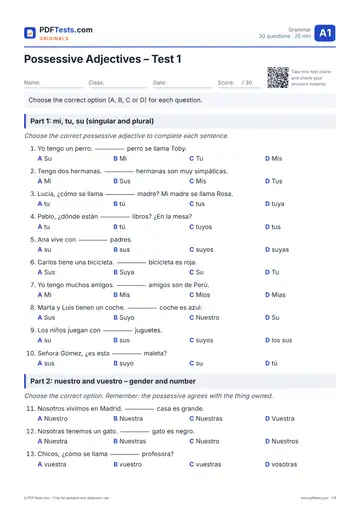
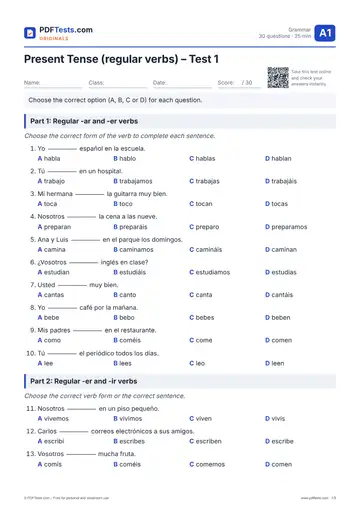
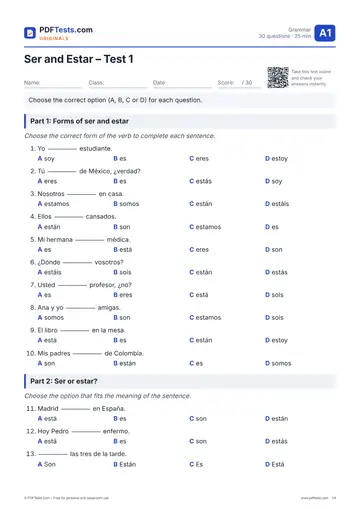
Now put these forms into practice: test yourself with our A1 Present Tense (irregular verbs) test, and if you mix up regular and irregular patterns, try the A1 Present Tense (regular verbs) test as well. When you feel confident, explore the other Spanish A1 tests to keep building your basic grammar.
Practise this topic: Spanish Present Tense Irregular Verbs
Was this page helpful?
What was the problem?
Thank you for your feedback!