Spanish has two verbs for ‘to be’: ser and estar. Use ser to say what someone or something is: name, origin, job, character, time. Use estar to say where something is or how someone is right now. At A1, a few clear rules cover almost every sentence you need.
Ser and estar at a glance
| Ser | Estar | |
|---|---|---|
| Main idea | What something is | Where it is / how it is now |
| Typical uses | name, nationality, origin, job, description, time, date, possession | location, feelings, health, temporary states |
| Example | Soy Laura. (I’m Laura.) | Estoy en casa. (I’m at home.) |
Present tense forms
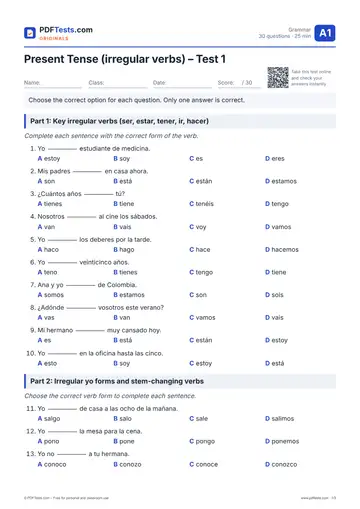
Both verbs are irregular, so you need to learn them by heart. They are among the first irregular verbs learners meet. You can see more like them in our guide to the present tense of irregular verbs.
| Person | Ser | Estar |
|---|---|---|
| yo | soy | estoy |
| tú | eres | estás |
| él / ella / usted | es | está |
| nosotros / nosotras | somos | estamos |
| vosotros / vosotras | sois | estáis |
| ellos / ellas / ustedes | son | están |
Vosotros is used in Spain. In Latin America, people use ustedes for ‘you’ (plural) in all situations.
Spanish often drops the subject pronoun, because the verb ending already shows the person. Soy de Chile is more natural than Yo soy de Chile, unless you want to stress ‘I’.
Negative and question forms
| Affirmative | Negative | Question |
|---|---|---|
| Soy estudiante. (I’m a student.) | No soy estudiante. (I’m not a student.) | ¿Eres estudiante? (Are you a student?) |
| Está cansada. (She’s tired.) | No está cansada. (She isn’t tired.) | ¿Está cansada? (Is she tired?) |
| Son de Italia. (They’re from Italy.) | No son de Italia. (They aren’t from Italy.) | ¿Son de Italia? (Are they from Italy?) |
- Negative: put no directly before the verb.
- Questions: keep the same word order and use rising intonation, or start with a question word: ¿Dónde está Ana? (Where is Ana?). Written questions need ¿ at the start and ? at the end.
Spelling note: accents on estar
Four forms of estar have a written accent: estás, está, estáis, están. The accent matters: está means ‘is’, but esta means ‘this’.
- ¿Dónde está esta calle? Where is this street?
Ser has no accents in the present tense.
When to use ser
A popular memory trick is DOCTOR: Description, Occupation, Characteristic, Time, Origin, Relationship.
1. Identity and names
- Soy Marta. I’m Marta.
- Esta es mi casa. This is my house.
2. Origin and nationality (often with de)
- Somos de Colombia. We’re from Colombia.
- Klaus es alemán. Klaus is German.
3. Occupation
- Mi madre es enfermera. My mother is a nurse.
- Son profesores. They’re teachers.
Note: Spanish does not use un/una before a job after ser: Soy médico, not Soy un médico.
4. Description and characteristics (what someone or something is like)
- Pedro es alto y simpático. Pedro is tall and friendly.
- El piso es pequeño pero bonito. The flat is small but nice.
5. Time, days and dates
- Es la una. It’s one o’clock.
- Son las cinco y media. It’s half past five.
- Hoy es martes. Today is Tuesday.
Use es for one o’clock and son for all other hours.
6. Relationships
- Carlos es mi hermano. Carlos is my brother.
- Lucía y yo somos amigas. Lucía and I are friends.
7. Possession and material (with de)
- El móvil es de Ana. The phone is Ana’s.
- La mesa es de madera. The table is made of wood.
When to use estar
For estar, remember PLACE: Position, Location, Action, Condition, Emotion.
1. Location (where people and things are)
- El banco está en la plaza. The bank is in the square.
- Madrid está en España. Madrid is in Spain.
- ¿Dónde estás? — Estoy en el trabajo. Where are you? — I’m at work.
2. Emotions and feelings
- Estoy contenta. I’m happy.
- Estamos nerviosos por el examen. We’re nervous about the exam.
3. Health and condition
- ¿Cómo estás? — Estoy bien, gracias. How are you? — I’m fine, thanks.
- Mi padre está enfermo. My father is ill.
4. Temporary states of things
- La puerta está abierta. The door is open.
- El café está frío. The coffee is cold.
5. Actions in progress (estar + -ando / -iendo)
- Estoy estudiando. I’m studying.
- Están comiendo. They’re eating.
Permanent vs temporary: a useful but imperfect rule
Many learners hear ‘ser is permanent, estar is temporary’. This works for a lot of sentences, but not all of them.
- Madrid está en España. The location is permanent, but location always takes estar.
- Son las ocho. The time changes all the time, but time always takes ser.
So it is safer to think in categories: if you are talking about location, use estar; if you are talking about time, origin or a job, use ser, whether it is permanent or not.
Same adjective, different meaning
Some adjectives can go with both verbs. Ser describes what a person or thing is like; estar describes how it is at the moment.
| With ser | With estar |
|---|---|
| Juan es aburrido. Juan is boring. | Juan está aburrido. Juan is bored. |
| Eva es lista. Eva is clever. | Eva está lista. Eva is ready. |
| Mi hijo es nervioso. My son is a nervous person. | Mi hijo está nervioso. My son is nervous (now). |
| Tu hermana es guapa. Your sister is pretty. | Tu hermana está guapa hoy. Your sister looks pretty today. |
Key questions and signal words
The question often tells you which verb to use in the answer.
| Question | Meaning | Answer |
|---|---|---|
| ¿Cómo eres? | What are you like? | Soy simpático. I’m friendly. |
| ¿Cómo estás? | How are you? | Estoy bien. I’m fine. |
| ¿De dónde eres? | Where are you from? | Soy de Perú. I’m from Peru. |
| ¿Dónde está el hotel? | Where is the hotel? | Está cerca. It’s near. |
| ¿Qué hora es? | What time is it? | Son las ocho. It’s eight. |
Signals for estar: en + place, aquí, allí, cerca, lejos, bien, mal, feelings such as cansado, contento, triste, enfadado.
Signals for ser: de + country or city, job nouns, clock times, days of the week, mi/tu/su + family member.
Ser, estar or hay?
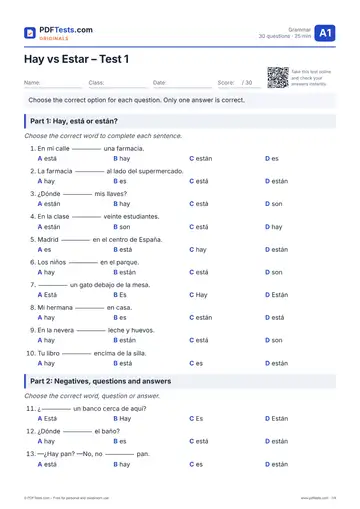
To say that something exists, use hay (there is / there are). To say where a specific thing is, use estar.
- Hay un banco en la plaza. There’s a bank in the square.
- El banco está en la plaza. The bank is in the square.
One small exception: for the place of an event, use ser: La fiesta es en mi casa. (The party is at my house.) For more practice with location, read our guide to hay vs estar.
Common mistakes
- ✗ Soy cansado. → ✓ Estoy cansado. Feelings and physical states use estar.
- ✗ Madrid es en España. → ✓ Madrid está en España. Location of places and things uses estar.
- ✗ Estoy profesora. → ✓ Soy profesora. Jobs use ser.
- ✗ Soy un médico. → ✓ Soy médico. No un/una before an unmodified job after ser.
- ✗ Estoy de México. → ✓ Soy de México. Origin uses ser + de.
- ✗ Son la una. → ✓ Es la una. One o’clock is singular: es la una.
- ✗ ¿Cómo eres? (to ask ‘How are you?’) → ✓ ¿Cómo estás? ¿Cómo eres? asks about personality.
- ✗ Soy 20 años. → ✓ Tengo 20 años. Age uses tener, not ser or estar.
- ✗ ¿Dónde esta Pablo? → ✓ ¿Dónde está Pablo? Without the accent, esta means ‘this’.
Quick check
Choose the correct form of ser or estar.
- Mi hermano ___ médico.
- ¿Dónde ___ el baño?
- Hoy nosotras ___ muy cansadas.
- ___ las tres y media.
- Vosotros ___ de Argentina, ¿verdad?
Answers
- es – occupation (My brother is a doctor.)
- está – location (Where is the bathroom?)
- estamos – physical state (Today we are very tired.)
- Son – time, plural hour (It’s half past three.)
- sois – origin (You’re from Argentina, right?)
Next step
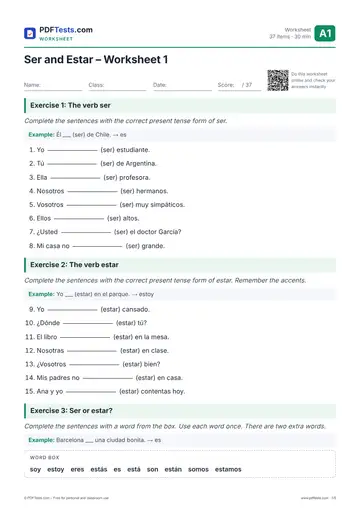
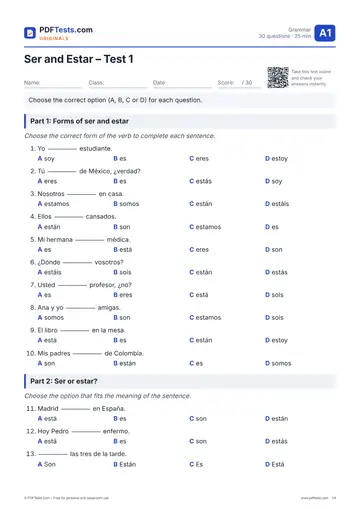
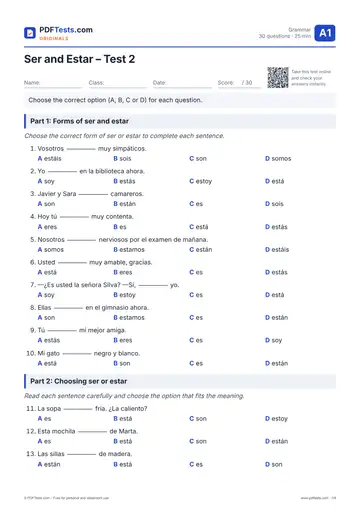
Now put the rules into practice: test yourself with our A1 Ser and Estar test, then try Ser and Estar – Test 2 to check that the rules stick with new sentences. If location still causes problems, take the A1 Hay vs Estar test. Later, when you reach a higher level, the guide to advanced uses of ser and estar explains passive forms, changes of meaning and fixed expressions.
Was this page helpful?
What was the problem?
Thank you for your feedback!