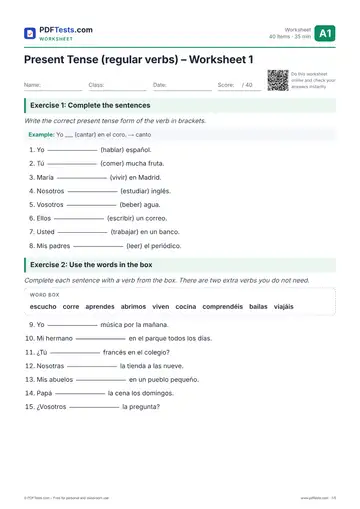
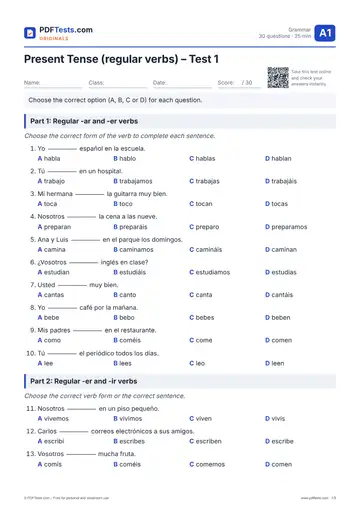
The Spanish present tense (el presente de indicativo) describes habits, facts, current situations and actions happening now. Regular verbs follow a simple pattern. You remove the infinitive ending (-ar, -er or -ir) and add a set of personal endings. Learn three patterns and you can use hundreds of everyday verbs.
When to use the present tense
Spanish uses the present tense more widely than English uses the present simple. One Spanish form often covers both I work and I am working.
1. Habits and routines
- Trabajo de lunes a viernes. I work from Monday to Friday.
- Mis padres cenan a las nueve. My parents have dinner at nine.
2. Facts and general truths
- El agua hierve a 100 grados. Water boils at 100 degrees.
- Los gatos beben agua y leche. Cats drink water and milk.
3. Current situations
- Vivo en Valencia. I live in Valencia.
- Mi hermano estudia Medicina. My brother studies medicine.
4. Actions happening now
- ¿Qué lees? — Leo una novela. What are you reading? — I’m reading a novel.
- Espero el autobús. I’m waiting for the bus.
5. Planned future with a time expression
- Mañana trabajo en casa. Tomorrow I’m working from home.
- El tren llega a las seis. The train arrives at six.
6. Offers and quick suggestions
- ¿Abro la ventana? Shall I open the window?
- ¿Tomamos un café? Shall we have a coffee?
How to form the present tense
Every Spanish infinitive ends in -ar, -er or -ir. To conjugate a regular verb:
- Take the infinitive: hablar, comer, vivir.
- Remove the last two letters to get the stem: habl-, com-, viv-.
- Add the ending that matches the subject.
-ar verbs: hablar (to speak)
| Pronoun | Form | English |
|---|---|---|
| yo | hablo | I speak |
| tú | hablas | you speak |
| él / ella / usted | habla | he / she speaks, you (formal) speak |
| nosotros / nosotras | hablamos | we speak |
| vosotros / vosotras | habláis | you all speak (Spain) |
| ellos / ellas / ustedes | hablan | they speak, you all speak |
Other common -ar verbs: trabajar (to work), estudiar (to study), escuchar (to listen), comprar (to buy), cocinar (to cook), tomar (to take, to drink), llegar (to arrive), necesitar (to need).
-er verbs: comer (to eat)
| Pronoun | Form | English |
|---|---|---|
| yo | como | I eat |
| tú | comes | you eat |
| él / ella / usted | come | he / she eats, you (formal) eat |
| nosotros / nosotras | comemos | we eat |
| vosotros / vosotras | coméis | you all eat (Spain) |
| ellos / ellas / ustedes | comen | they eat, you all eat |
Other common -er verbs: beber (to drink), leer (to read), aprender (to learn), comprender (to understand), correr (to run), vender (to sell).
-ir verbs: vivir (to live)
| Pronoun | Form | English |
|---|---|---|
| yo | vivo | I live |
| tú | vives | you live |
| él / ella / usted | vive | he / she lives, you (formal) live |
| nosotros / nosotras | vivimos | we live |
| vosotros / vosotras | vivís | you all live (Spain) |
| ellos / ellas / ustedes | viven | they live, you all live |
Other common -ir verbs: escribir (to write), abrir (to open), recibir (to receive), compartir (to share), subir (to go up), decidir (to decide).
All endings at a glance
| Subject | -ar | -er | -ir |
|---|---|---|---|
| yo | -o | -o | -o |
| tú | -as | -es | -es |
| él / ella / usted | -a | -e | -e |
| nosotros | -amos | -emos | -imos |
| vosotros | -áis | -éis | -ís |
| ellos / ellas / ustedes | -an | -en | -en |
Two shortcuts help:
- The yo form always ends in -o.
- -er and -ir verbs share the same endings except for nosotros (-emos / -imos) and vosotros (-éis / -ís).
Usted and ustedes
Usted (formal you) uses the same form as él/ella. Ustedes (plural you) uses the same form as ellos/ellas. In Latin America, ustedes is the normal plural you in all situations, and vosotros is not used.
- ¿Usted trabaja aquí? Do you work here? (formal)
- ¿Ustedes viven en Lima? Do you all live in Lima?
Subject pronouns are usually dropped
Because the ending shows who is doing the action, Spanish speakers often leave out the pronoun.
- Hablo inglés y francés. I speak English and French.
- ¿Bebes café? Do you drink coffee?
Use the pronoun for emphasis or contrast, or when habla, come and similar forms could refer to several people:
- Yo cocino y tú lavas los platos. I cook and you wash the dishes.
- Ella estudia inglés, pero él estudia alemán. She studies English, but he studies German.
Negative sentences
Put no directly before the verb. There is no extra word like English don’t.
- No trabajo los domingos. I don’t work on Sundays.
- Marta no come carne. Marta doesn’t eat meat.
- No vivimos en el centro. We don’t live in the centre.
With nunca (never), you can put it before the verb, or use no + verb + nunca:
- Nunca bebo té. / No bebo té nunca. I never drink tea.
Questions
In speech, a yes/no question is often just the statement with rising intonation. In writing, Spanish uses an opening ¿ and a closing ?.
- ¿Hablas español? Do you speak Spanish?
- ¿Tus amigos viven en Barcelona? Do your friends live in Barcelona?
You can also put the verb before the subject:
- ¿Trabaja tu hermana los sábados? Does your sister work on Saturdays?
With question words, the verb usually comes straight after the question word:
- ¿Dónde vives? Where do you live?
- ¿Qué estudia Pablo? What does Pablo study?
- ¿A qué hora abren las tiendas? What time do the shops open?
Spelling and pronunciation notes
Stress. In yo, tú, él and ellos forms, the stress falls on the stem: HA-blo, CO-mes, VI-ven. In nosotros and vosotros, it moves to the ending: ha-BLA-mos, co-MÉIS.
Written accents. Only the vosotros forms carry a written accent: habláis, coméis, vivís. Watch out for hablo vs habló: hablo means I speak, but habló is a past form meaning he/she spoke.
Small spelling changes in the yo form. A few regular verbs change one letter in the yo form to keep the same sound:
- -ger / -gir → -jo: escoger → escojo (I choose), recoger → recojo (I pick up).
- The other forms stay regular: escoges, escoge, escogemos…
Signal words
These time expressions often go with the present tense:
| Spanish | English |
|---|---|
| siempre | always |
| normalmente / generalmente | usually |
| a menudo | often |
| a veces | sometimes |
| nunca | never |
| todos los días | every day |
| los lunes, los martes… | on Mondays, on Tuesdays… |
| cada semana | every week |
| ahora / hoy | now / today |
- A veces cocinamos juntos. Sometimes we cook together.
- Los viernes bailo salsa. On Fridays I dance salsa.
Present tense vs estar + gerund
English speakers often reach for estar + gerund (estoy comiendo) whenever English uses -ing. In Spanish, the simple present is the default.
- Use the simple present for habits, facts and most actions in progress: Leo mucho. I read a lot.
- Use estar + gerund to stress that something is happening at this exact moment: Ahora estoy hablando por teléfono. I’m talking on the phone right now.
Never use estar + gerund for routines:
- ✗ Estoy trabajando todos los días. → ✓ Trabajo todos los días. I work every day.
Regular vs irregular verbs
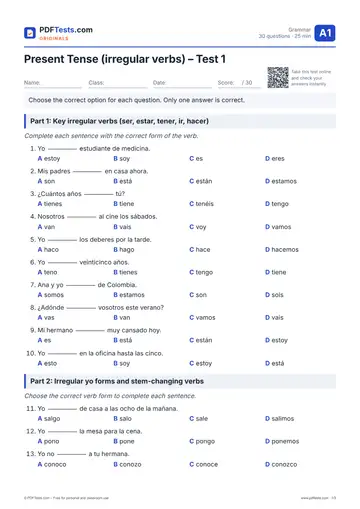
Many very common verbs, such as ser, tener, ir, hacer and querer, do not follow these patterns, or change their stem (querer → quiero). Learn the regular endings first, because irregular verbs use the same endings in most forms. When you are ready, read our guide to the present tense of irregular verbs.
Common mistakes
- ✗ Yo hablar español. → ✓ Yo hablo español. The verb must be conjugated, not left as an infinitive.
- ✗ Ella vivo en Madrid. → ✓ Ella vive en Madrid. -o is only for yo; él/ella takes -e.
- ✗ Nosotros vivemos aquí. → ✓ Nosotros vivimos aquí. -ir verbs take -imos, not -emos.
- ✗ Vosotros escribéis mucho. → ✓ Vosotros escribís mucho. -ir verbs take -ís in the vosotros form.
- ✗ ¿Usted hablas inglés? → ✓ ¿Usted habla inglés? Usted uses the third-person form.
- ✗ Yo trabajo no los lunes. → ✓ Yo no trabajo los lunes. No goes directly before the verb.
- ✗ Yo habló con mi madre. → ✓ Yo hablo con mi madre. Habló (with an accent) is past tense.
- ✗ Escogo el rojo. → ✓ Escojo el rojo. -ger verbs change g to j in the yo form.
- ✗ Estoy comiendo fruta cada mañana. → ✓ Como fruta cada mañana. Routines use the simple present.
Quick check
- Nosotros ___ (vivir) en Sevilla.
- Mi hermana ___ (trabajar) en un hospital.
- ¿Tú ___ (beber) café por la mañana?
- Make it negative: Ellos estudian los sábados.
- Correct the sentence: Yo estoy leyendo el periódico cada día.
Answers
- vivimos — We live in Seville.
- trabaja — My sister works in a hospital.
- bebes — Do you drink coffee in the morning?
- Ellos no estudian los sábados. — They don’t study on Saturdays.
- Leo el periódico cada día. — I read the newspaper every day.
Next step
Now put the endings into practice: test yourself with our A1 Present Tense (regular verbs) test and check which forms still trip you up, especially nosotros and vosotros. Then build sentences about your day with the A1 Everyday Vocabulary test, move on to the A1 Present Tense (irregular verbs) test, or browse all our Spanish A1 tests to keep building your foundation.
Practise this topic: Spanish Present Tense (Regular Verbs)
Was this page helpful?
What was the problem?
Thank you for your feedback!