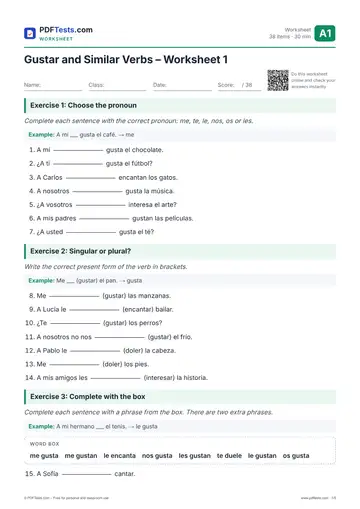
Gustar is the verb Spanish speakers use to say what they like. It works differently from English like: the thing you like is the subject, and the person who likes it is an indirect object. You use gustar, and a small group of verbs that follow the same pattern, to talk about likes, loves, interests and aches.
How gustar works
In English, the person is the subject: I like music. In Spanish, the thing is the subject, and the person receives the feeling.
- Me gusta la música. — I like music. (Literally: Music is pleasing to me.)
- Te gustan los perros. — You like dogs. (Literally: Dogs are pleasing to you.)
This has two consequences:
- The verb agrees with the thing liked, not with the person.
- The person is shown with an indirect object pronoun (me, te, le…), not a subject pronoun (yo, tú, él…).
In the present tense you only need two forms of the verb: gusta and gustan.
Form
The pronouns
| Person | Pronoun | Example | Translation |
|---|---|---|---|
| yo | me | Me gusta el té. | I like tea. |
| tú | te | Te gusta el té. | You like tea. |
| él / ella / usted | le | Le gusta el té. | He / She likes tea. You (formal) like tea. |
| nosotros / nosotras | nos | Nos gusta el té. | We like tea. |
| vosotros / vosotras | os | Os gusta el té. | You (plural, Spain) like tea. |
| ellos / ellas / ustedes | les | Les gusta el té. | They like tea. You (plural) like tea. |
Os is used in Spain. In Latin America, ustedes is the normal plural ‘you’, so speakers use les. These are the same pronouns you will use later with verbs like dar and decir; our guide to direct and indirect object pronouns explains them in more detail.
Gusta or gustan?
Look at what comes after the verb.
| What you like | Verb | Example | Translation |
|---|---|---|---|
| One thing (singular noun) | gusta | Me gusta el chocolate. | I like chocolate. |
| Two or more things (plural noun) | gustan | Me gustan las fresas. | I like strawberries. |
| An action (infinitive) | gusta | Me gusta cocinar. | I like cooking. |
| Two or more actions | gusta | Me gusta leer y nadar. | I like reading and swimming. |
| Two or more nouns | gustan | Me gustan el fútbol y el tenis. | I like football and tennis. |
Notice the article. When you talk about things you like in general, Spanish uses the definite article (el, la, los, las): Me gusta el café — I like coffee, not Me gusta café. If you are unsure which article a noun takes, review articles and gender in Spanish.
Negatives and questions
To make a negative, put no before the pronoun. For a question, keep the same word order and add question marks (and rising intonation when you speak).
| Form | Example | Translation |
|---|---|---|
| Affirmative | Te gusta el cine. | You like the cinema. |
| Negative | No te gusta el cine. | You don’t like the cinema. |
| Question | ¿Te gusta el cine? | Do you like the cinema? |
| Negative question | ¿No te gusta el cine? | Don’t you like the cinema? |
The order is always no + pronoun + verb. Nothing goes between the pronoun and the verb.
To say how much you like something, add mucho or nada after the verb:
- Me gusta mucho el verano. — I like summer a lot.
- No me gusta nada el frío. — I don’t like the cold at all.
Two very useful questions:
- ¿Qué te gusta hacer? — What do you like doing?
- ¿Qué música te gusta? — What music do you like?
Adding a mí, a ti, a él…
You will often hear an extra phrase at the start of the sentence: A mí me gusta… This phrase adds emphasis or contrast, or makes le and les clear. It does not replace the pronoun; you still need me, te, le, etc.
| Extra phrase | Pronoun | Example | Translation |
|---|---|---|---|
| a mí | me | A mí me gusta el rock. | I like rock. |
| a ti | te | A ti te gusta el pop. | You like pop. |
| a él / a ella / a usted | le | A ella le gusta el jazz. | She likes jazz. |
| a nosotros / a nosotras | nos | A nosotros nos gusta la salsa. | We like salsa. |
| a vosotros / a vosotras | os | A vosotros os gusta el flamenco. | You (plural) like flamenco. |
| a ellos / a ellas / a ustedes | les | A ellos les gusta el reguetón. | They like reggaeton. |
Spelling note: mí (me) has an accent; mi without an accent means ‘my’. Ti never has an accent.
Making le and les clear
Le gusta el pescado can mean he likes fish, she likes fish or you (formal) like fish. Add a + person to be clear:
- A Carlos le gusta el pescado. — Carlos likes fish.
- A mis padres les gusta viajar. — My parents like travelling.
- ¿A usted le gusta el pescado? — Do you like fish? (formal)
Even with a name, keep le or les: A Carlos le gusta, never A Carlos gusta.
Agreeing and disagreeing
Because gustar uses a mí, a ti and so on, short replies also use these phrases, not yo or tú.
| Someone says | You reply | Meaning |
|---|---|---|
| Me gusta el café. (I like coffee.) | A mí también. | Me too. |
| Me gusta el café. (I like coffee.) | A mí no. | I don’t. |
| No me gusta el café. (I don’t like coffee.) | A mí tampoco. | Me neither. |
| No me gusta el café. (I don’t like coffee.) | A mí sí. | I do. |
Use también to agree with a positive sentence and tampoco to agree with a negative one.
Verbs like gustar
Several common verbs follow exactly the same pattern: same pronouns, and the verb agrees with the thing.
| Verb | Meaning | Singular | Plural |
|---|---|---|---|
| encantar | to love (things, activities) | Me encanta la playa. I love the beach. | Me encantan los tacos. I love tacos. |
| interesar | to interest | Nos interesa el arte. We’re interested in art. | Nos interesan los idiomas. We’re interested in languages. |
| doler (o → ue) | to hurt, to ache | Me duele la cabeza. My head hurts. | Me duelen los pies. My feet hurt. |
| molestar | to bother, to annoy | Le molesta el ruido. The noise bothers him. | Le molestan los mosquitos. Mosquitoes annoy her. |
| apetecer (mainly Spain) | to feel like | ¿Te apetece un café? Do you feel like a coffee? | Me apetecen unas tapas. I feel like some tapas. |
Two notes:
- Encantar is already strong, so do not add mucho: Me encanta bailar — I love dancing.
- With doler, use the article with body parts, not a possessive: Me duele la espalda — My back hurts.
Gustar compared with querer
Learners often mix up gustar and querer. Gustar means ‘to like’. Querer means ‘to want’ or, with people, ‘to love’.
- Me gusta el helado. — I like ice cream. (in general)
- Quiero un helado. — I want an ice cream. (now)
- Quiero mucho a mi abuela. — I love my grandma very much.
So for people you love, such as family, use querer, not encantar.
Liking people: me gustas
When the thing liked is a person, gustar agrees with that person. Be careful: with people, gustar usually suggests attraction.
- Me gustas. — I like you. (I’m attracted to you.)
- ¿Te gusto? — Do you like me?
- A Pablo le gusta Marta. — Pablo likes Marta.
To say you like someone as a person, without romance, Spanish speakers often say Me cae bien Ana — I like Ana / I get on well with Ana.
Common mistakes
- ✗ Yo gusto la pizza. → ✓ Me gusta la pizza. I like pizza. — The person is a pronoun like me, not the subject yo.
- ✗ Me gusta los perros. → ✓ Me gustan los perros. I like dogs. — A plural thing needs gustan.
- ✗ Me gustan bailar y cantar. → ✓ Me gusta bailar y cantar. I like dancing and singing. — Infinitives always take gusta.
- ✗ A Ana gusta el cine. → ✓ A Ana le gusta el cine. Ana likes the cinema. — The pronoun is required, even with a name.
- ✗ Mí me gusta el té. → ✓ A mí me gusta el té. I like tea. — The phrase needs a, and mí needs an accent.
- ✗ Me no gusta el té. → ✓ No me gusta el té. I don’t like tea. — No goes before the pronoun.
- ✗ Me gusta café. → ✓ Me gusta el café. I like coffee. — General likes need the definite article.
- ✗ Me encanta mucho el chocolate. → ✓ Me encanta el chocolate. I love chocolate. — Encantar already means ‘like a lot’.
- ✗ Me duele mi cabeza. → ✓ Me duele la cabeza. My head hurts. — Use the article with body parts.
- ✗ Yo también. (replying to Me gusta el café) → ✓ A mí también. Me too. — Replies follow the gustar pattern.
Quick check
Complete or correct each sentence.
- A mí me ___ (gustar) los gatos.
- ¿___ gusta bailar? (to a friend)
- A mis padres ___ gusta viajar.
- Me ___ (doler) los pies.
- Correct the mistake: Yo gusto el chocolate.
Answers
- gustan — A mí me gustan los gatos. I like cats. (plural noun)
- Te — ¿Te gusta bailar? Do you like dancing?
- les — A mis padres les gusta viajar. My parents like travelling.
- duelen — Me duelen los pies. My feet hurt. (plural noun, o → ue)
- Me gusta el chocolate. I like chocolate.
Next step
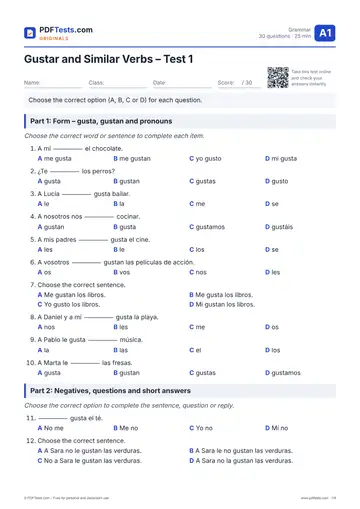
Now put the rules into practice with our A1 Gustar and Similar Verbs test, paying close attention to gusta versus gustan and to the pronoun before the verb. To build the nouns you need for talking about your likes, try the A1 Everyday Vocabulary test on family, home and daily routine, then explore the full set of Spanish A1 tests to review the rest of the level.
Was this page helpful?
What was the problem?
Thank you for your feedback!