Spanish has two main past tenses. The preterite (pretérito indefinido) tells you what happened: completed actions with a clear start or end. The imperfect (pretérito imperfecto) describes how things were: background, habits and actions in progress. Most stories need both, and choosing correctly depends on how you see the action, not just on when it happened.
The core difference
Think of a film. The imperfect is the scenery and the background music. The preterite is the plot: the events that move the story forward.
- Llovía y hacía frío. It was raining and it was cold. (background)
- Salí de casa y cogí un taxi. I left the house and took a taxi. (events)
Ask yourself one question: Is this action finished and complete, or am I describing it as ongoing or repeated? Finished and complete points to the preterite. Ongoing, repeated or descriptive points to the imperfect.
When to use the preterite
1. Single completed actions
- Ayer compré un móvil nuevo. Yesterday I bought a new phone.
- Mi hermana llamó a las ocho. My sister called at eight.
2. A sequence of events
- Me levanté, me duché y desayuné. I got up, showered and had breakfast.
3. Actions with a defined length of time
If you say exactly how long something lasted, and that period is over, use the preterite, even when the period is long.
- Viví en Madrid cinco años. I lived in Madrid for five years.
- Estuvimos dos horas en el museo. We were in the museum for two hours.
4. Actions that interrupt another action
- Estaba en la ducha cuando sonó el teléfono. I was in the shower when the phone rang.
When to use the imperfect
1. Habits and repeated actions in the past
This is often translated as used to or would in English.
- De niño, jugaba al fútbol todos los sábados. As a child, I used to play football every Saturday.
- Mis abuelos vivían en un pueblo. My grandparents lived in a village.
2. Descriptions of people, places and things
- La casa era pequeña pero tenía un jardín precioso. The house was small but it had a lovely garden.
- Mi profesora era muy simpática. My teacher was very nice.
3. Time, age, weather and feelings
- Eran las once de la noche. It was eleven at night.
- Tenía diez años. I was ten years old.
- Hacía sol y estábamos contentos. It was sunny and we were happy.
4. Actions in progress
- Mientras cocinaba, escuchaba la radio. While I was cooking, I was listening to the radio.
Form at a glance
Regular endings
| Person | Preterite -ar (hablar) | Preterite -er/-ir (comer) | Imperfect -ar (hablar) | Imperfect -er/-ir (comer) |
|---|---|---|---|---|
| yo | hablé | comí | hablaba | comía |
| tú | hablaste | comiste | hablabas | comías |
| él / ella / usted | habló | comió | hablaba | comía |
| nosotros | hablamos | comimos | hablábamos | comíamos |
| vosotros | hablasteis | comisteis | hablabais | comíais |
| ellos / ustedes | hablaron | comieron | hablaban | comían |
-ir verbs follow the -er pattern in both tenses: viví, vivió (preterite) and vivía, vivíamos (imperfect).
Key irregular verbs
The imperfect has only three irregular verbs. The preterite has many more; here are the most common.
| Verb | Preterite (yo / él) | Imperfect (yo / él) |
|---|---|---|
| ser | fui / fue | era / era |
| ir | fui / fue | iba / iba |
| ver | vi / vio | veía / veía |
| tener | tuve / tuvo | tenía / tenía |
| estar | estuve / estuvo | estaba / estaba |
| hacer | hice / hizo | hacía / hacía |
| poder | pude / pudo | podía / podía |
Note that ser and ir share the same preterite forms: Fui a Roma (I went to Rome) and Fui camarero (I was a waiter). Context tells you which verb it is.
Spelling and accent notes
- In the preterite, the accent matters: hablo (I speak) vs habló (he spoke); hablé (I spoke).
- Verbs ending in -car, -gar, -zar change spelling in the yo form of the preterite: busqué, llegué, empecé.
- In the imperfect, only the nosotros form of -ar verbs has an accent: hablábamos. All -er/-ir forms carry an accent on the í: comía, vivíamos.
- Vi and fui have no accent.
For full conjugations, see our guides to the preterite and the imperfect.
Using both tenses together
The most common pattern combines the two tenses: an action in progress (imperfect) is interrupted by a new event (preterite).
- Cuando llegué, mis amigos cenaban. When I arrived, my friends were having dinner.
- Mientras caminaba por el parque, vi a mi ex. While I was walking in the park, I saw my ex.
Mientras (while) usually introduces the background action, so it is normally followed by the imperfect. Cuando (when) can go with either tense, depending on the meaning.
Compare:
- Cuando vivía en Londres, iba mucho al teatro. When I lived in London, I used to go to the theatre a lot. (background + habit)
- Cuando llegó el tren, subimos. When the train arrived, we got on. (two events, one after the other)
Signal words
These words often point to one tense. They are useful clues, but always check the meaning of the whole sentence.
| Usually preterite | Usually imperfect |
|---|---|
| ayer (yesterday) | siempre (always) |
| anoche (last night) | todos los días (every day) |
| la semana pasada (last week) | a menudo (often) |
| el año pasado (last year) | normalmente (usually) |
| en 2020 (in 2020) | de niño / de pequeño (as a child) |
| hace tres días (three days ago) | cuando era joven (when I was young) |
| de repente (suddenly) | mientras (while) |
| una vez, dos veces (once, twice) | antes (before, in the past) |
The signal word does not decide the tense on its own. Compare Ayer llovía cuando salí (Yesterday it was raining when I left) with Ayer llovió mucho (Yesterday it rained a lot). Both are correct: the first describes the background, the second reports a complete event.
Verbs that change meaning
A few common verbs translate differently depending on the tense.
| Verb | Preterite | Imperfect |
|---|---|---|
| conocer | Conocí a Marta en 2019. I met Marta in 2019. | Conocía bien la ciudad. I knew the city well. |
| saber | Supe la noticia ayer. I found out the news yesterday. | Sabía la respuesta. I knew the answer. |
| tener | Tuve una idea. I had (got) an idea. | Tenía un perro. I had a dog. |
The preterite marks the moment something started or happened. The imperfect describes an ongoing state.
A short story with both tenses
Read this paragraph and notice which tense each verb uses.
Era sábado y hacía mucho calor. Yo estaba en la playa con mis amigos. Todos leían o tomaban el sol. De repente, un perro corrió hacia nosotros y cogió mi bocadillo. Todos nos reímos.
It was Saturday and it was very hot. I was at the beach with my friends. Everyone was reading or sunbathing. Suddenly, a dog ran towards us and grabbed my sandwich. We all laughed.
The imperfect (era, hacía, estaba, leían, tomaban) sets the scene. The preterite (corrió, cogió, nos reímos) tells you what happened.
Common mistakes
- ✗ Ayer iba al cine. → ✓ Ayer fui al cine. Yesterday I went to the cinema. A single completed event needs the preterite.
- ✗ Cuando fui niño, viví en Sevilla. → ✓ Cuando era niño, vivía en Sevilla. When I was a child, I lived in Seville. Childhood is background, so use the imperfect.
- ✗ Mientras cociné, sonó el teléfono. → ✓ Mientras cocinaba, sonó el teléfono. While I was cooking, the phone rang. The action in progress takes the imperfect.
- ✗ Trabajaba allí tres años. → ✓ Trabajé allí tres años. I worked there for three years. A defined, finished period takes the preterite.
- ✗ Fueron las diez cuando llegué. → ✓ Eran las diez cuando llegué. It was ten o’clock when I arrived. Clock time in the past is always imperfect.
- ✗ Hablo con ella ayer. → ✓ Hablé con ella ayer. I spoke to her yesterday. Without the accent, you have the present tense.
- ✗ Tuve ocho años en esta foto. → ✓ Tenía ocho años en esta foto. I was eight in this photo. Age in the past is described with the imperfect.
Quick check
Choose the preterite or the imperfect.
- De pequeña, Ana ___ (jugar) en el parque todos los días.
- Ayer nosotros ___ (comer) en un restaurante mexicano.
- Mientras yo ___ (ducharse), llegó mi hermano.
- ___ (ser) las diez de la noche y ___ (llover).
- El año pasado ___ (ir, yo) a Perú y ___ (ver) Machu Picchu.
Answers
- jugaba – a past habit (todos los días).
- comimos – a single completed action (ayer).
- me duchaba – an action in progress interrupted by llegó.
- Eran, llovía – time and weather as background.
- fui, vi – completed events in a finished period.
Next step
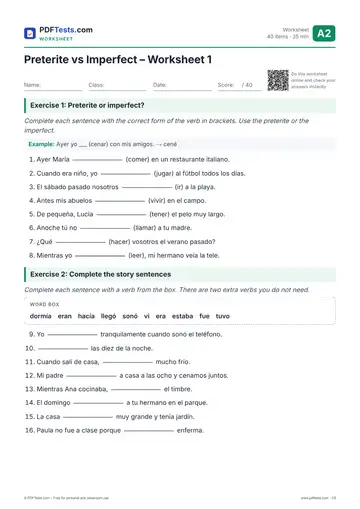
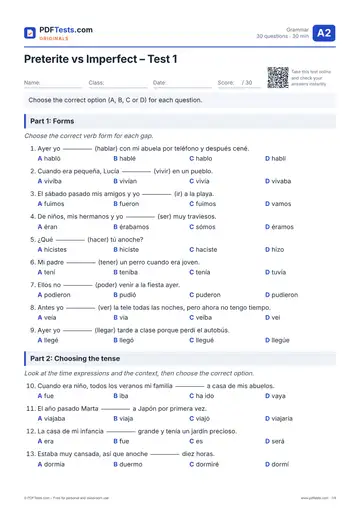
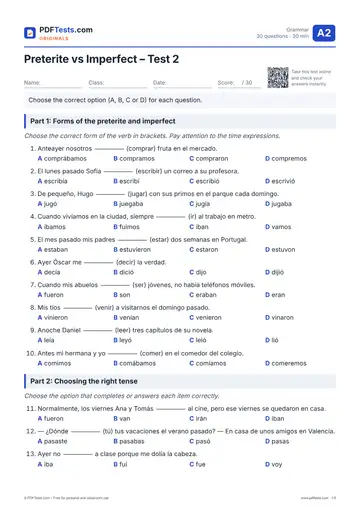
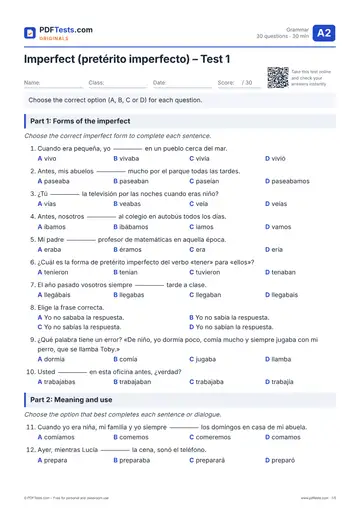
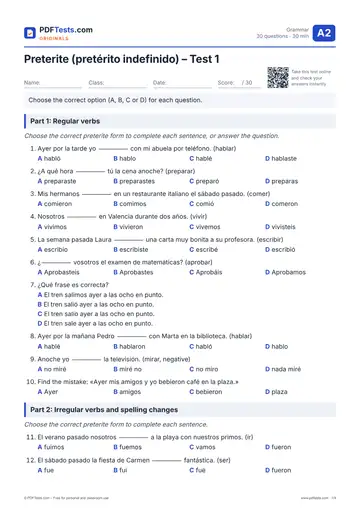
The best way to master this contrast is to practise it in context. Start with our A2 Preterite vs Imperfect test 1, then try Preterite vs Imperfect test 2 to check you can choose the right tense in new sentences. If the endings themselves still slow you down, review them first with the individual guides above, and when you feel confident, explore more practice in our Spanish A2 tests.
Was this page helpful?
What was the problem?
Thank you for your feedback!