PDFTests Originals

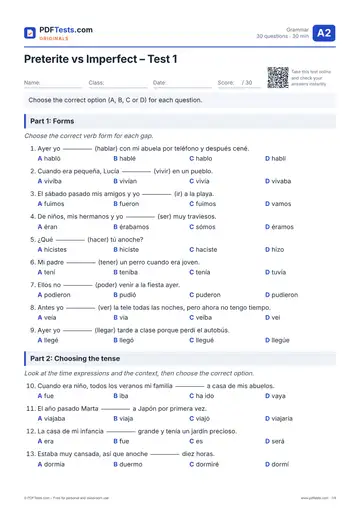
Preterite vs Imperfect – Worksheet 1

A2 Elementary WorksheetSpanish

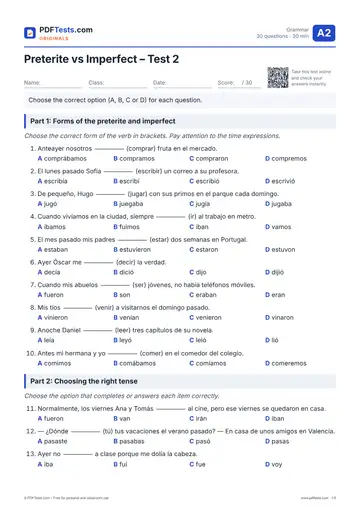
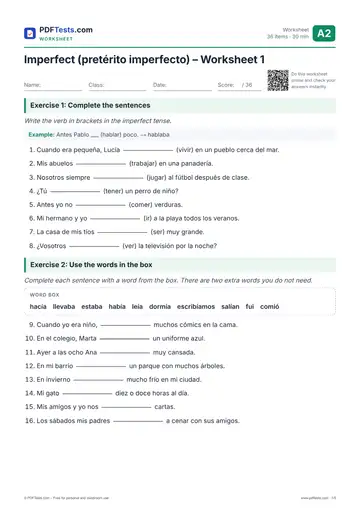
This worksheet helps A2 learners of Spanish choose between the preterite and the imperfect. Students practise both forms, time expressions such as ayer, antes and todos los días, interrupted actions with cuando and mientras, and negative sentences and questions. It suits classroom use or self-study.
items
40
Time
35 min
PDF
5 pages
Answer key
Included
  • 100% free
  • No sign-up or email
  • Print-ready A4 PDF
Preview of page 1 of Preterite vs Imperfect – Worksheet 1 Open PDF
New to this topic? Read the guide first: Preterite vs Imperfect in Spanish: Rules, Examples and Common Mistakes

Do the worksheet online

Type your answers, then press “Check my answers”. Alternative correct answers are accepted.

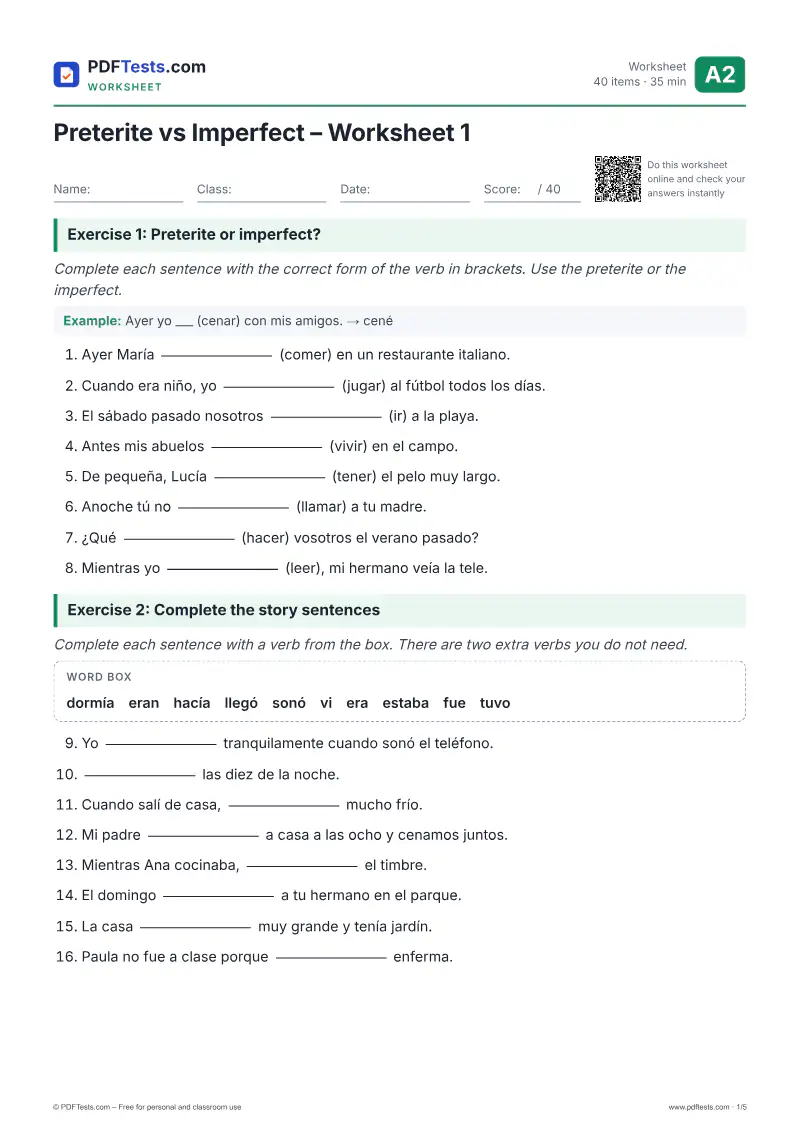
Exercise 1: Preterite or imperfect?

Complete each sentence with the correct form of the verb in brackets. Use the preterite or the imperfect.

Example: Ayer yo ___ (cenar) con mis amigos. → cené

  1. Ayer María (comer) en un restaurante italiano.

  2. Cuando era niño, yo (jugar) al fútbol todos los días.

  3. El sábado pasado nosotros (ir) a la playa.

  4. Antes mis abuelos (vivir) en el campo.

  5. De pequeña, Lucía (tener) el pelo muy largo.

  6. Anoche tú no (llamar) a tu madre.

  7. ¿Qué (hacer) vosotros el verano pasado?

  8. Mientras yo (leer), mi hermano veía la tele.

Exercise 2: Complete the story sentences

Complete each sentence with a verb from the box. There are two extra verbs you do not need.

Word box dormíaeranhacíallegósonóvieraestabafuetuvo

  1. Yo tranquilamente cuando sonó el teléfono.

  2. las diez de la noche.

  3. Cuando salí de casa, mucho frío.

  4. Mi padre a casa a las ocho y cenamos juntos.

  5. Mientras Ana cocinaba, el timbre.

  6. El domingo a tu hermano en el parque.

  7. La casa muy grande y tenía jardín.

  8. Paula no fue a clase porque enferma.

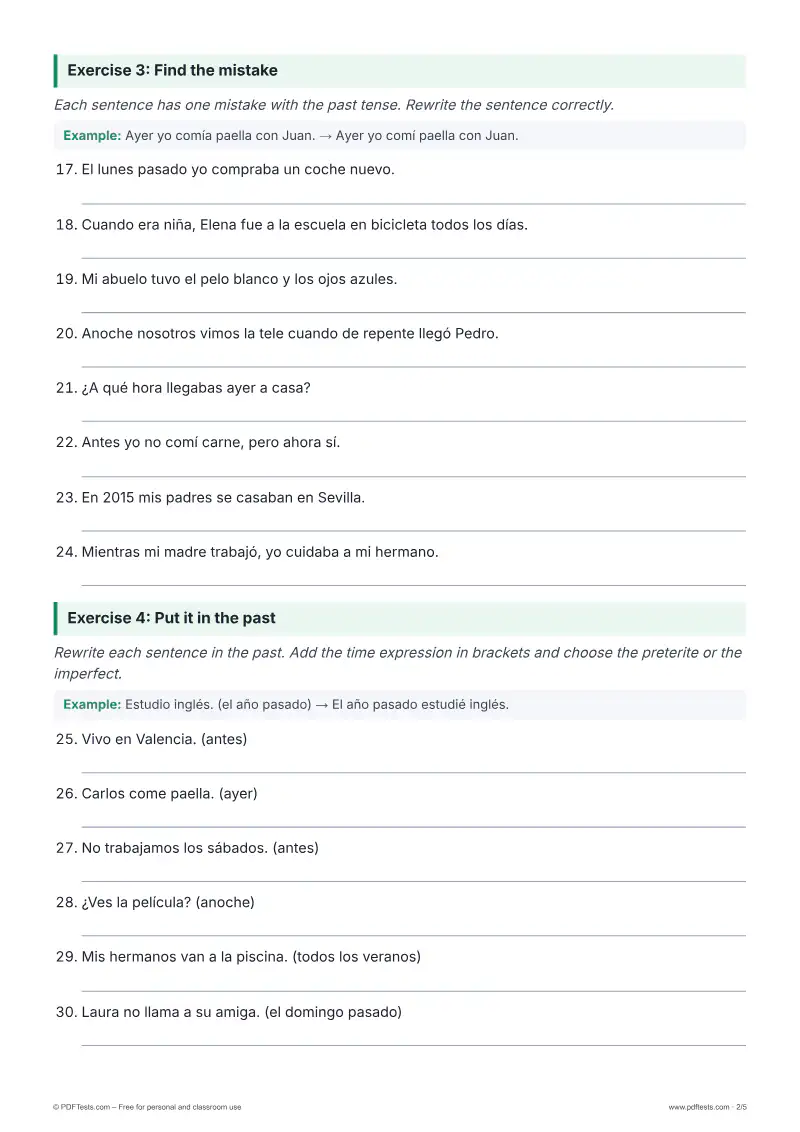
Exercise 3: Find the mistake

Each sentence has one mistake with the past tense. Rewrite the sentence correctly.

Example: Ayer yo comía paella con Juan. → Ayer yo comí paella con Juan.

  1. El lunes pasado yo compraba un coche nuevo.

  2. Cuando era niña, Elena fue a la escuela en bicicleta todos los días.

  3. Mi abuelo tuvo el pelo blanco y los ojos azules.

  4. Anoche nosotros vimos la tele cuando de repente llegó Pedro.

  5. ¿A qué hora llegabas ayer a casa?

  6. Antes yo no comí carne, pero ahora sí.

  7. En 2015 mis padres se casaban en Sevilla.

  8. Mientras mi madre trabajó, yo cuidaba a mi hermano.

Exercise 4: Put it in the past

Rewrite each sentence in the past. Add the time expression in brackets and choose the preterite or the imperfect.

Example: Estudio inglés. (el año pasado) → El año pasado estudié inglés.

  1. Vivo en Valencia. (antes)

  2. Carlos come paella. (ayer)

  3. No trabajamos los sábados. (antes)

  4. ¿Ves la película? (anoche)

  5. Mis hermanos van a la piscina. (todos los veranos)

  6. Laura no llama a su amiga. (el domingo pasado)

  7. ¿Dónde viven tus padres? (antes)

  8. Hacemos un examen. (el martes pasado)

Exercise 5: Put the words in order

Put the words in the correct order to make sentences and questions. Add capital letters and punctuation.

Example: ayer / al / fui / mercado → Ayer fui al mercado.

  1. de pequeña / gatos / tenía / dos

  2. viniste / por qué / no / ayer

  3. las / eran / de la noche / once

  4. cine / el / fuimos / al / sábado

  5. dormía / el / bebé / cuando / llamaste

  6. tu / qué / hiciste / cumpleaños / en

  7. hacía / no / calor / mucho

  8. mi / profesor / muy / era / simpático

Was this page helpful?

Report a mistake

Spotted a wrong answer, a typo or an unclear explanation? Tell us and we will fix it.

Preview

About this test

Printable A2 Spanish worksheet on preterite vs imperfect: forms, uses, time markers, negatives and questions, with an answer key.

Topics covered

Preterite tenseImperfect tenseTime expressionsInterrupted actions (cuando / mientras)Descriptions in the pastPast questions and negatives

Notes for teachers

Start by eliciting the key time markers. Ayer, anoche and el año pasado usually go with the preterite. Antes, de pequeño, siempre and todos los días usually go with the imperfect. A common mistake is using the preterite for descriptions such as age, weather, time or appearance. Learners also often mix up the irregular preterites fui, hice and tuve. As a follow-up, ask students to write a short paragraph about a childhood memory, using the imperfect for the background and the preterite for one special event.

All Spanish A2 tests →