Spanish has two common ways to talk about the future. The first is ir a + infinitive (voy a estudiar, I’m going to study), and the second is the simple future tense (estudiaré, I will study). Use ir a for plans and things that are about to happen. Use the simple future for predictions, promises and more formal or distant statements. At A2 you need to form both correctly and know which one sounds natural.
Two ways to talk about the future
Compare these two sentences:
- Voy a viajar a México en julio. I’m going to travel to Mexico in July.
- Algún día viajaré a México. One day I will travel to Mexico.
Both are correct. The first is a concrete plan. The second is a more general or distant idea. In everyday conversation, ir a + infinitive is very common. You will often hear it where English uses will.
Ir a + infinitive
Form
Conjugate the verb ir in the present tense. Then add a and a verb in the infinitive (the -ar, -er or -ir form). Only ir changes. The infinitive never changes.
| Subject | ir (present) | + a + infinitive | Example |
|---|---|---|---|
| yo | voy | a + infinitive | Voy a cocinar. I’m going to cook. |
| tú | vas | a + infinitive | Vas a llegar tarde. You’re going to be late. |
| él / ella / usted | va | a + infinitive | Va a llamar. She’s going to call. |
| nosotros/as | vamos | a + infinitive | Vamos a salir. We’re going to go out. |
| vosotros/as | vais | a + infinitive | Vais a ganar. You’re going to win. |
| ellos / ellas / ustedes | van | a + infinitive | Van a mudarse. They’re going to move. |
If you need to review ir and other irregular present forms, see our guide to the Spanish present tense with irregular verbs.
Negative and questions
For the negative, put no before the form of ir. For questions, change your intonation or add a question word. You don’t need an extra word like English do.
| Type | Example |
|---|---|
| Affirmative | Voy a trabajar mañana. I’m going to work tomorrow. |
| Negative | No voy a trabajar mañana. I’m not going to work tomorrow. |
| Yes/no question | ¿Vas a venir a la fiesta? Are you going to come to the party? |
| Wh- question | ¿Qué vais a hacer este verano? What are you going to do this summer? |
Uses
1. Plans and intentions. This is the most common use. You have already decided to do something.
- Este fin de semana voy a limpiar el piso. This weekend I’m going to clean the flat.
- Vamos a ver una serie esta noche. We’re going to watch a series tonight.
2. Predictions based on what you can see now. There is evidence in the present situation.
- Mira esas nubes. Va a llover. Look at those clouds. It’s going to rain.
- Corre, ¡el autobús va a salir! Run, the bus is about to leave.
3. Things that will happen very soon.
- Un momento, voy a abrir la puerta. One moment, I’m going to open the door.
Note that ir a ir is perfectly correct: Voy a ir al médico. I’m going to go to the doctor.
Where to put pronouns
With reflexive and object pronouns, you have two correct options. Put the pronoun before ir, or attach it to the end of the infinitive.
- Me voy a duchar. / Voy a ducharme. I’m going to have a shower.
- Lo voy a comprar. / Voy a comprarlo. I’m going to buy it.
Never put the pronoun between a and the infinitive. For more practice, see our guides to reflexive verbs and direct and indirect object pronouns.
The simple future tense (futuro simple)
Regular verbs
The simple future is easy to form. Take the whole infinitive and add the endings. The endings are the same for -ar, -er and -ir verbs.
| Subject | Ending | hablar | comer | vivir |
|---|---|---|---|---|
| yo | -é | hablaré | comeré | viviré |
| tú | -ás | hablarás | comerás | vivirás |
| él / ella / usted | -á | hablará | comerá | vivirá |
| nosotros/as | -emos | hablaremos | comeremos | viviremos |
| vosotros/as | -éis | hablaréis | comeréis | viviréis |
| ellos / ellas / ustedes | -án | hablarán | comerán | vivirán |
Spelling note: every form has a written accent except nosotros (-emos). The accent matters. Hablara without an accent is a different verb form.
The verbs ser and ir are regular in the future: seré, iré.
Irregular verbs
A small group of common verbs changes its stem. The endings stay the same.
| Infinitive | Stem | yo form | English |
|---|---|---|---|
| tener | tendr- | tendré | I will have |
| poner | pondr- | pondré | I will put |
| salir | saldr- | saldré | I will leave |
| venir | vendr- | vendré | I will come |
| poder | podr- | podré | I will be able to |
| saber | sabr- | sabré | I will know |
| querer | querr- | querré | I will want |
| haber | habr- | habrá (hay) | there will be |
| hacer | har- | haré | I will do / make |
| decir | dir- | diré | I will say |
These stems fall into three groups:
- Lose the vowel: poder → podr-, saber → sabr-, querer → querr-, haber → habr-.
- Vowel replaced by d: tener → tendr-, poner → pondr-, salir → saldr-, venir → vendr-.
- Completely irregular: hacer → har-, decir → dir-.
The same stems are used in the conditional (tendría, haría). Learning them now will help you later with the conditional tense.
Uses
1. General predictions about the future, often more distant or less certain.
- En el futuro, los coches serán eléctricos. In the future, cars will be electric.
- Creo que mañana hará sol. I think it will be sunny tomorrow.
2. Promises and decisions.
- Te llamaré esta noche, te lo prometo. I’ll call you tonight, I promise.
- No volveré a llegar tarde. I won’t be late again.
3. Formal or written language, such as news, forecasts and official announcements.
- El presidente viajará a Chile la próxima semana. The president will travel to Chile next week.
- Mañana habrá tormentas en el norte. Tomorrow there will be storms in the north.
4. Guesses about the present. This use is for recognition at A2. The future can show that you are not sure about something happening now.
- ¿Dónde está Ana? — Estará en el trabajo. Where’s Ana? She’s probably at work.
The present tense for the future
Spanish also uses the simple present for fixed arrangements and timetables, just like English does.
- Mañana tengo un examen. I have an exam tomorrow.
- El tren sale a las ocho. The train leaves at eight.
Ir a + infinitive vs the simple future
| Ir a + infinitive | Simple future | |
|---|---|---|
| Typical meaning | plans, intentions, immediate future | predictions, promises, distant future |
| Evidence now? | often yes (Va a llover) | not necessary (Lloverá en abril) |
| Register | very common in speech | common in writing and formal speech |
| Example | Voy a estudiar Medicina. I’m going to study Medicine. | Algún día seré médico. One day I’ll be a doctor. |
In many everyday situations both are possible, and the difference is small. If you are unsure in conversation, ir a + infinitive is usually the safe and natural choice for plans.
Signal words
These time expressions often appear with future forms:
- mañana (tomorrow), pasado mañana (the day after tomorrow)
- esta noche / esta tarde (tonight / this afternoon)
- este fin de semana (this weekend)
- la semana que viene / la próxima semana (next week)
- el mes que viene, el año que viene (next month, next year)
- dentro de dos días / dentro de un año (in two days / in a year)
- pronto (soon), algún día (one day), en el futuro (in the future)
Common mistakes
- ✗ Voy comer a las dos. → ✓ Voy a comer a las dos. Ir always needs a before the infinitive.
- ✗ Vamos a estudiamos. → ✓ Vamos a estudiar. Only ir is conjugated, and the second verb stays in the infinitive.
- ✗ Voy a me duchar. → ✓ Me voy a duchar / Voy a ducharme. Pronouns go before ir or attached to the infinitive.
- ✗ Teneré tiempo mañana. → ✓ Tendré tiempo mañana. Tener has the irregular stem tendr-.
- ✗ Haceré los deberes. → ✓ Haré los deberes. Hacer uses the stem har-.
- ✗ Mañana hablare con él. → ✓ Mañana hablaré con él. Future forms need the written accent, except nosotros.
- ✗ Si lloverá, no saldremos. → ✓ Si llueve, no saldremos. After si (if), use the present, not the future.
Quick check
- Esta noche (yo) ___ (ir a + cenar) con mis padres.
- Mira el cielo. ___ (ir a + llover).
- El año que viene, mi hermana ___ (tener, future) dieciocho años.
- Correct the mistake: Mañana voy salir temprano.
- ¿Qué ___ (hacer, nosotros, future) en verano?
Answers:
- voy a cenar
- Va a llover
- tendrá
- Mañana voy a salir temprano.
- haremos
Next step
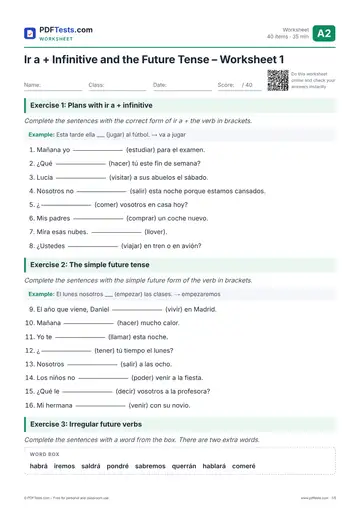
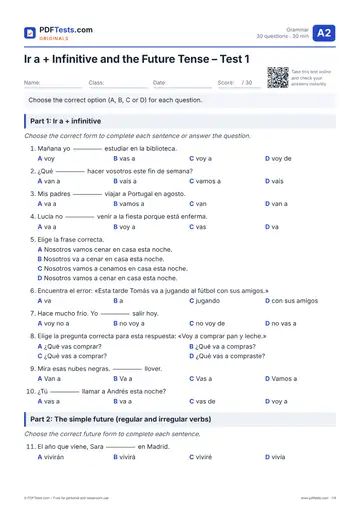
Now put both future forms into practice with our A2 Ir a + Infinitive and Future Tense test. It mixes plans, predictions and irregular stems, so you can see which ones still need work. When you feel confident, take the Spanish Level Test A2 to check how the future fits with the rest of your A2 grammar.
Practise this topic: Ir a + Infinitive and the Future Tense in Spanish
Was this page helpful?
What was the problem?
Thank you for your feedback!