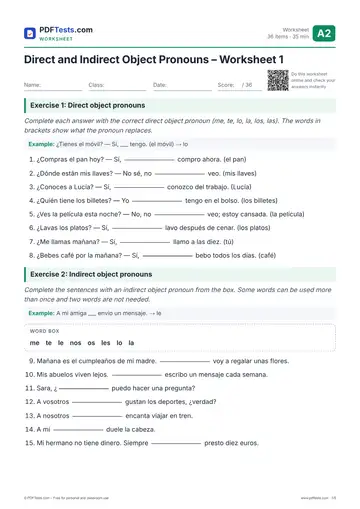
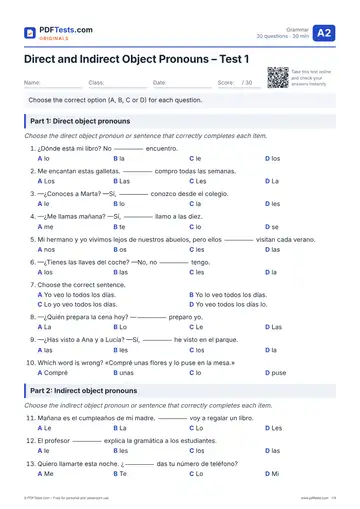
Spanish object pronouns are short words like lo, la, le and me that replace a noun so you don’t have to repeat it. Direct object pronouns replace the thing or person that receives the action (Lo compro: I buy it). Indirect object pronouns replace the person who receives the thing or benefits from the action (Le compro un regalo: I buy him/her a present).
What is a direct object and an indirect object?
The direct object answers the question what? or whom? after the verb.
- Compro el pan. I buy the bread. (What do I buy? The bread.)
- Veo a Carlos. I see Carlos. (Whom do I see? Carlos.)
The indirect object answers to whom? or for whom? It is usually a person, and in Spanish it is introduced by a.
- Doy el pan a mi hermana. I give the bread to my sister.
- Escribo un correo a mis padres. I write an email to my parents.
In the first example, el pan is the direct object and a mi hermana is the indirect object. Each one has its own set of pronouns.
Direct object pronouns
| Person | Pronoun | English |
|---|---|---|
| yo | me | me |
| tú | te | you |
| él / usted (masc.) | lo | him, it, you (formal) |
| ella / usted (fem.) | la | her, it, you (formal) |
| nosotros/as | nos | us |
| vosotros/as | os | you (plural, Spain) |
| ellos / ustedes (masc.) | los | them, you (plural) |
| ellas / ustedes (fem.) | las | them, you (plural) |
In the third person, the pronoun must agree in gender and number with the noun it replaces:
- ¿Dónde está el móvil? — No lo encuentro. Where’s the phone? — I can’t find it.
- ¿Conoces a Lucía? — Sí, la conozco. Do you know Lucía? — Yes, I know her.
- Me encantan estos zapatos. Los compro. I love these shoes. I’ll buy them.
- ¿Has visto mis gafas? — No, no las he visto. Have you seen my glasses? — No, I haven’t seen them.
- Te llamo mañana. I’ll call you tomorrow.
- Nuestros abuelos nos visitan los domingos. Our grandparents visit us on Sundays.
Neuter lo
Lo can also replace a whole idea or sentence, not just a masculine noun:
- ¿Sabes dónde vive Marta? — No, no lo sé. Do you know where Marta lives? — No, I don’t know.
Indirect object pronouns
| Person | Pronoun | English |
|---|---|---|
| yo | me | (to/for) me |
| tú | te | (to/for) you |
| él / ella / usted | le | (to/for) him, her, you (formal) |
| nosotros/as | nos | (to/for) us |
| vosotros/as | os | (to/for) you (plural, Spain) |
| ellos / ellas / ustedes | les | (to/for) them, you (plural) |
Indirect pronouns do not change for gender: le is used for both men and women, les for any group.
- Le escribo a mi tía. I write to my aunt.
- Les explico la tarea a los alumnos. I explain the homework to the students.
- ¿Me pasas la sal? Can you pass me the salt?
- El camarero nos trae la carta. The waiter brings us the menu.
You already use these pronouns with gustar: me gusta, te gusta, le gusta. If you need a refresher, see our guide to gustar and similar verbs.
The doubled indirect pronoun
Spanish very often uses le/les even when the person is also named in the sentence. This sounds repetitive to English speakers, but it is completely normal and often expected:
- Le doy el libro a Ana. I give the book to Ana.
- Les compro helado a los niños. I buy the kids ice cream.
When the indirect object comes first in the sentence, the pronoun is required:
- A mi madre le regalo flores. I give my mother flowers.
Direct or indirect: lo/la or le?
Only the third person forms are different. Me, te, nos and os look the same in both tables, so the real decision is lo/la/los/las versus le/les.
Ask yourself: is the person receiving the action directly, or receiving something?
- La veo. I see her. (She is what I see: direct.)
- Le doy un beso. I give her a kiss. (The kiss is the direct object; she receives it: indirect.)
- Lo invito a la fiesta. I invite him to the party. (direct)
- Le mando una invitación. I send him an invitation. (indirect)
A quick test: if the sentence already has a thing as its object (un beso, una invitación, el libro), the person is almost always indirect, so use le/les.
A note on le for men in Spain
In much of Spain you will hear le instead of lo for a male person: Le vi ayer (I saw him yesterday). This use is accepted for masculine people only. Using lo (Lo vi ayer) is correct everywhere, so it is the safest choice for learners.
Where to put the pronoun
Before a conjugated verb
With a single conjugated verb, the pronoun goes before the verb. In negative sentences, no goes before the pronoun.
- Lo compro. I buy it.
- No lo compro. I don’t buy it.
- La llamé ayer. I called her yesterday.
- Te he enviado un mensaje. I’ve sent you a message.
With compound tenses like the present perfect, the pronoun goes before haber, never between haber and the participle.
With an infinitive or a gerund: two options
With an infinitive (comprar) or a gerund (comprando), you can put the pronoun before the conjugated verb or attach it to the end of the infinitive/gerund. Both are correct and mean the same.
| Before the verb | Attached |
|---|---|
| Lo voy a comprar. | Voy a comprarlo. |
| Te quiero ayudar. | Quiero ayudarte. |
| La estoy leyendo. | Estoy leyéndola. |
I’m going to buy it. / I want to help you. / I’m reading it.
This is very common with ir a + infinitive; see our guide to ir a + infinitive and the future for more practice with that structure.
With affirmative commands
With affirmative commands the pronoun is always attached: Cómpralo (Buy it), Llámame (Call me). With negative commands it goes before the verb: No lo compres. The imperative guide covers this in detail.
Accent marks when you attach pronouns
Attaching a pronoun can move the stress away from where Spanish spelling expects it, so you often need a written accent:
- Gerund + pronoun: leyendo → leyéndolo, comprando → comprándola
- Command + pronoun: compra → cómpralo, escucha → escúchame
- Infinitive + one pronoun: no accent (comprarlo, ayudarte)
- Infinitive + two pronouns: accent (dármelo, comprárselo)
Using two pronouns together
When a sentence has both an indirect and a direct pronoun, the order is always indirect + direct (person before thing). A simple way to remember it: me lo, te la, nos los.
- ¿Me prestas el libro? — Sí, te lo presto. Will you lend me the book? — Yes, I’ll lend it to you.
- Mi padre nos la explicó. My father explained it to us. (la = la pregunta)
The le/les → se rule
Spanish never says le lo or les la. When le or les comes before lo, la, los, las, it changes to se.
| Without pronouns | Step 1 | Final sentence |
|---|---|---|
| Doy el regalo a Juan. | Se lo doy. | |
| Envío las fotos a mis amigos. | Se las envío. | |
| Explico la regla a usted. | Se la explico. |
I give it to him. / I send them to them. / I explain it to you.
Because se can mean him, her, you or them, you can add a + person for clarity: Se lo doy a ella.
This se is not the reflexive se of verbs like levantarse; they only look the same. If the two are getting mixed up, our reflexive verbs guide explains the reflexive one.
Both pronouns follow the same placement rules as one pronoun: before the conjugated verb, or attached together to an infinitive, gerund or affirmative command.
- Se lo voy a dar. / Voy a dárselo. I’m going to give it to him.
Common mistakes
- ✗ Veo él todos los días. → ✓ Lo veo todos los días. Él is a subject pronoun; objects need lo/la.
- ✗ Compro lo. → ✓ Lo compro. With a conjugated verb, the pronoun goes before it.
- ✗ Le lo doy. → ✓ Se lo doy. Le/les becomes se before lo/la/los/las.
- ✗ Lo doy te. / Lo te doy. → ✓ Te lo doy. Indirect comes before direct.
- ✗ Lo quiero comprarlo. → ✓ Lo quiero comprar / Quiero comprarlo. Use the pronoun once, in one position.
- ✗ La doy un regalo a mi madre. → ✓ Le doy un regalo a mi madre. Your mother receives the present, so she is indirect.
- ✗ ¿Las flores? Los compré ayer. → ✓ Las compré ayer. Flores is feminine plural.
- ✗ A mi hermano doy el libro. → ✓ A mi hermano le doy el libro. When the indirect object comes first, le is required.
- ✗ Estoy leyendolo. → ✓ Estoy leyéndolo. The attached pronoun needs a written accent to keep the stress.
Quick check
- ¿Tienes las llaves? — Sí, ___ tengo.
- Mañana ___ escribo un mensaje a Pedro.
- Replace both objects with pronouns: Doy el libro a Ana.
- Write the sentence in two ways with the pronoun: Voy a llamar a mis padres.
- Correct the mistake: Lo estoy leyendolo.
Answers
- las (las llaves is feminine plural)
- le (Pedro receives the message: indirect)
- Se lo doy. (le + lo → se lo)
- Los voy a llamar. / Voy a llamarlos.
- Lo estoy leyendo. or Estoy leyéndolo.
Next step
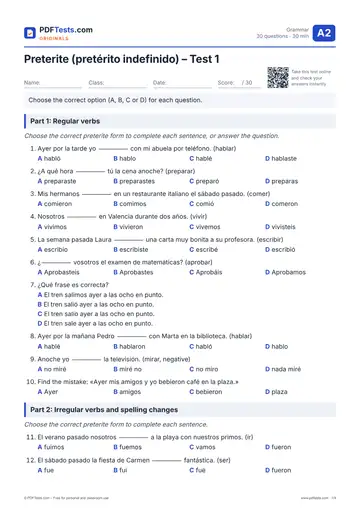
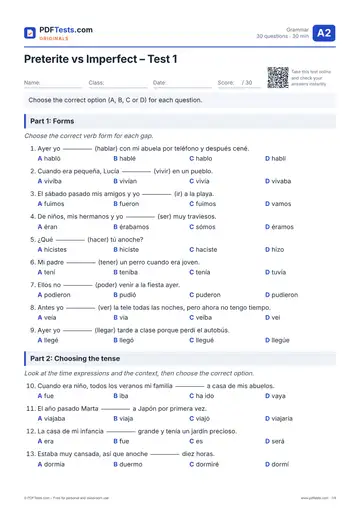
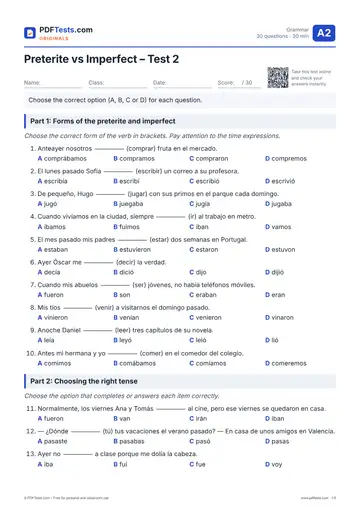
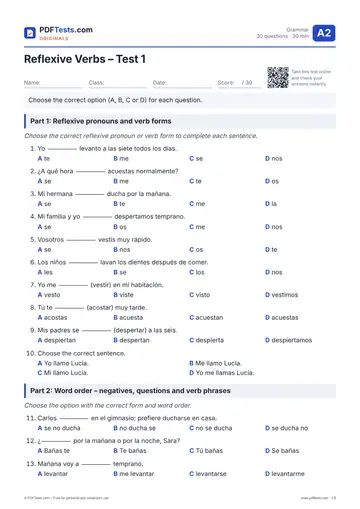
Now put the rules into practice: test yourself with our A2 Direct and Indirect Object Pronouns test, paying special attention to le versus lo/la and the se lo change. If you score well, try mixing pronouns with past tenses and other structures in the wider set of Spanish A2 tests.
Was this page helpful?
What was the problem?
Thank you for your feedback!