Spanish reflexive verbs are verbs used with a reflexive pronoun (me, te, se, nos, os, se). This often shows that the subject does the action to itself, as in me lavo (I wash myself). You need them for your daily routine, for changes in mood, and for a group of everyday verbs whose meaning changes when you add the pronoun.
What is a reflexive verb?
In the dictionary, a reflexive verb ends in -se: levantarse, ducharse, llamarse. The -se tells you that the verb needs a pronoun that refers back to the subject.
- Lavo el coche. I wash the car. (the action goes to the car)
- Me lavo. I wash (myself). (the action comes back to me)
English usually leaves out “myself”, but Spanish needs the pronoun. Without it, the sentence means something different or sounds wrong.
Form: reflexive pronouns and conjugation
To use a reflexive verb, take off -se, conjugate the verb normally, and put the correct pronoun in front. If you need to review regular endings, see our guide to the present tense of regular verbs.
Affirmative: levantarse (to get up)
| Subject | Pronoun | Verb | Translation |
|---|---|---|---|
| yo | me | levanto | I get up |
| tú | te | levantas | you get up |
| él / ella / usted | se | levanta | he / she gets up, you (formal) get up |
| nosotros/as | nos | levantamos | we get up |
| vosotros/as | os | levantáis | you (plural, Spain) get up |
| ellos / ellas / ustedes | se | levantan | they get up, you (plural) get up |
Notice that se is used for both singular and plural third person, and for usted and ustedes.
Negative and questions
| Type | Pattern | Example |
|---|---|---|
| Negative | no + pronoun + verb | No me levanto temprano los domingos. I don’t get up early on Sundays. |
| Yes/no question | pronoun + verb | ¿Te levantas temprano? Do you get up early? |
| Wh- question | question word + pronoun + verb | ¿A qué hora se levanta usted? What time do you get up? |
No always goes before the pronoun, never between the pronoun and the verb.
Stem-changing reflexive verbs
Many common reflexive verbs also change their stem in the present. The pronoun does not affect this: follow the normal rules from our guide to the present tense of irregular verbs.
| Verb | Change | yo | nosotros |
|---|---|---|---|
| despertarse (to wake up) | e → ie | me despierto | nos despertamos |
| acostarse (to go to bed) | o → ue | me acuesto | nos acostamos |
| vestirse (to get dressed) | e → i | me visto | nos vestimos |
| sentarse (to sit down) | e → ie | me siento | nos sentamos |
- Mi hermana se despierta a las seis. My sister wakes up at six.
- ¿Cuándo os acostáis? When do you go to bed?
Where does the pronoun go?
This is the part learners find hardest. The rules are the same as for direct and indirect object pronouns.
1. Before a conjugated verb
- Me ducho por la noche. I shower at night.
- Se vistieron rápido. They got dressed quickly.
2. With an infinitive: before the first verb or attached to the infinitive
Both options are correct and mean the same:
- Me voy a duchar. / Voy a ducharme. I’m going to have a shower.
- Te quieres sentar? / ¿Quieres sentarte? Do you want to sit down?
The pronoun must match the subject. With ir a + infinitive (see our ir a + infinitive guide), yo voy a takes -me, nosotros vamos a takes -nos, and so on.
- Vamos a levantarnos tarde. We’re going to get up late.
3. With a gerund (-ando / -iendo): before or attached
- Me estoy vistiendo. / Estoy vistiéndome. I’m getting dressed.
When you attach the pronoun to a gerund, add a written accent to keep the stress in the same place: duchando → duchándome.
4. With commands
In affirmative commands, the pronoun is attached: ¡Levántate! Get up! In negative commands, it goes before: No te levantes. Don’t get up. You will study this fully at B1.
Uses of reflexive verbs
Daily routine
This is the most common A2 use. Typical verbs: despertarse, levantarse, ducharse, lavarse, peinarse, afeitarse, maquillarse, vestirse, acostarse, dormirse.
- Me despierto a las siete, pero me levanto a las siete y cuarto. I wake up at seven, but I get up at quarter past seven.
- Mi padre se afeita todas las mañanas. My father shaves every morning.
If you need more routine vocabulary, try our everyday vocabulary test on family, home and daily routine.
Body parts and clothes: use the article, not a possessive
With reflexive verbs, Spanish uses el, la, los, las with body parts and clothes. The pronoun already shows whose they are.
- Me lavo las manos. I wash my hands.
- Se pone la chaqueta. She puts on her jacket.
- Nos lavamos los dientes. We brush our teeth.
Feelings and changes of state
Many reflexive verbs describe becoming or starting to feel something:
- aburrirse – to get bored: Me aburro en clase. I get bored in class.
- enfadarse (Spain) / enojarse (Latin America) – to get angry: Se enfada si llegas tarde. He gets angry if you’re late.
- preocuparse (por) – to worry (about): No te preocupes. Don’t worry.
- ponerse + adjective – to become: Me pongo nerviosa antes de un examen. I get nervous before an exam.
Reciprocal actions: “each other”
In the plural, nos, os, se can mean “each other”.
- Nos escribimos todos los días. We write to each other every day.
- Ana y Luis se conocen desde el colegio. Ana and Luis have known each other since school.
Verbs that change meaning
Some verbs exist with and without -se, and the meaning changes. Learn these as pairs.
| Without -se | With -se |
|---|---|
| ir – to go: Voy al cine. I’m going to the cinema. | irse – to leave: Me voy. I’m leaving. |
| dormir – to sleep: Duermo ocho horas. I sleep eight hours. | dormirse – to fall asleep: Me duermo en el sofá. I fall asleep on the sofa. |
| llamar – to call: Llamo a mi madre. I call my mother. | llamarse – to be called: Me llamo Carmen. My name is Carmen. |
| poner – to put: Pongo la mesa. I set the table. | ponerse – to put on: Me pongo el abrigo. I put on my coat. |
| quedar – to meet up: Quedo con amigos. I meet up with friends. | quedarse – to stay: Me quedo en casa. I’m staying at home. |
| llevar – to carry, wear: Llevo gafas. I wear glasses. | llevarse bien/mal – to get on well/badly: Me llevo bien con mi jefe. I get on well with my boss. |
Verbs that are always reflexive
A few verbs are almost always used with a pronoun:
- quejarse (de) – to complain (about): Siempre se queja del tiempo. He always complains about the weather.
- acordarse (de) – to remember: ¿Te acuerdas de mí? Do you remember me?
- darse cuenta (de) – to realise: No me di cuenta. I didn’t realise.
Reflexive or not? Who receives the action
Ask yourself: does the action go back to the subject, or to someone or something else?
- Me acuesto a las once. I go to bed at eleven.
- Acuesto a los niños a las nueve. I put the children to bed at nine.
- Mi madre se despierta temprano. My mother wakes up early.
- Mi madre me despierta a las siete. My mother wakes me up at seven.
In the last example, me is not reflexive: the subject is mi madre, and the action goes to me.
Reflexive verbs in the past
The pronouns stay the same in every tense. Only the verb changes.
- Ayer me levanté a las ocho. Yesterday I got up at eight.
- Nos acostamos muy tarde el sábado. We went to bed very late on Saturday.
- Pablo se durmió en el tren. Pablo fell asleep on the train.
Note that -ar stem-changing verbs do not change in the preterite: me acuesto (present) but me acosté (past). For the full rules, see our preterite guide.
Signal words for routines
Reflexive verbs often appear with words that describe habits and the order of actions:
- Frequency: siempre, normalmente, todos los días, a veces, nunca
- Sequence: primero, luego, después, más tarde, por último
- antes de / después de + infinitive (the pronoun attaches to the infinitive): Antes de acostarme, leo un poco. Before going to bed, I read a bit.
Primero me ducho, luego me visto y después desayuno. First I shower, then I get dressed and after that I have breakfast.
Common mistakes
- ✗ Levanto a las siete. → ✓ Me levanto a las siete. Without me, levantar means to lift something.
- ✗ Me lavo mis manos. → ✓ Me lavo las manos. Use the article with body parts; me already shows whose hands.
- ✗ Voy a ducharse. → ✓ Voy a ducharme. The attached pronoun must match the subject.
- ✗ Me voy a ducharme. → ✓ Me voy a duchar / Voy a ducharme. Use the pronoun once, not twice.
- ✗ Me no levanto. → ✓ No me levanto. No goes before the pronoun.
- ✗ ¿A qué hora te acostas? → ✓ ¿A qué hora te acuestas? Acostarse has an o → ue stem change.
- ✗ Me despierto a mi hermano. → ✓ Despierto a mi hermano. The action goes to someone else, so it is not reflexive.
- ✗ Me acuerdo tu cumpleaños. → ✓ Me acuerdo de tu cumpleaños. Acordarse needs de.
Quick check
Complete or correct each sentence.
- Yo ___ (ducharse) por la mañana.
- ¿A qué hora ___ (acostarse) tú?
- Mañana vamos a ___ (levantarse) temprano.
- Choose: Ana ___ (lava / se lava) el pelo cada día.
- Correct the mistake: Me pongo mi abrigo.
Answers
- me ducho – I shower in the morning.
- te acuestas – What time do you go to bed? (o → ue)
- levantarnos – Tomorrow we’re going to get up early. (also correct: nos vamos a levantar)
- se lava – Ana washes her hair every day.
- Me pongo el abrigo. – I put on my coat. (article, not possessive)
Next step
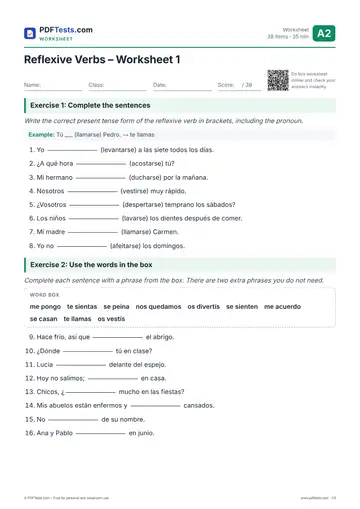
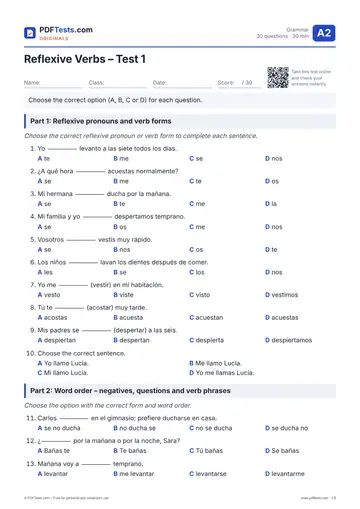
Now put the rules into practice with our A2 Reflexive Verbs test, which checks pronoun choice, position and the difference between reflexive and non-reflexive meanings. A good routine is to write five sentences about your own day using primero, luego and después, then rewrite them in the past with the preterite. When you can do both without hesitating over the pronouns, you are ready to combine reflexive verbs with object pronouns and commands.
Practise this topic: Spanish Reflexive Verbs
Was this page helpful?
What was the problem?
Thank you for your feedback!