The preterite (pretérito indefinido, also called pretérito perfecto simple) is the Spanish past tense for completed actions. These are things that happened, started or finished at a specific moment in the past. You use it to say what you did yesterday, last summer or in 2015, and to tell the main events of a story in order.
When to use the preterite
1. Completed actions at a specific time
The action happened once and is finished. Often a time expression tells you when.
- Ayer comí con mis abuelos. Yesterday I had lunch with my grandparents.
- El año pasado viajamos a México. Last year we travelled to Mexico.
2. A sequence of events
When you list actions one after another, each one uses the preterite.
- Me levanté, me duché y salí de casa. I got up, had a shower and left the house.
- Llegó, pagó la cuenta y se fue. He arrived, paid the bill and left.
3. Actions with a closed duration
Even long actions take the preterite if the period is finished and clearly limited.
- Viví en Madrid tres años. I lived in Madrid for three years.
- La película duró dos horas. The film lasted two hours.
4. The start or end of an action, and interruptions
- La clase empezó a las nueve. The class started at nine.
- Estaba en casa cuando sonó el teléfono. I was at home when the phone rang.
In the last example, the interrupting event (the phone rang) is in the preterite, while the background (I was at home) is in the imperfect.
Regular forms
Remove -ar, -er or -ir from the infinitive and add the endings below. Verbs ending in -er and -ir share the same endings.
| Subject | hablar (to speak) | comer (to eat) | vivir (to live) |
|---|---|---|---|
| yo | hablé | comí | viví |
| tú | hablaste | comiste | viviste |
| él / ella / usted | habló | comió | vivió |
| nosotros/as | hablamos | comimos | vivimos |
| vosotros/as | hablasteis | comisteis | vivisteis |
| ellos / ellas / ustedes | hablaron | comieron | vivieron |
Notes on accents and stress
- The yo and él/ella/usted forms of regular verbs have a written accent on the last vowel. This accent changes the meaning: hablo I speak (present) vs habló he/she spoke (preterite).
- The nosotros form of -ar and -ir verbs is the same as in the present: hablamos, vivimos. Context makes the meaning clear: Ayer hablamos con Luis. Yesterday we spoke to Luis.
- For -er verbs, the forms are different: comemos we eat vs comimos we ate.
- Vosotros is used in Spain. In Latin America, ustedes is used for all plural you.
Negatives and questions
Spanish needs no auxiliary verb like English did. Put no before the verb for negatives, and use question marks (and intonation) for questions.
| Affirmative | Negative | Question |
|---|---|---|
| Compraste pan. You bought bread. | No compraste pan. You didn’t buy bread. | ¿Compraste pan? Did you buy bread? |
| Vieron la película. They watched the film. | No vieron la película. They didn’t watch the film. | ¿Vieron la película? Did they watch the film? |
With a question word, the verb usually comes straight after it: ¿Dónde comiste ayer? Where did you eat yesterday?
Spelling changes
-car, -gar and -zar verbs (yo form only)
These verbs change their spelling in the yo form to keep the same sound. All other forms are regular.
| Ending | Change | Example |
|---|---|---|
| -car | c → qu | buscar → busqué I looked for |
| -gar | g → gu | llegar → llegué I arrived |
| -zar | z → c | empezar → empecé I started |
Other common examples: toqué (tocar, I played/touched), pagué (pagar, I paid), jugué (jugar, I played), almorcé (almorzar, I had lunch).
- Llegué tarde, pero llegaste a tiempo. I arrived late, but you arrived on time.
Vowel + -er/-ir: i → y
When the stem ends in a vowel, the i of the third-person endings becomes y.
- leer → leyó, leyeron he/she read, they read
- oír → oyó, oyeron he/she heard, they heard
- construir → construyó, construyeron he/she built, they built
The other forms of leer and oír take an accent on the í: leí, leíste, leímos.
Irregular verbs
Many of the most frequent verbs are irregular in the preterite. Learn these first.
Ser and ir: identical forms
| Subject | ser / ir |
|---|---|
| yo | fui |
| tú | fuiste |
| él / ella / usted | fue |
| nosotros/as | fuimos |
| vosotros/as | fuisteis |
| ellos / ellas / ustedes | fueron |
Context tells you which verb it is:
- Fui a la playa. I went to the beach. (ir)
- Fue un día perfecto. It was a perfect day. (ser)
Verbs with irregular stems
These verbs use a special stem plus these endings: -e, -iste, -o, -imos, -isteis, -ieron. Note that the yo and él/ella forms have no written accent.
| Infinitive | Stem | yo | él / ella | ellos |
|---|---|---|---|---|
| tener (to have) | tuv- | tuve | tuvo | tuvieron |
| estar (to be) | estuv- | estuve | estuvo | estuvieron |
| poder (can) | pud- | pude | pudo | pudieron |
| poner (to put) | pus- | puse | puso | pusieron |
| saber (to know) | sup- | supe | supo | supieron |
| querer (to want) | quis- | quise | quiso | quisieron |
| venir (to come) | vin- | vine | vino | vinieron |
| hacer (to do/make) | hic- | hice | hizo | hicieron |
| decir (to say) | dij- | dije | dijo | dijeron |
| traer (to bring) | traj- | traje | trajo | trajeron |
Two details to watch:
- hizo is spelled with z to keep the sound.
- After j, the ellos ending is -eron, not -ieron: dijeron, trajeron.
The preterite of hay is hubo: Hubo un accidente en la autopista. There was an accident on the motorway.
- ¿Qué hiciste el sábado? What did you do on Saturday?
- Estuve en casa de Marta y no pude salir. I was at Marta’s house and couldn’t go out.
Dar and ver
| Subject | dar (to give) | ver (to see) |
|---|---|---|
| yo | di | vi |
| tú | diste | viste |
| él / ella / usted | dio | vio |
| nosotros/as | dimos | vimos |
| vosotros/as | disteis | visteis |
| ellos / ellas / ustedes | dieron | vieron |
Dar is an -ar verb but takes -er/-ir endings. One-syllable forms (di, dio, vi, vio, fui, fue) never have a written accent.
Stem-changing -ir verbs
Some -ir verbs change their stem only in the third person (él/ella/usted and ellos/ellas/ustedes): e → i or o → u.
-
pedir → pidió, pidieron he/she asked for, they asked for
-
dormir → durmió, durmieron he/she slept, they slept
-
Also: prefirió (preferir), sintió (sentir), repitió (repetir), murió (morir).
-
Mi hermano pidió una pizza. My brother ordered a pizza.
Stem-changing -ar and -er verbs are regular in the preterite: pensé (not piensé), volví (not vuelví). These verbs behave differently in the present, so review them in our guide to the present tense of irregular verbs.
Signal words
These expressions usually point to the preterite because they refer to a finished moment or period:
-
ayer yesterday, anteayer the day before yesterday, anoche last night
-
el lunes (pasado) (last) Monday, la semana pasada last week, el mes / año pasado last month / year
-
hace dos días / tres años two days / three years ago
-
en 2020 in 2020, el otro día the other day
-
una vez once, de repente suddenly
-
Hace dos años conocí a mi pareja. Two years ago I met my partner.
Preterite vs imperfect
The other main past tense, the imperfect, describes background, habits and ongoing situations. The preterite tells you what happened.
| Preterite | Imperfect |
|---|---|
| Completed actions and events | Habits and repeated actions in the past |
| A sequence of events | Descriptions (people, places, weather, time) |
| Actions that interrupt | Actions in progress (the background) |
- Cuando era pequeña, nadaba todos los días. When I was little, I swam every day. (habit → imperfect)
- Ayer nadé una hora. Yesterday I swam for an hour. (one completed action → preterite)
For the full picture, read our guide to the imperfect and the detailed comparison in preterite vs imperfect.
Preterite vs present perfect
In most of Spain, the present perfect (he comido) is used for actions in a time period that is not finished yet (hoy, esta semana, este año), and the preterite for finished periods (ayer, el año pasado). In Latin America, the preterite is used for most completed actions, including today’s.
- Esta mañana he desayunado café. This morning I had coffee for breakfast. (common in Spain)
- Esta mañana desayuné café. This morning I had coffee for breakfast. (common in Latin America)
With ayer and other finished time expressions, both regions use the preterite. See our present perfect guide for more.
Common mistakes
- ✗ Ayer hablo con mi madre. → ✓ Ayer hablé con mi madre. Yesterday I spoke to my mother. Without the accent, hablo is the present tense.
- ✗ Yo buscé las llaves. → ✓ Yo busqué las llaves. I looked for the keys. -car verbs change c → qu in the yo form.
- ✗ Tuvé un problema. → ✓ Tuve un problema. I had a problem. Irregular-stem preterites have no written accent.
- ✗ Ellos dijieron la verdad. → ✓ Ellos dijeron la verdad. They told the truth. After j, the ending is -eron.
- ✗ Él pedió agua. → ✓ Él pidió agua. He asked for water. Pedir changes e → i in the third person.
- ✗ Me dió un regalo. → ✓ Me dio un regalo. She gave me a present. One-syllable forms take no accent.
- ✗ Yo fue al cine. → ✓ Yo fui al cine. I went to the cinema. Fue is the él/ella form; yo needs fui.
- ✗ De niño, fui a la playa todos los veranos. → ✓ De niño, iba a la playa todos los veranos. As a child, I went to the beach every summer. Repeated past habits need the imperfect.
Quick check
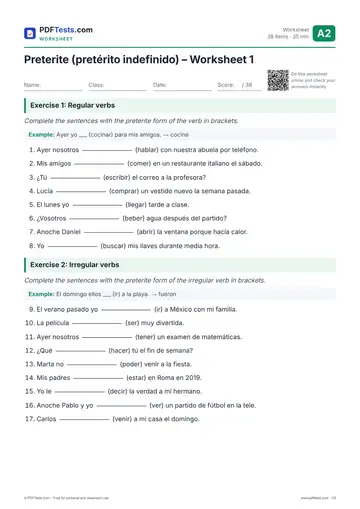
Complete each sentence with the correct preterite form.
- Ayer yo ___ (llegar) tarde al trabajo. Yesterday I arrived late for work.
- ¿Qué ___ (hacer) tú el fin de semana? What did you do at the weekend?
- Mis padres ___ (ir) a Sevilla en 2022. My parents went to Seville in 2022.
- Anoche Ana no ___ (dormir) bien. Last night Ana didn’t sleep well.
- Nosotros ___ (tener) un examen el lunes pasado. We had an exam last Monday.
Answers
- llegué (g → gu in the yo form)
- hiciste
- fueron
- durmió (o → u in the third person)
- tuvimos
Next step
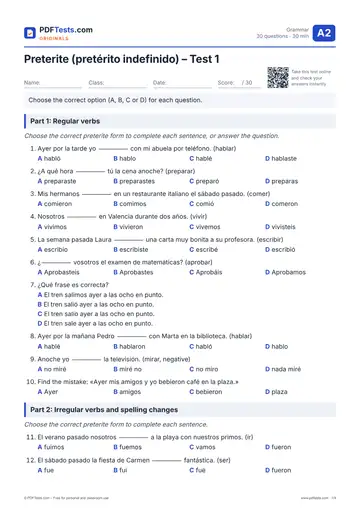
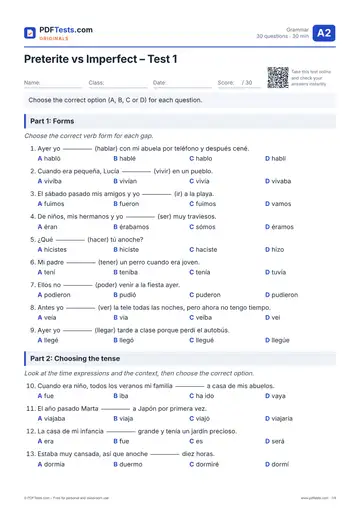
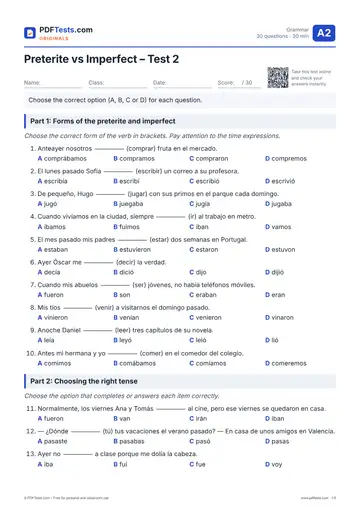
Now put the forms into practice: test yourself with our A2 Spanish preterite test, focusing on the spelling changes and irregular stems that cause the most errors. When you feel confident, move on to choosing between the two past tenses in our A2 preterite vs imperfect test.
Was this page helpful?
What was the problem?
Thank you for your feedback!