The Spanish imperfect (pretérito imperfecto) is a past tense for describing how things were, what used to happen regularly, and what was going on at a particular moment. In English it often means ‘used to’, ‘was/were + -ing’ or a simple past for descriptions. It is one of the easiest tenses to conjugate, because it has only three irregular verbs.
When to use the imperfect
1. Habits and repeated actions
Use the imperfect for things that happened regularly in the past, with no clear beginning or end.
- De pequeño, jugaba al fútbol todos los sábados. As a child, I used to play football every Saturday.
- Mis abuelos vivían en un pueblo y siempre comíamos con ellos los domingos. My grandparents lived in a village and we always had lunch with them on Sundays.
- Antes no tenía móvil. I didn’t have a mobile phone before.
2. Descriptions of people, places and things
When you set the scene in the past (what something looked like, what the weather was like, what there was), use the imperfect.
- Mi primer piso era pequeño, pero tenía mucha luz. My first flat was small, but it had a lot of light.
- La profesora llevaba gafas y hablaba muy rápido. The teacher wore glasses and spoke very fast.
- Hacía sol y había mucha gente en la playa. It was sunny and there were a lot of people on the beach.
3. Time, age and states
Clock time, age, feelings and physical states in the past are normally expressed with the imperfect.
- Eran las once de la noche. It was eleven at night.
- Cuando tenía quince años, quería ser veterinaria. When I was fifteen, I wanted to be a vet.
- Estábamos cansados y teníamos hambre. We were tired and hungry.
4. Actions in progress
The imperfect describes an action that was happening when something else happened. The interrupting action is usually in the preterite.
- Leía un libro cuando sonó el teléfono. I was reading a book when the phone rang.
- Mientras mi hermano cocinaba, yo ponía la mesa. While my brother was cooking, I was setting the table.
In the second example, both actions are in the imperfect because they were happening at the same time.
5. Polite requests
In shops and cafés, quería makes a request softer, like ‘I’d like’ in English.
- Hola, quería un café con leche, por favor. Hi, I’d like a white coffee, please.
How to form the imperfect
Take the infinitive, remove -ar, -er or -ir, and add the endings below. If you already know the regular present tense, you know how to find the stem. Note that -er and -ir verbs share exactly the same endings.
Regular verbs
| Pronoun | hablar | comer | vivir |
|---|---|---|---|
| yo | hablaba | comía | vivía |
| tú | hablabas | comías | vivías |
| él / ella / usted | hablaba | comía | vivía |
| nosotros / nosotras | hablábamos | comíamos | vivíamos |
| vosotros / vosotras | hablabais | comíais | vivíais |
| ellos / ellas / ustedes | hablaban | comían | vivían |
Good news: the imperfect has no stem changes. Verbs that change in the present tense are regular here:
- querer → quería, poder → podía, dormir → dormía, jugar → jugaba
- tener → tenía, hacer → hacía, decir → decía, salir → salía
The three irregular verbs
Only ser, ir and ver are irregular, so memorise these tables.
| Pronoun | ser | ir | ver |
|---|---|---|---|
| yo | era | iba | veía |
| tú | eras | ibas | veías |
| él / ella / usted | era | iba | veía |
| nosotros / nosotras | éramos | íbamos | veíamos |
| vosotros / vosotras | erais | ibais | veíais |
| ellos / ellas / ustedes | eran | iban | veían |
Ver is only slightly irregular: it keeps the e of the stem (veía, not vía).
- Mi padre era cocinero. My father was a cook.
- Íbamos al colegio en bici. We used to go to school by bike.
- Veía dibujos animados después de clase. I used to watch cartoons after school.
Hay → había
The past of hay (there is / there are) in descriptions is había. It is always singular.
- Había dos cafeterías en mi calle. There were two cafés on my street.
Negative sentences and questions
The imperfect works like other Spanish tenses: put no before the verb for the negative, and use rising intonation or a question word for questions.
| Type | Example | Translation |
|---|---|---|
| Affirmative | Vivíamos cerca del centro. | We lived near the centre. |
| Negative | No vivíamos cerca del centro. | We didn’t live near the centre. |
| Yes/no question | ¿Vivíais cerca del centro? | Did you (all) live near the centre? |
| Wh- question | ¿Dónde vivíais? | Where did you (all) live? |
Spelling and pronunciation notes
- All -er and -ir forms have an accent on the í: comía, vivíamos, veían. Pronounce it as a separate syllable: co-MÍ-a.
- -ar verbs have an accent only in the nosotros form: hablábamos, estudiábamos. The same goes for éramos and íbamos.
- -ar endings are spelt with b, never v: hablaba, not hablava.
- The yo and él/ella/usted forms are identical. Hablaba can mean ‘I spoke’ or ‘he/she spoke’. Add a subject pronoun when the context is unclear: Yo trabajaba y ella estudiaba. I was working and she was studying.
- In Latin America, ustedes replaces vosotros, so you will mostly hear forms like hablaban and comían.
Signal words
These expressions often appear with the imperfect because they talk about habits, background or longer periods:
- siempre always
- todos los días / cada día every day
- normalmente / generalmente usually
- a menudo / muchas veces often
- a veces sometimes
- antes before, in the past
- de niño / de pequeña as a child
- cuando era joven when I was young
- en aquella época at that time
- mientras while
Signal words are clues, not strict rules. What matters is the meaning: a habit or background description takes the imperfect; a single, finished event takes the preterite.
Imperfect vs preterite
This is the comparison learners find hardest. The preterite tells you what happened; the imperfect describes the situation around it.
| Imperfect | Preterite |
|---|---|
| Background, descriptions | Main events of a story |
| Habits and repeated actions | Single, completed actions |
| No clear end point | Finished, often with a specific time |
| Cada verano íbamos a Asturias. Every summer we used to go to Asturias. | El verano pasado fuimos a Asturias. Last summer we went to Asturias. |
| Llovía. It was raining. | Llovió toda la tarde. It rained all afternoon. |
In a story, the two tenses work together:
Era un sábado por la mañana. Hacía frío y yo dormía. De repente, alguien llamó a la puerta. It was a Saturday morning. It was cold and I was sleeping. Suddenly, someone knocked at the door.
The first three verbs set the scene (imperfect); llamó is the event that moves the story forward (preterite). For a full explanation, read our guide to preterite vs imperfect.
Common mistakes
- ✗ De niño, fui a la playa todos los veranos. → ✓ De niño, iba a la playa todos los veranos. As a child, I went to the beach every summer. A repeated habit needs the imperfect.
- ✗ Tuve diez años cuando nos mudamos. → ✓ Tenía diez años cuando nos mudamos. I was ten when we moved. Age in the past is a background state.
- ✗ Fue las ocho. → ✓ Eran las ocho. It was eight o’clock. Clock time uses the imperfect of ser, plural except for la una.
- ✗ Yo hablía con ella. → ✓ Yo hablaba con ella. I used to talk to her. -ar verbs take -aba, not -ía.
- ✗ Quiería / puedía. → ✓ Quería / podía. I wanted / I could. The imperfect has no stem changes.
- ✗ Comiamos / eramos. → ✓ Comíamos / éramos. We used to eat / we were. These forms need a written accent.
- ✗ Vía la tele. → ✓ Veía la tele. I was watching TV. Ver keeps the e in the imperfect.
- ✗ Habían muchos turistas. → ✓ Había muchos turistas. There were lots of tourists. Había is always singular when it means ‘there was/were’.
- ✗ De pequeña, jugaría en el parque. → ✓ De pequeña, jugaba en el parque. As a child, I would play in the park. English ‘would’ for past habits is the imperfect in Spanish, not the conditional.
Quick check
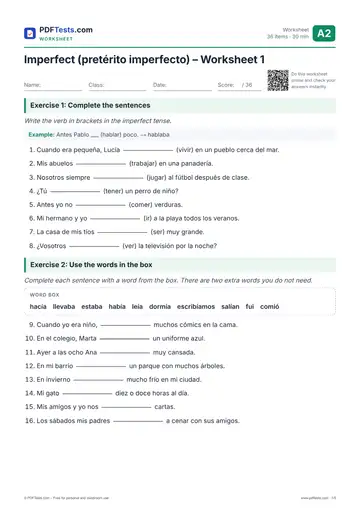
Complete with the imperfect of the verb in brackets.
- Cuando era pequeño, yo ___ (vivir) en Valencia.
- Nosotros ___ (ir) al cine todos los viernes.
- ___ (ser) las diez y ___ (llover) mucho.
- Mi abuela siempre ___ (hacer) paella los domingos.
- Correct the mistake: Habían dos perros en el jardín.
Answers
- vivía When I was little, I lived in Valencia.
- íbamos We used to go to the cinema every Friday.
- Eran, llovía It was ten o’clock and it was raining a lot.
- hacía My grandmother always made paella on Sundays.
- Había dos perros en el jardín. There were two dogs in the garden.
Next step
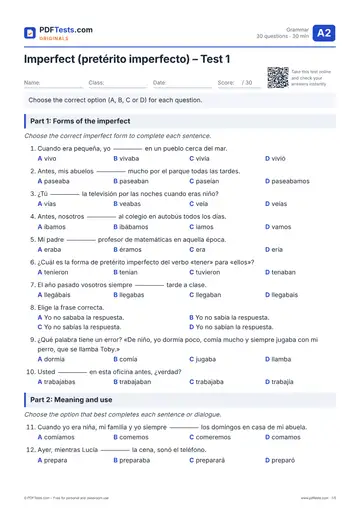
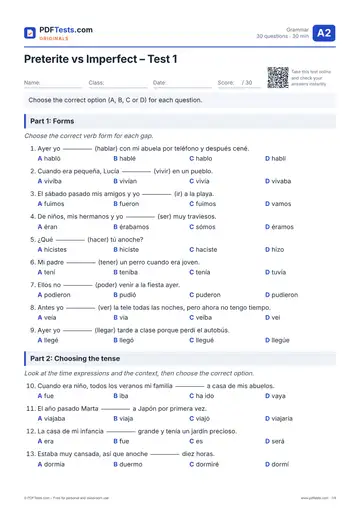
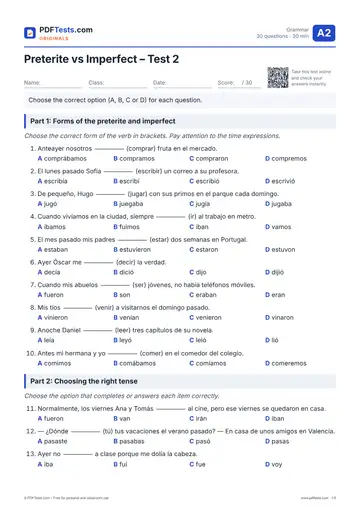
Now put the endings and the three irregular verbs into practice: test yourself with our A2 Imperfect test and review any items you get wrong using the tables above. Once you feel confident, move on to the Preterite vs Imperfect test, where you choose between the two past tenses in real contexts, which is the skill you need to tell stories and talk about your childhood in Spanish.
Was this page helpful?
What was the problem?
Thank you for your feedback!