The Spanish imperative (el imperativo) is the verb form you use to tell someone to do something or not to do something. You use it for instructions, advice, requests, invitations and warnings. Each person (tú, usted, vosotros, ustedes and nosotros) has its own form, and negative commands are built differently from affirmative ones. At B1 level, the key skills are choosing the right form, knowing the irregular tú commands and putting pronouns in the right place.
When to use the imperative
- Instructions and directions: Gira a la derecha y sigue recto. Turn right and go straight on.
- Advice: Duerme más y no tomes tanto café. Sleep more and don’t drink so much coffee.
- Requests: Pásame la sal, por favor. Pass me the salt, please.
- Invitations and offers: Pasa, pasa, siéntate. Come in, come in, sit down.
- Warnings: ¡Cuidado! No toques eso, quema. Careful. Don’t touch that, it’s hot.
- Recipes, manuals and signs: Corte la cebolla y añada sal. Cut the onion and add salt.
Spanish speakers use direct commands much more often than English speakers do, and they are not rude in themselves. Tone of voice, por favor and context make a command friendly or sharp.
Choosing the right person
| Person | Who you are talking to | Example |
|---|---|---|
| tú | one person, informal | Escucha. Listen. |
| usted | one person, formal | Escuche. Listen. |
| vosotros | a group, informal (Spain) | Escuchad. Listen. |
| ustedes | a group (formal in Spain; all groups in Latin America) | Escuchen. Listen. |
| nosotros | a group including yourself (let’s) | Escuchemos. Let’s listen. |
Affirmative commands: form
Tú: use the él/ella form of the present
For most verbs, the affirmative tú command is identical to the third person singular of the present tense.
| Infinitive | Present (él) | Tú command |
|---|---|---|
| hablar | habla | habla |
| comer | come | come |
| escribir | escribe | escribe |
| cerrar | cierra | cierra |
| volver | vuelve | vuelve |
| pedir | pide | pide |
Stem changes stay: Cierra la ventana, hace frío. Close the window, it’s cold. Vuelve pronto. Come back soon.
The eight irregular tú commands
These must be memorised. They are short and very common.
| Infinitive | Tú command | Example |
|---|---|---|
| decir | di | Di la verdad. Tell the truth. |
| hacer | haz | Haz los deberes. Do your homework. |
| ir | ve | Ve a la farmacia. Go to the chemist’s. |
| poner | pon | Pon la mesa. Set the table. |
| salir | sal | Sal de ahí. Get out of there. |
| ser | sé | Sé paciente. Be patient. |
| tener | ten | Ten cuidado. Be careful. |
| venir | ven | Ven aquí. Come here. |
Compounds follow the same pattern: mantener → mantén, componer → compón. If you need to review the present-tense forms behind these, see our guide to the Spanish present tense with irregular verbs.
Vosotros: change the final -r to -d
This is the most regular form in the language. There are no exceptions in the basic form.
- hablar → hablad: Hablad más despacio. Speak more slowly.
- comer → comed: Comed algo antes de salir. Eat something before you go out.
- ir → id: Id con cuidado. Go carefully.
Usted, ustedes and nosotros: use the present subjunctive
Take the yo form of the present, drop the -o and add the opposite vowel: -e for -ar verbs, -a for -er and -ir verbs.
| Infinitive | Yo (present) | Usted | Ustedes | Nosotros |
|---|---|---|---|---|
| hablar | hablo | hable | hablen | hablemos |
| comer | como | coma | coman | comamos |
| tener | tengo | tenga | tengan | tengamos |
| decir | digo | diga | digan | digamos |
Five verbs are irregular: ser → sea, ir → vaya, saber → sepa, dar → dé, estar → esté. One more detail: the affirmative nosotros form of ir is vamos, not vayamos: ¡Vamos a la playa! Let’s go to the beach.
Pase usted, por favor. Come in, please. Tengan paciencia. Be patient (all of you).
Negative commands: no + present subjunctive
All negative commands, for every person, use no + present subjunctive. This means the tú and vosotros forms change completely from affirmative to negative.
| Person | hablar | comer | vivir | hacer |
|---|---|---|---|---|
| tú | no hables | no comas | no vivas | no hagas |
| usted | no hable | no coma | no viva | no haga |
| vosotros | no habléis | no comáis | no viváis | no hagáis |
| ustedes | no hablen | no coman | no vivan | no hagan |
| nosotros | no hablemos | no comamos | no vivamos | no hagamos |
Compare the irregular tú commands with their negatives:
| Affirmative | Negative |
|---|---|
| di | no digas |
| haz | no hagas |
| ve | no vayas |
| pon | no pongas |
| sal | no salgas |
| sé | no seas |
| ten | no tengas |
| ven | no vengas |
Ven mañana, pero no vengas tarde. Come tomorrow, but don’t come late. Venid conmigo. / No vengáis solos. Come with me. / Don’t come alone.
Spelling changes
Because negative and formal commands use the subjunctive, some verbs change spelling to keep the same sound:
- -car → -que: buscar → no busques, busque
- -gar → -gue: llegar → no llegues, pague (pagar)
- -zar → -ce: empezar → no empieces, empiece
- -ger/-gir → -ja: coger → no cojas, elegir → elija
No llegues tarde. Don’t be late. Empiece cuando quiera. Start whenever you like.
Where to put pronouns
This is the rule that causes most errors at B1:
- Affirmative: pronouns are attached to the end of the verb.
- Negative: pronouns go before the verb, after no.
| Affirmative | Negative | Meaning |
|---|---|---|
| Dímelo. | No me lo digas. | Tell me (it). / Don’t tell me. |
| Siéntate. | No te sientes. | Sit down. / Don’t sit down. |
| Cómpralo. | No lo compres. | Buy it. / Don’t buy it. |
| Dígame. | No me diga. | Tell me. / You don’t say. |
| Levantaos. | No os levantéis. | Get up. / Don’t get up. |
The order is the same as elsewhere: indirect or reflexive pronoun first, then direct. Le and les become se before lo, la, los, las: Dáselo a tu hermano. Give it to your brother. For a full review, read our guide to direct and indirect object pronouns.
Written accents
Attaching pronouns adds syllables, but the stress stays on the same syllable of the verb. That often requires a written accent: mira → mírame, explica → explícamelo, siente → siéntese. A one-syllable command plus one pronoun usually needs no accent: dime, hazlo, ponte. With two pronouns it does: dímelo, póntelo.
Two forms that lose a letter
- Vosotros + os: drop the -d. sentad + os → sentaos, levantad + os → levantaos. The exception is ir: idos. In speech you will often hear sentaros, but sentaos is the standard written form.
- Nosotros + nos or + se: drop the final -s. sentemos + nos → sentémonos, vamos + nos → vámonos, digamos + se + lo → digámoselo.
Reflexive verbs appear constantly in commands (levántate, no te preocupes, acuérdate), so it helps to be comfortable with Spanish reflexive verbs.
Imperative vs present subjunctive
Many imperative forms look exactly like the present subjunctive, because the usted, ustedes, nosotros forms and all negatives are subjunctive forms. The difference is how they are used:
- The imperative is a direct command in a main clause: Ven mañana. Come tomorrow.
- The subjunctive usually follows a trigger such as quiero que, te pido que, es importante que: Quiero que vengas mañana. I want you to come tomorrow.
Notice the pronouns: Hazlo (attached, imperative) but Te pido que lo hagas (before the verb, subjunctive). Also note that que + subjunctive can express an indirect command or a wish: Que lo haga él. Let him do it. ¡Que te mejores! Get well soon. Our present subjunctive guide covers these triggers in detail.
Softer alternatives
Commands are normal in Spanish, but you can soften them:
- A question in the present: ¿Me pasas la sal? Can you pass me the salt?
- Poder + infinitive: ¿Podría cerrar la puerta? Could you close the door?
- The infinitive on signs and instructions: No fumar. No smoking.
- Vamos a + infinitive instead of the nosotros command: Vamos a empezar. Let’s start.
Common mistakes
- ✗ No habla tan alto. → ✓ No hables tan alto. Negative tú commands use the subjunctive, not the present.
- ✗ Ves a la tienda. → ✓ Ve a la tienda. Ves is the present of ver; the command of ir is ve.
- ✗ Hace tus deberes. → ✓ Haz tus deberes. Hacer has the irregular tú command haz.
- ✗ No dime. → ✓ No me digas. Negatives need the subjunctive and the pronoun before the verb.
- ✗ No lo hazlo. → ✓ No lo hagas. Never attach pronouns to a negative command.
- ✗ Me dé el libro, por favor. → ✓ Deme el libro, por favor. In affirmative commands, the pronoun is attached, even with usted.
- ✗ Compralo. → ✓ Cómpralo. Adding a pronoun moves the stress pattern, so a written accent is needed.
- ✗ Sentémosnos. → ✓ Sentémonos. The nosotros form drops the -s before nos.
- ✗ Sentados. → ✓ Sentaos. The vosotros form drops the -d before os, it does not keep it.
Quick check
Write the correct command.
- (tú, cerrar) ___ la puerta, por favor.
- (tú, no tocar) ___ el horno.
- (usted, sentarse) ___, por favor.
- (vosotros, decir + me) ___ la verdad.
- (tú, no preocuparse) ___, todo va a salir bien.
Answers
- Cierra (stem change e → ie)
- No toques (subjunctive, with -c → -qu)
- Siéntese (subjunctive, pronoun attached, written accent)
- Decidme (vosotros form with the pronoun attached)
- No te preocupes (pronoun before the verb in the negative)
Next step
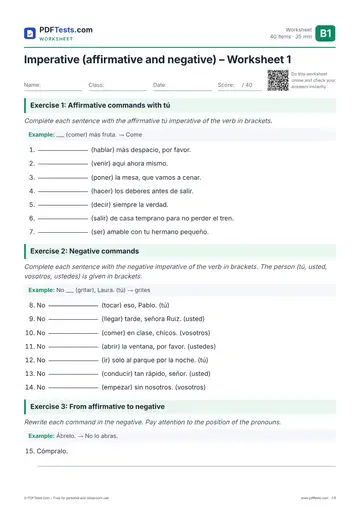
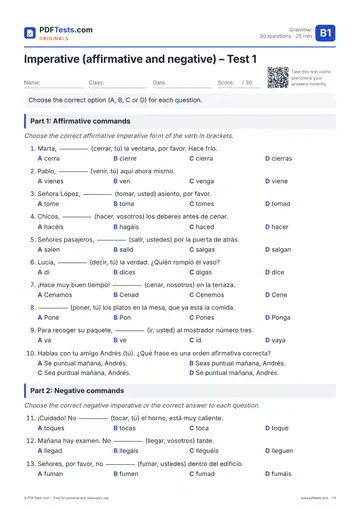
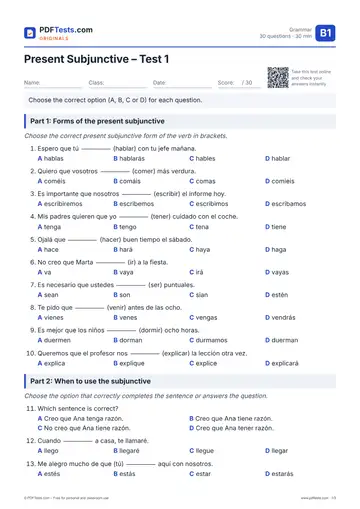
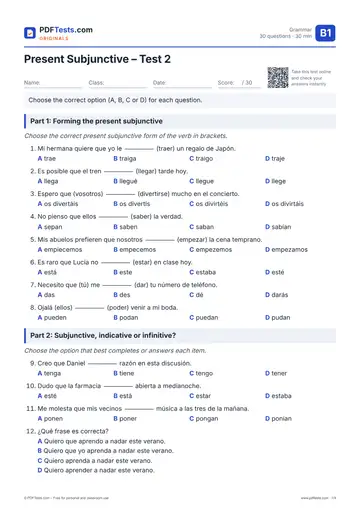
Now put the rules into practice: test yourself with our B1 Imperative test, which mixes affirmative and negative commands, irregular tú forms and pronoun placement. If you hesitate over the negative forms, review the present subjunctive first and then try the B1 Present Subjunctive test, since every negative command depends on it.
Was this page helpful?
What was the problem?
Thank you for your feedback!