PDFTests Originals

Reported Speech (estilo indirecto) – Worksheet 1

B2 Upper-intermediate WorksheetSpanish

This B2 worksheet practises reported speech (estilo indirecto) in Spanish. Learners backshift tenses, report yes/no and wh- questions, turn commands and requests into the past subjunctive, and adapt time and place expressions. It suits upper-intermediate learners who know the main past tenses and the imperfect subjunctive.
items
36
Time
40 min
PDF
5 pages
Answer key
Included
  • 100% free
  • No sign-up or email
  • Print-ready A4 PDF
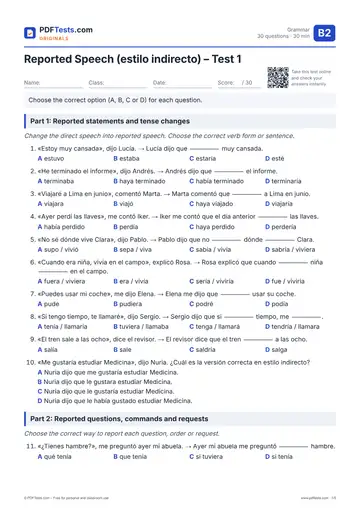
Preview of page 1 of Reported Speech (estilo indirecto) – Worksheet 1 Open PDF
New to this topic? Read the guide first: Reported Speech in Spanish (estilo indirecto): Tense Changes, Commands and Questions

Do the worksheet online

Type your answers, then press “Check my answers”. Alternative correct answers are accepted.

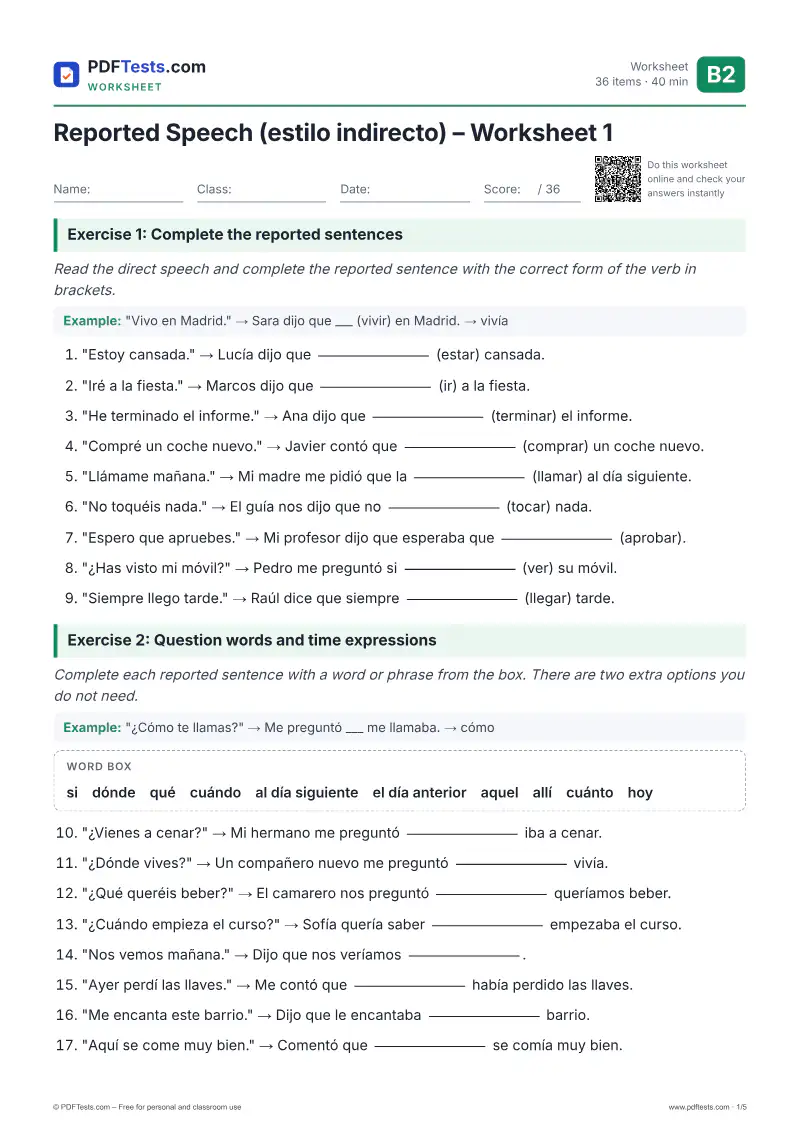
Exercise 1: Complete the reported sentences

Read the direct speech and complete the reported sentence with the correct form of the verb in brackets.

Example: "Vivo en Madrid." → Sara dijo que ___ (vivir) en Madrid. → vivía

  1. "Estoy cansada." → Lucía dijo que (estar) cansada.

  2. "Iré a la fiesta." → Marcos dijo que (ir) a la fiesta.

  3. "He terminado el informe." → Ana dijo que (terminar) el informe.

  4. "Compré un coche nuevo." → Javier contó que (comprar) un coche nuevo.

  5. "Llámame mañana." → Mi madre me pidió que la (llamar) al día siguiente.

  6. "No toquéis nada." → El guía nos dijo que no (tocar) nada.

  7. "Espero que apruebes." → Mi profesor dijo que esperaba que (aprobar).

  8. "¿Has visto mi móvil?" → Pedro me preguntó si (ver) su móvil.

  9. "Siempre llego tarde." → Raúl dice que siempre (llegar) tarde.

Exercise 2: Question words and time expressions

Complete each reported sentence with a word or phrase from the box. There are two extra options you do not need.

Example: "¿Cómo te llamas?" → Me preguntó ___ me llamaba. → cómo

Word box sidóndequécuándoal día siguienteel día anterioraquelallícuántohoy

  1. "¿Vienes a cenar?" → Mi hermano me preguntó iba a cenar.

  2. "¿Dónde vives?" → Un compañero nuevo me preguntó vivía.

  3. "¿Qué queréis beber?" → El camarero nos preguntó queríamos beber.

  4. "¿Cuándo empieza el curso?" → Sofía quería saber empezaba el curso.

  5. "Nos vemos mañana." → Dijo que nos veríamos .

  6. "Ayer perdí las llaves." → Me contó que había perdido las llaves.

  7. "Me encanta este barrio." → Dijo que le encantaba barrio.

  8. "Aquí se come muy bien." → Comentó que se comía muy bien.

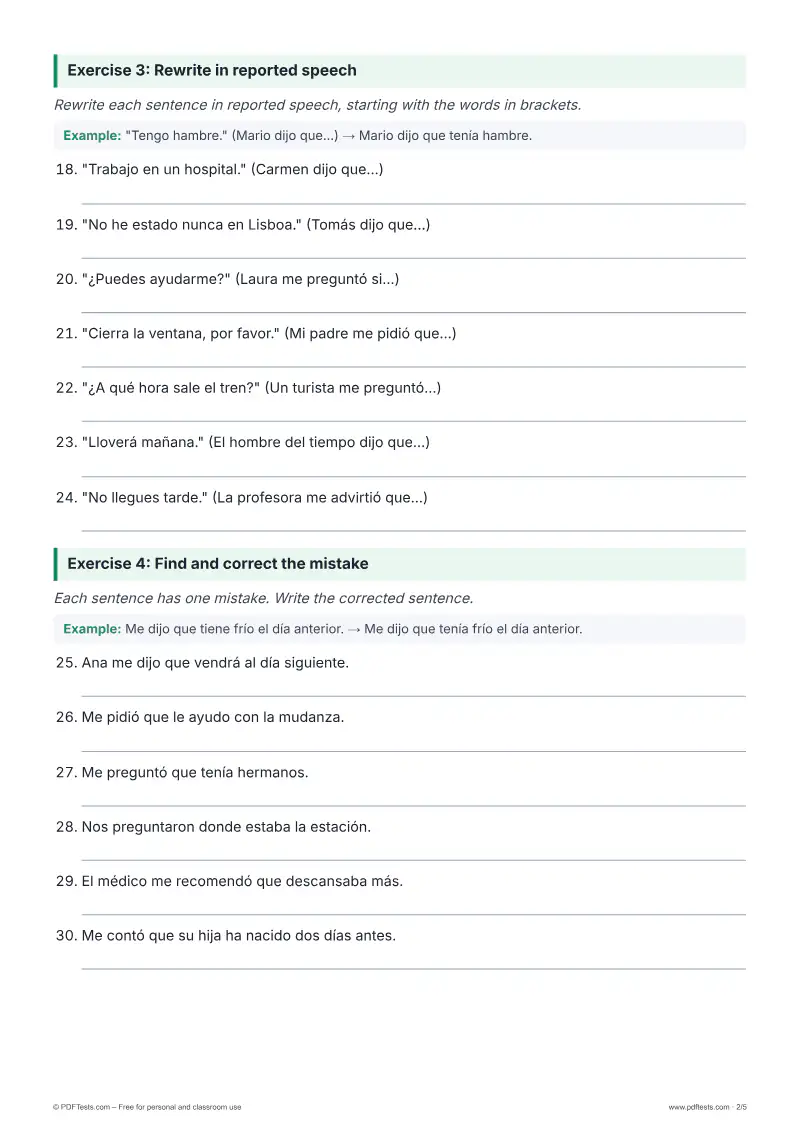
Exercise 3: Rewrite in reported speech

Rewrite each sentence in reported speech, starting with the words in brackets.

Example: "Tengo hambre." (Mario dijo que...) → Mario dijo que tenía hambre.

  1. "Trabajo en un hospital." (Carmen dijo que...)

  2. "No he estado nunca en Lisboa." (Tomás dijo que...)

  3. "¿Puedes ayudarme?" (Laura me preguntó si...)

  4. "Cierra la ventana, por favor." (Mi padre me pidió que...)

  5. "¿A qué hora sale el tren?" (Un turista me preguntó...)

  6. "Lloverá mañana." (El hombre del tiempo dijo que...)

  7. "No llegues tarde." (La profesora me advirtió que...)

Exercise 4: Find and correct the mistake

Each sentence has one mistake. Write the corrected sentence.

Example: Me dijo que tiene frío el día anterior. → Me dijo que tenía frío el día anterior.

  1. Ana me dijo que vendrá al día siguiente.

  2. Me pidió que le ayudo con la mudanza.

  3. Me preguntó que tenía hermanos.

  4. Nos preguntaron donde estaba la estación.

  5. El médico me recomendó que descansaba más.

  6. Me contó que su hija ha nacido dos días antes.

Exercise 5: Put the words in order

Put the words in the correct order to make reported sentences.

Example: dijo / que / tenía / sueño / Lola → Lola dijo que tenía sueño.

  1. dijo / que / estaba / Rosa / muy / ocupada

  2. me / preguntó / si / tenía / tiempo / Iván

  3. nos / pidió / que / no / habláramos / el profesor / alto

  4. quería / saber / dónde / había / dejado / las llaves / Nuria

  5. contaron / que / se / casarían / el año siguiente / nos / Pablo y Eva

  6. preguntó / me / qué / pensaba / hacer / aquel / verano / Diego

Was this page helpful?

Report a mistake

Spotted a wrong answer, a typo or an unclear explanation? Tell us and we will fix it.

Preview

About this test

B2 Spanish reported speech worksheet: tense backshift, reported questions, commands with subjunctive, time words. Printable, with answers.

Topics covered

Estilo indirectoTense backshiftReported questions (si / qué / dónde)Reported commands with subjunctiveTime and place expressions

Notes for teachers

Start with a quick review of the backshift chart (presente → imperfecto, futuro → condicional, pretérito perfecto → pluscuamperfecto, imperativo → imperfecto de subjuntivo), then let learners work through the exercises in order. Typical mistakes include keeping the future after a past reporting verb, using the indicative after pedir/decir que for commands, leaving out 'si' in yes/no questions, and dropping the accent on question words (dónde, qué). Point out that both -ra and -se subjunctive forms are correct. As a follow-up, pairs can interview each other and then report the answers to the class in the past.

All Spanish B2 tests →