PDFTests Originals

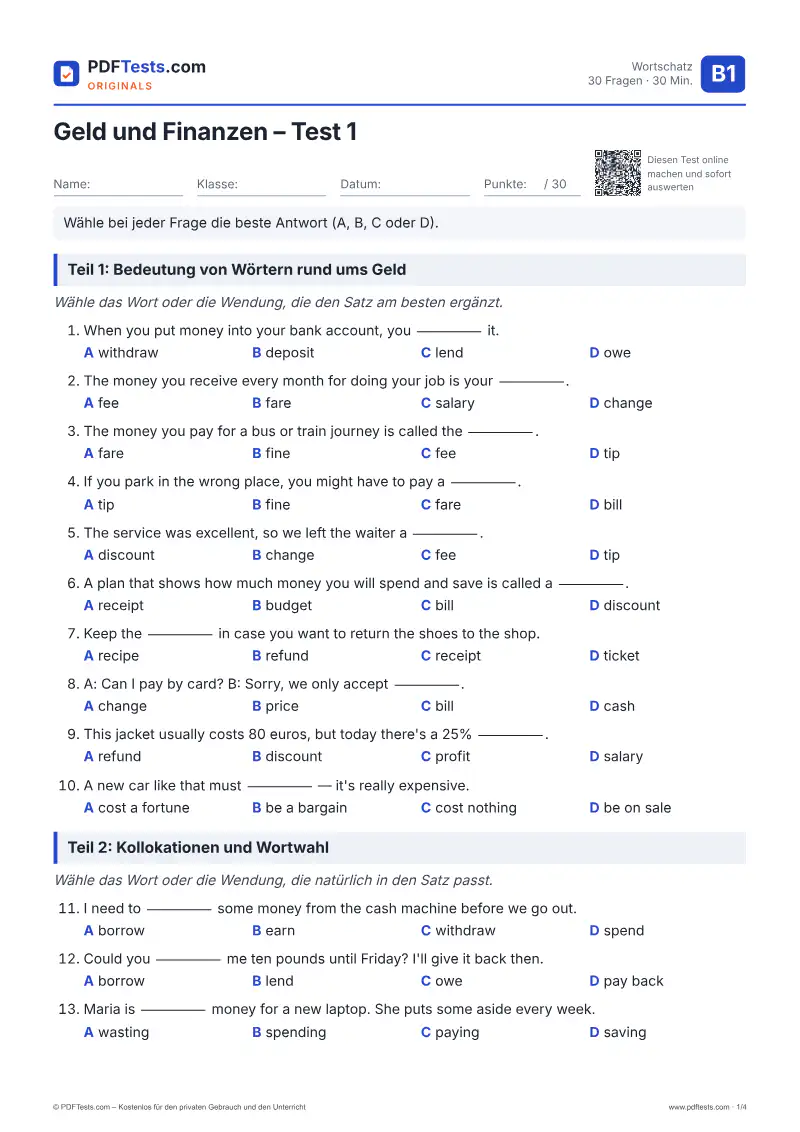
Geld und Finanzen – Test 1

B1 Mittelstufe WortschatzEnglisch

Dieser Wortschatztest auf Niveau B1 behandelt den alltäglichen englischen Wortschatz rund um Geld und Finanzen: Bank, Einkaufen, Sparen, Leihen und Haushaltsplanung. Geübt werden Wortbedeutungen, gängige Kollokationen, Wortfamilien und Vokabeln in einem kurzen Lesetext. Der Test eignet sich für Lernende auf mittlerem Niveau, zur Wiederholung im Unterricht und zum Selbststudium.
Fragen
30
Zeit
30 Min.
PDF
4 Seiten
Lösungen
Enthalten
  • 100 % kostenlos
  • Ohne Anmeldung
  • Druckfertiges A4-PDF
Vorschau von Seite 1: Geld und Finanzen – Test 1 PDF öffnen

Test online machen

Wähle bei jeder Frage die beste Antwort (A, B, C oder D). Wählen Sie Ihre Antworten und klicken Sie auf „Antworten prüfen“.

Teil 1: Bedeutung von Wörtern rund ums Geld

Wähle das Wort oder die Wendung, die den Satz am besten ergänzt.

  1. When you put money into your bank account, you _____ it.

  2. The money you receive every month for doing your job is your _____.

  3. The money you pay for a bus or train journey is called the _____.

  4. If you park in the wrong place, you might have to pay a _____.

  5. The service was excellent, so we left the waiter a _____.

  6. A plan that shows how much money you will spend and save is called a _____.

  7. Keep the _____ in case you want to return the shoes to the shop.

  8. A: Can I pay by card? B: Sorry, we only accept _____.

  9. This jacket usually costs 80 euros, but today there's a 25% _____.

  10. A new car like that must _____ — it's really expensive.

Teil 2: Kollokationen und Wortwahl

Wähle das Wort oder die Wendung, die natürlich in den Satz passt.

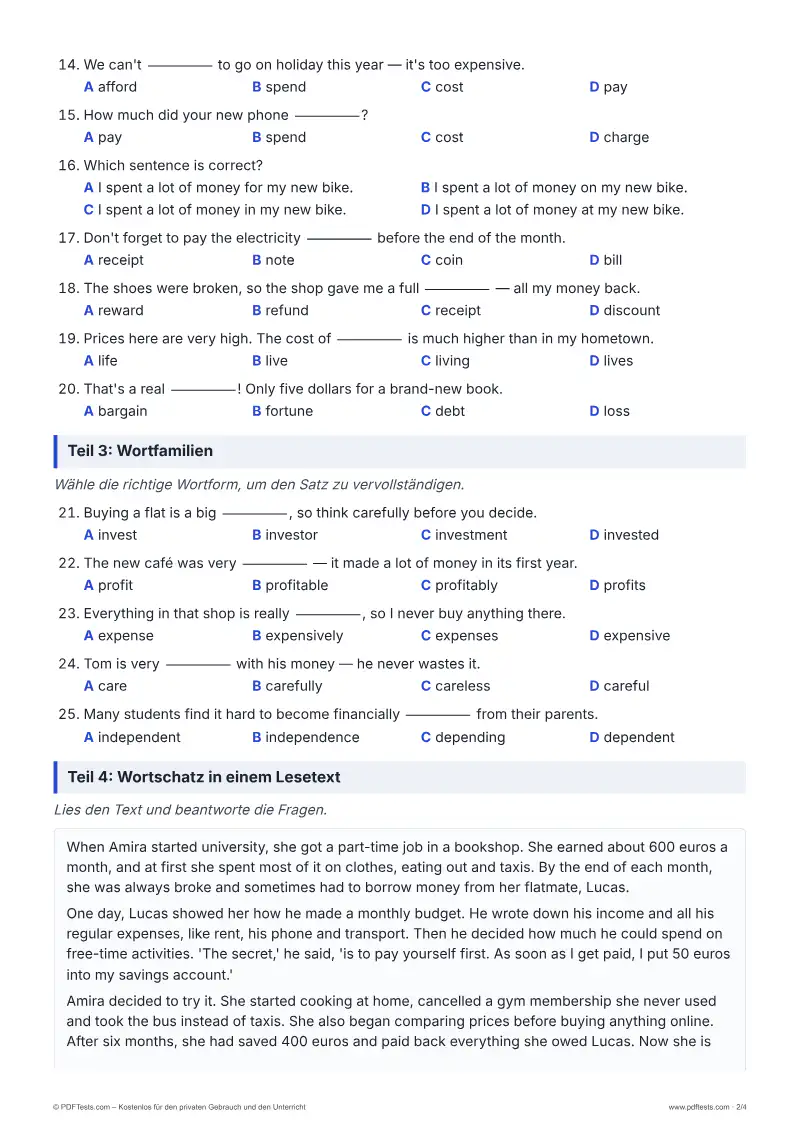
  1. I need to _____ some money from the cash machine before we go out.

  2. Could you _____ me ten pounds until Friday? I'll give it back then.

  3. Maria is _____ money for a new laptop. She puts some aside every week.

  4. We can't _____ to go on holiday this year — it's too expensive.

  5. How much did your new phone _____?

  6. Which sentence is correct?

  7. Don't forget to pay the electricity _____ before the end of the month.

  8. The shoes were broken, so the shop gave me a full _____ — all my money back.

  9. Prices here are very high. The cost of _____ is much higher than in my hometown.

  10. That's a real _____! Only five dollars for a brand-new book.

Teil 3: Wortfamilien

Wähle die richtige Wortform, um den Satz zu vervollständigen.

  1. Buying a flat is a big _____, so think carefully before you decide.

  2. The new café was very _____ — it made a lot of money in its first year.

  3. Everything in that shop is really _____, so I never buy anything there.

  4. Tom is very _____ with his money — he never wastes it.

  5. Many students find it hard to become financially _____ from their parents.

Teil 4: Wortschatz in einem Lesetext

Lies den Text und beantworte die Fragen.

When Amira started university, she got a part-time job in a bookshop. She earned about 600 euros a month, and at first she spent most of it on clothes, eating out and taxis. By the end of each month, she was always broke and sometimes had to borrow money from her flatmate, Lucas.

One day, Lucas showed her how he made a monthly budget. He wrote down his income and all his regular expenses, like rent, his phone and transport. Then he decided how much he could spend on free-time activities. 'The secret,' he said, 'is to pay yourself first. As soon as I get paid, I put 50 euros into my savings account.'

Amira decided to try it. She started cooking at home, cancelled a gym membership she never used and took the bus instead of taxis. She also began comparing prices before buying anything online. After six months, she had saved 400 euros and paid back everything she owed Lucas. Now she is saving up for a trip to Portugal next summer, and she no longer worries about money at the end of the month.

  1. In paragraph 1, the word 'broke' means:

  2. In paragraph 2, 'income' means:

  3. What does Lucas mean by 'pay yourself first'?

  4. Which of these things did Amira NOT do to spend less money?

  5. In the last paragraph, 'saving up for' a trip means:

War diese Seite hilfreich?

Fehler melden

Falsche Lösung, Tippfehler oder unklare Erklärung? Schreiben Sie uns, wir korrigieren es.

Mit einem Arbeitsblatt üben: Geld und Finanzen – Arbeitsblatt 1

Vorschau

Über diesen Test

Dieser Wortschatztest auf Niveau B1 behandelt den alltäglichen englischen Wortschatz rund um Geld und Finanzen: Bank, Einkaufen, Sparen, Leihen und Haushaltsplanung. Geübt werden Wortbedeutungen, gängige Kollokationen, Wortfamilien und Vokabeln in einem kurzen Lesetext. Der Test eignet sich für Lernende auf mittlerem Niveau, zur Wiederholung im Unterricht und zum Selbststudium.

Themen

Bank und ZahlungsverkehrEinkaufen und PreiseSparen und LeihenKollokationen mit „money“WortfamilienLeseverstehen und Wortbedeutung

So nutzen Sie diesen Test

  1. Laden Sie das PDF herunter und drucken Sie es aus – oder machen Sie den Test unten online.
  2. Beantworten Sie alle Fragen ohne Wörterbuch und ohne Zeitdruck.
  3. Prüfen Sie Ihre Antworten und notieren Sie, was Sie wiederholen sollten.

Hinweise für Lehrkräfte

Setzen Sie den Test nach einer Unterrichtseinheit zum Thema Geld ein oder vorab als Einstufungstest. Er zielt auf typische Verwechslungen ab, etwa lend/borrow, cost/pay/spend, fare/fee/fine, receipt/recipe sowie die Präposition in „spend money on“. Zur Vertiefung können die Lernenden mit dem neuen Wortschatz ihr eigenes Monatsbudget aufstellen oder den Lesetext in eigenen Worten nacherzählen.