PDFTests Originals

Umwelt (The Environment) – Test 1

B1 Mittelstufe WortschatzEnglisch

Dieser Wortschatztest auf Niveau B1 behandelt gängige englische Wörter und Wendungen rund um die Umwelt, etwa Umweltverschmutzung, Recycling, Klimawandel und Tierwelt. Abgefragt werden Wortbedeutungen, typische Kollokationen, die passende Wortwahl im Kontext und Wortfamilien; außerdem enthält der Test einen kurzen Lesetext. Er eignet sich für Lernende auf mittlerem Niveau und für Lehrkräfte, die einen druckfertigen Thementest suchen.

Fragen
30
Zeit
35 Min.
PDF
5 Seiten
Lösungen
Enthalten
  • 100 % kostenlos
  • Ohne Anmeldung
  • Druckfertiges A4-PDF
Vorschau von Seite 1: Umwelt (The Environment) – Test 1 PDF öffnen

Test online machen

Wähle bei jeder Frage die beste Antwort (A, B, C oder D). Wählen Sie Ihre Antworten und klicken Sie auf „Antworten prüfen“.

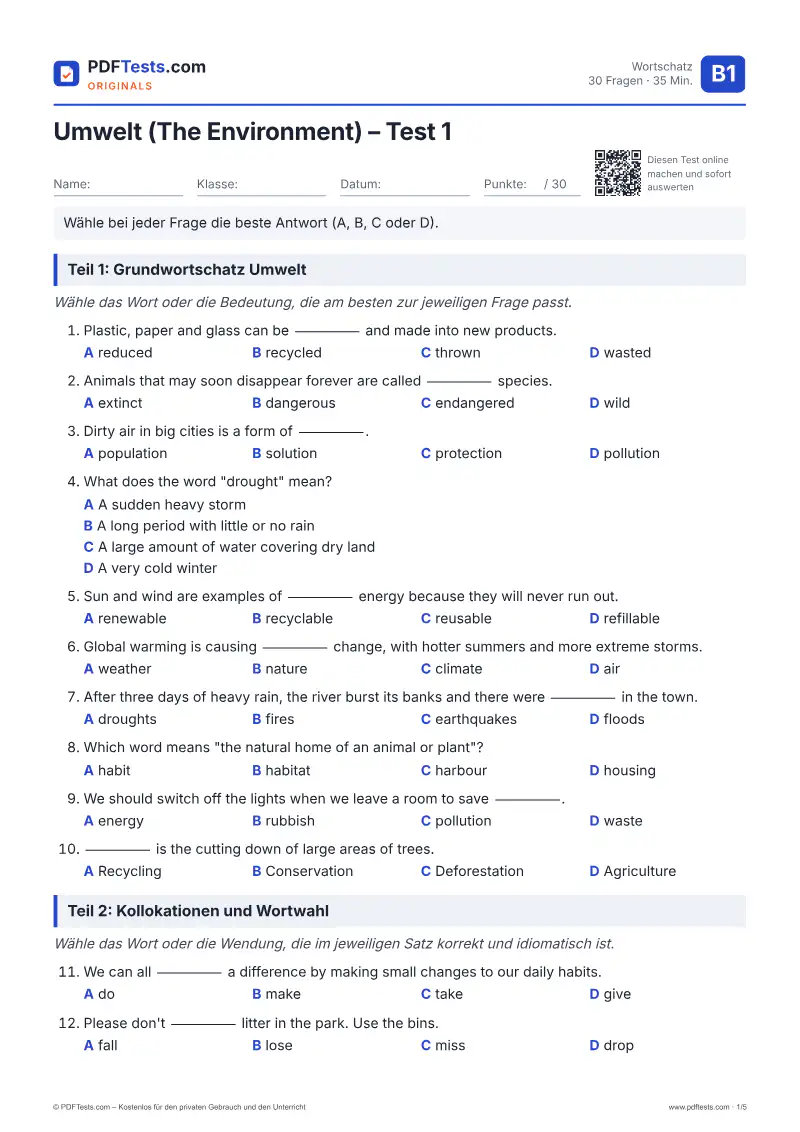
Teil 1: Grundwortschatz Umwelt

Wähle das Wort oder die Bedeutung, die am besten zur jeweiligen Frage passt.

  1. Plastic, paper and glass can be _____ and made into new products.

  2. Animals that may soon disappear forever are called _____ species.

  3. Dirty air in big cities is a form of _____.

  4. What does the word "drought" mean?

  5. Sun and wind are examples of _____ energy because they will never run out.

  6. Global warming is causing _____ change, with hotter summers and more extreme storms.

  7. After three days of heavy rain, the river burst its banks and there were _____ in the town.

  8. Which word means "the natural home of an animal or plant"?

  9. We should switch off the lights when we leave a room to save _____.

  10. _____ is the cutting down of large areas of trees.

Teil 2: Kollokationen und Wortwahl

Wähle das Wort oder die Wendung, die im jeweiligen Satz korrekt und idiomatisch ist.

  1. We can all _____ a difference by making small changes to our daily habits.

  2. Please don't _____ litter in the park. Use the bins.

  3. Many people _____ part in the beach clean-up every year.

  4. It's important to _____ the environment for future generations.

  5. Cars and factories produce harmful _____ that pollute the air.

  6. Turn off the tap while you brush your teeth so you don't _____ water.

  7. The government plans to _____ a ban on single-use plastic bags.

  8. Find the mistake: "Most people now sort their rubbish, but we still produce too many waste."

  9. "Why do you always take a reusable bag to the supermarket?" Choose the best reply.

  10. Heavy traffic causes a lot of _____ pollution, which makes it hard to sleep.

Teil 3: Leseverstehen und Wortfamilien

Lies den Text und beantworte die Fragen 21–25. Wähle dann bei den Fragen 26–30 die richtige Form des Wortes in Klammern.

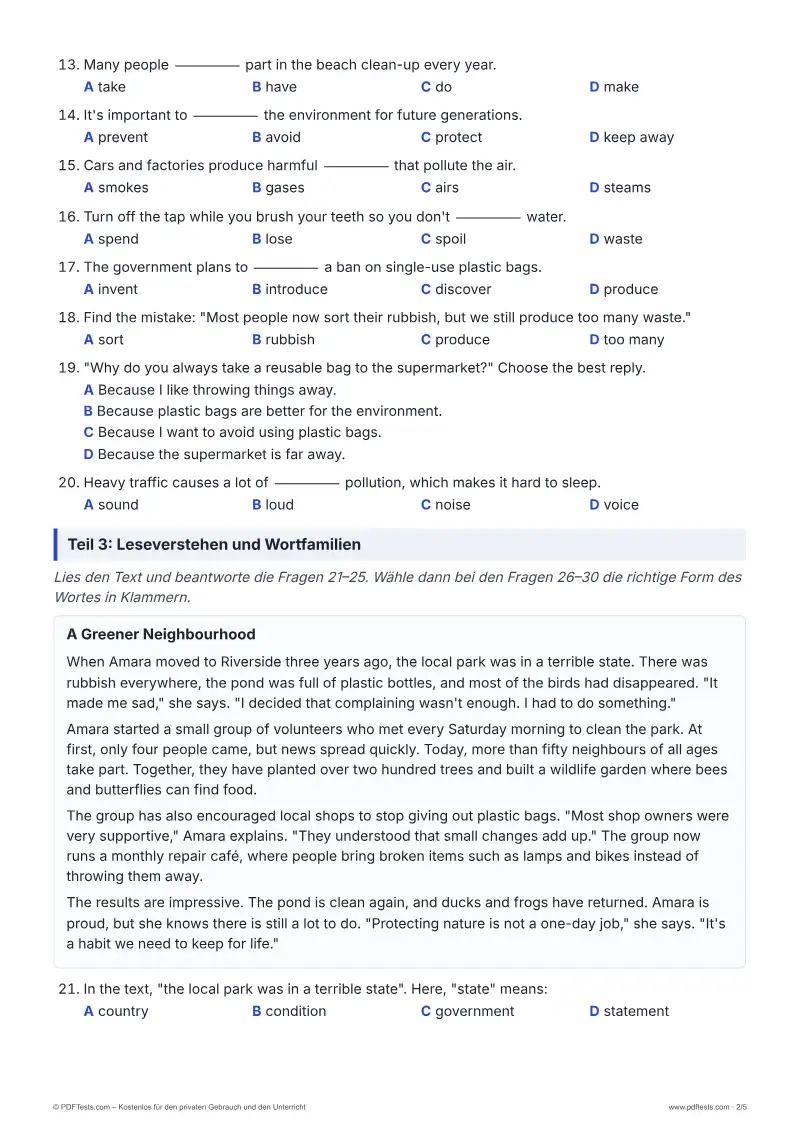
A Greener Neighbourhood

When Amara moved to Riverside three years ago, the local park was in a terrible state. There was rubbish everywhere, the pond was full of plastic bottles, and most of the birds had disappeared. "It made me sad," she says. "I decided that complaining wasn't enough. I had to do something."

Amara started a small group of volunteers who met every Saturday morning to clean the park. At first, only four people came, but news spread quickly. Today, more than fifty neighbours of all ages take part. Together, they have planted over two hundred trees and built a wildlife garden where bees and butterflies can find food.

The group has also encouraged local shops to stop giving out plastic bags. "Most shop owners were very supportive," Amara explains. "They understood that small changes add up." The group now runs a monthly repair café, where people bring broken items such as lamps and bikes instead of throwing them away.

The results are impressive. The pond is clean again, and ducks and frogs have returned. Amara is proud, but she knows there is still a lot to do. "Protecting nature is not a one-day job," she says. "It's a habit we need to keep for life."

  1. In the text, "the local park was in a terrible state". Here, "state" means:

  2. "At first, only four people came, but news spread quickly." This means:

  3. What is a "wildlife garden"?

  4. "Small changes add up" means:

  5. What is the "repair café" in the text?

  6. Many young people feel _____ about the future of the planet. (WORRY)

  7. There has been a big _____ in air quality since the factory closed. (IMPROVE)

  8. Some plastics are _____ to the environment because they take hundreds of years to break down. (HARM)

  9. Solar panels are a good _____ for families who want cheaper and cleaner energy. (CHOOSE)

  10. We need to find more _____ friendly ways to travel, like cycling and walking. (ENVIRONMENT)

Vorschau

Über diesen Test

Dieser Wortschatztest auf Niveau B1 behandelt gängige englische Wörter und Wendungen rund um die Umwelt, etwa Umweltverschmutzung, Recycling, Klimawandel und Tierwelt. Abgefragt werden Wortbedeutungen, typische Kollokationen, die passende Wortwahl im Kontext und Wortfamilien; außerdem enthält der Test einen kurzen Lesetext. Er eignet sich für Lernende auf mittlerem Niveau und für Lehrkräfte, die einen druckfertigen Thementest suchen.

Themen

Wortschatz UmweltUmweltverschmutzung und RecyclingKlima und WetterereignisseKollokationenWortfamilienBedeutung im Kontext

So nutzen Sie diesen Test

  1. Laden Sie das PDF herunter und drucken Sie es aus – oder machen Sie den Test unten online.
  2. Beantworten Sie alle Fragen ohne Wörterbuch und ohne Zeitdruck.
  3. Prüfen Sie Ihre Antworten und notieren Sie, was Sie wiederholen sollten.

Hinweise für Lehrkräfte

Setzen Sie den Test nach einer Unterrichtseinheit zum Thema Umwelt ein oder zur Wiederholung vor einer B1-Prüfung. Er zielt auf typische Fehler von Lernenden ab, etwa die Verwechslung von pollution/population, weather/climate und endangered/extinct, falsche Verb-Kollokationen (do/make a difference, have/take part), zählbare vs. nicht zählbare Nomen (too many waste) sowie Formen wie 'environmental friendly'. Als Anschlussaufgabe können die Schülerinnen und Schüler einen kurzen Absatz über ein Umweltprojekt in ihrer Region schreiben und dabei mindestens zehn Wörter aus dem Test verwenden.