PDFTests Originals

Money and Finance – Test 1

B1 Intermediate VocabularyEnglish

This B1 vocabulary test covers everyday money and finance language: banking, shopping, saving, borrowing and budgeting. It works on word meaning, common collocations, word families and vocabulary in a short reading text. It suits intermediate learners, classroom review and self-study.
Questions
30
Time
30 min
PDF
4 pages
Answer key
Included
  • 100% free
  • No sign-up or email
  • Print-ready A4 PDF
Preview of page 1 of Money and Finance – Test 1 Open PDF

Take the test online

Choose the best option (A, B, C or D) for each question. Choose your answers, then press “Check my answers”.

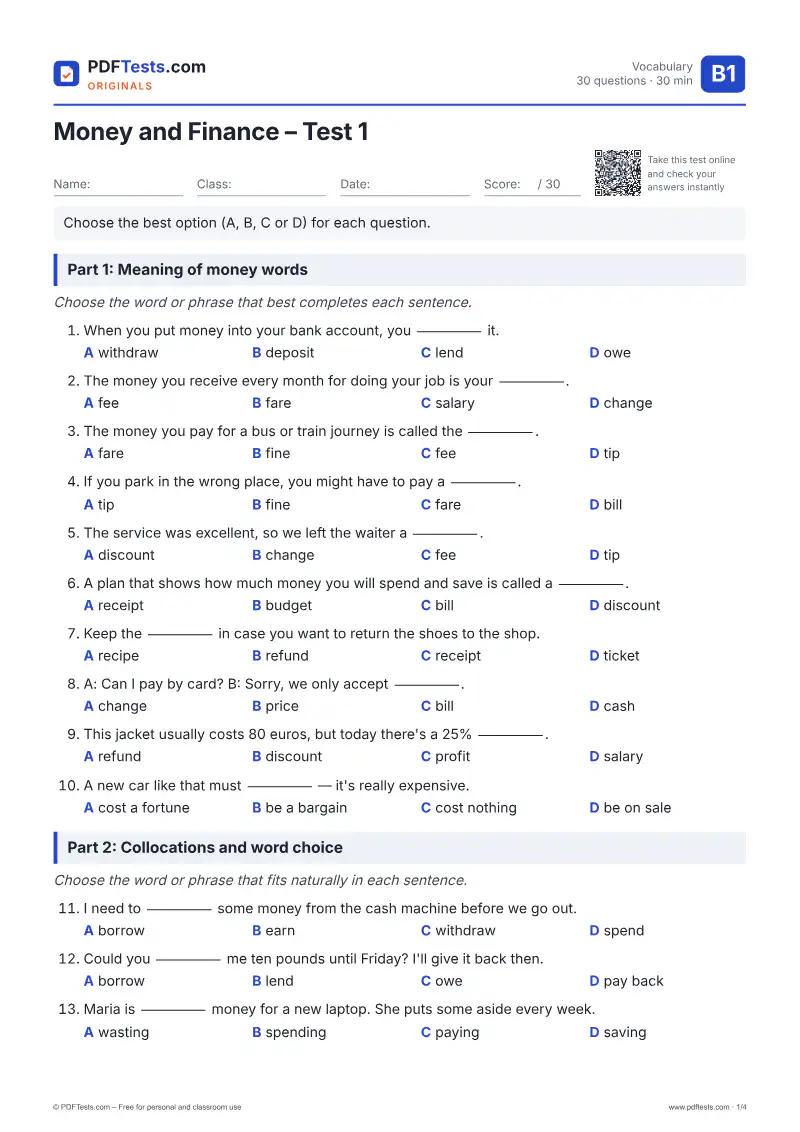
Part 1: Meaning of money words

Choose the word or phrase that best completes each sentence.

  1. When you put money into your bank account, you _____ it.

  2. The money you receive every month for doing your job is your _____.

  3. The money you pay for a bus or train journey is called the _____.

  4. If you park in the wrong place, you might have to pay a _____.

  5. The service was excellent, so we left the waiter a _____.

  6. A plan that shows how much money you will spend and save is called a _____.

  7. Keep the _____ in case you want to return the shoes to the shop.

  8. A: Can I pay by card? B: Sorry, we only accept _____.

  9. This jacket usually costs 80 euros, but today there's a 25% _____.

  10. A new car like that must _____ — it's really expensive.

Part 2: Collocations and word choice

Choose the word or phrase that fits naturally in each sentence.

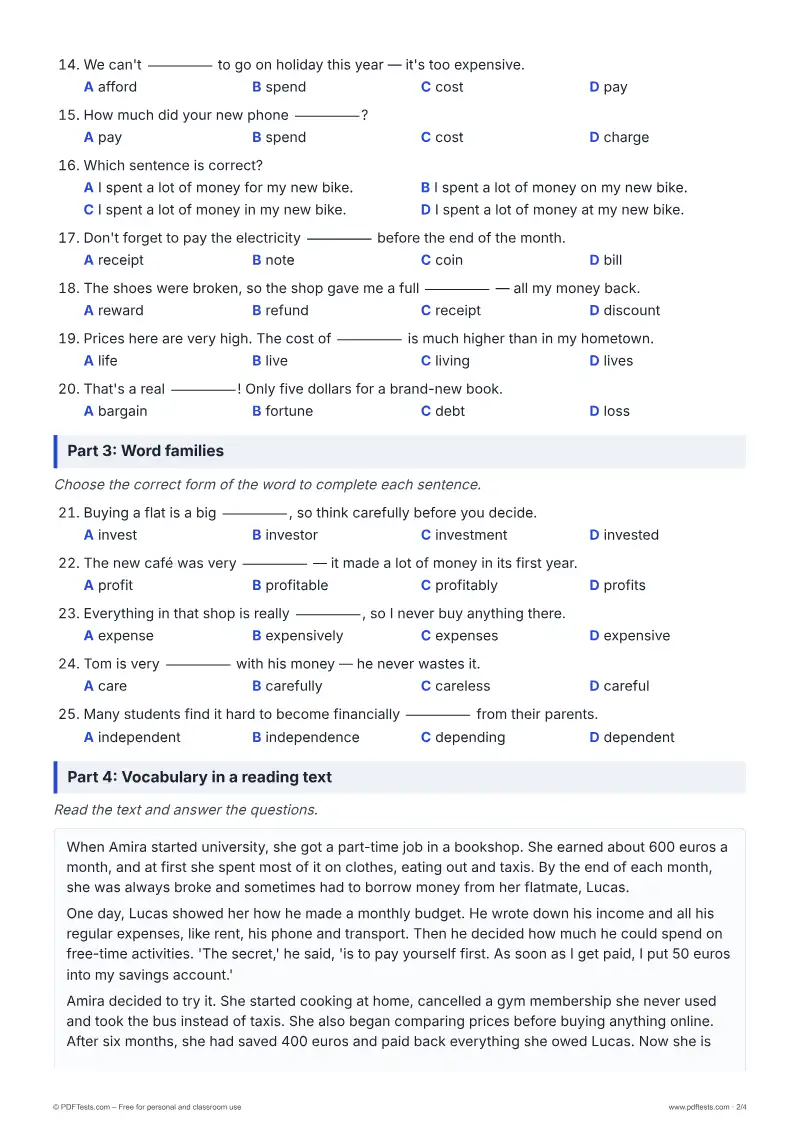
  1. I need to _____ some money from the cash machine before we go out.

  2. Could you _____ me ten pounds until Friday? I'll give it back then.

  3. Maria is _____ money for a new laptop. She puts some aside every week.

  4. We can't _____ to go on holiday this year — it's too expensive.

  5. How much did your new phone _____?

  6. Which sentence is correct?

  7. Don't forget to pay the electricity _____ before the end of the month.

  8. The shoes were broken, so the shop gave me a full _____ — all my money back.

  9. Prices here are very high. The cost of _____ is much higher than in my hometown.

  10. That's a real _____! Only five dollars for a brand-new book.

Part 3: Word families

Choose the correct form of the word to complete each sentence.

  1. Buying a flat is a big _____, so think carefully before you decide.

  2. The new café was very _____ — it made a lot of money in its first year.

  3. Everything in that shop is really _____, so I never buy anything there.

  4. Tom is very _____ with his money — he never wastes it.

  5. Many students find it hard to become financially _____ from their parents.

Part 4: Vocabulary in a reading text

Read the text and answer the questions.

When Amira started university, she got a part-time job in a bookshop. She earned about 600 euros a month, and at first she spent most of it on clothes, eating out and taxis. By the end of each month, she was always broke and sometimes had to borrow money from her flatmate, Lucas.

One day, Lucas showed her how he made a monthly budget. He wrote down his income and all his regular expenses, like rent, his phone and transport. Then he decided how much he could spend on free-time activities. 'The secret,' he said, 'is to pay yourself first. As soon as I get paid, I put 50 euros into my savings account.'

Amira decided to try it. She started cooking at home, cancelled a gym membership she never used and took the bus instead of taxis. She also began comparing prices before buying anything online. After six months, she had saved 400 euros and paid back everything she owed Lucas. Now she is saving up for a trip to Portugal next summer, and she no longer worries about money at the end of the month.

  1. In paragraph 1, the word 'broke' means:

  2. In paragraph 2, 'income' means:

  3. What does Lucas mean by 'pay yourself first'?

  4. Which of these things did Amira NOT do to spend less money?

  5. In the last paragraph, 'saving up for' a trip means:

Was this page helpful?

Report a mistake

Spotted a wrong answer, a typo or an unclear explanation? Tell us and we will fix it.

Practise with a worksheet: Money and Finance – Worksheet 1

Preview

About this test

This B1 vocabulary test covers everyday money and finance language: banking, shopping, saving, borrowing and budgeting. It works on word meaning, common collocations, word families and vocabulary in a short reading text. It suits intermediate learners, classroom review and self-study.

Topics covered

Banking and paymentsShopping and pricesSaving and borrowingCollocations with moneyWord familiesReading for meaning

How to use this test

  1. Download the PDF and print it, or take the test online below.
  2. Answer every question without a dictionary or time pressure.
  3. Check your answers and note the topics you need to review.

Notes for teachers

Use this test after a unit on money, or as a diagnostic before one. It targets common learner confusions such as lend/borrow, cost/pay/spend, fare/fee/fine, receipt/recipe and the preposition in 'spend money on'. For follow-up, ask students to write their own monthly budget using the vocabulary, or to retell the reading text in their own words.