PDFTests Originals

Adjektive auf -ed und -ing – Test 1

B1 Mittelstufe WortschatzEnglisch

Dieser Wortschatztest auf Niveau B1 übt den Unterschied zwischen Adjektiven auf -ed (wie sich jemand fühlt) und Adjektiven auf -ing (was das Gefühl auslöst), etwa bored/boring und excited/exciting. Er enthält Lückensätze, Fehlersuche, Kollokationen, Wortbildung und einen kurzen Lesetext. Ideal für Lernende auf mittlerem Niveau, zur Wiederholung im Unterricht und zum Selbstlernen.
Fragen
30
Zeit
30 Min.
PDF
4 Seiten
Lösungen
Enthalten
  • 100 % kostenlos
  • Ohne Anmeldung
  • Druckfertiges A4-PDF
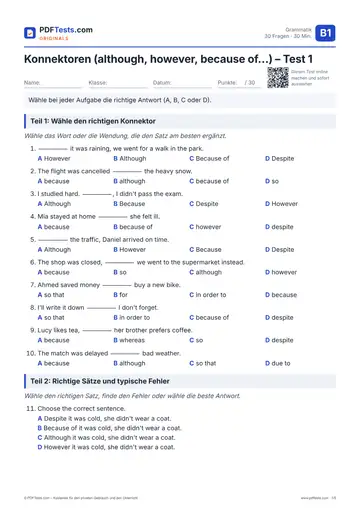
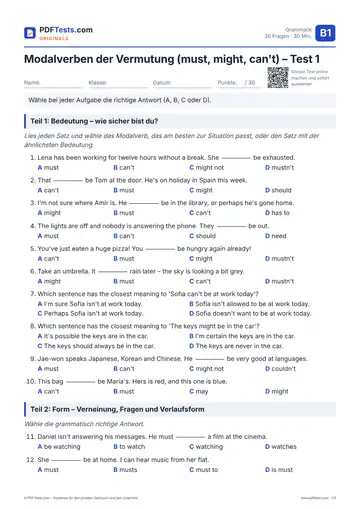
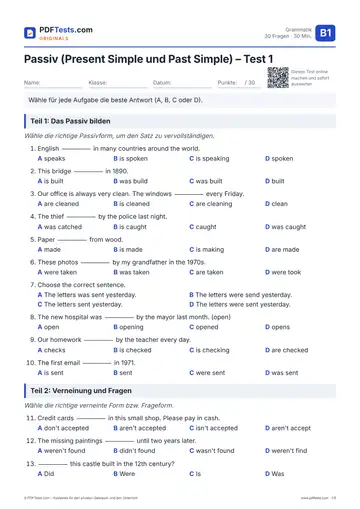
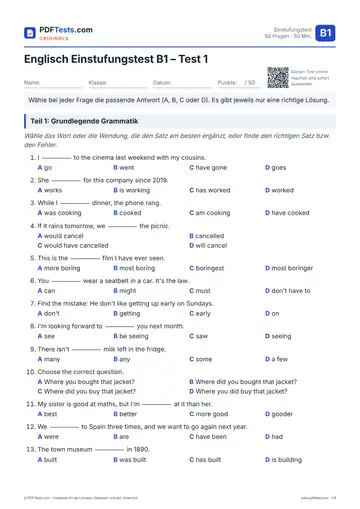
Vorschau von Seite 1: Adjektive auf -ed und -ing – Test 1 PDF öffnen

Test online machen

Wähle bei jeder Frage die beste Antwort. Es ist jeweils nur eine Lösung richtig. Wählen Sie Ihre Antworten und klicken Sie auf „Antworten prüfen“.

Teil 1: -ed oder -ing?

Wähle das Wort, das den Satz am besten ergänzt.

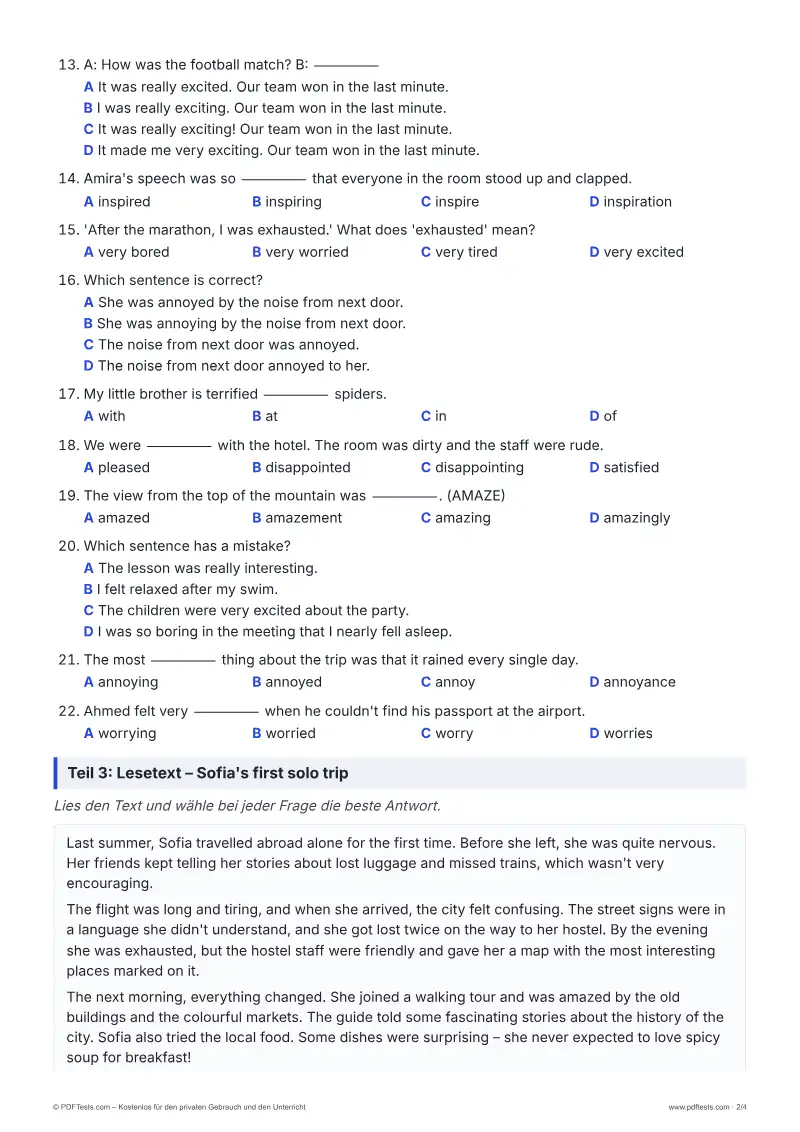
  1. The film was so _____ that I fell asleep halfway through.

  2. I was really _____ when I heard I had passed the exam.

  3. Maria felt _____ after working for twelve hours.

  4. The instructions were very _____, so nobody understood them.

  5. We were _____ to see snow in April.

  6. It's _____ that so many people still don't recycle.

  7. Are you _____ in joining the photography club?

  8. Walking alone in the forest at night can be quite _____.

  9. Kenji was _____ when he forgot his lines in the school play.

  10. The news about the accident was really _____.

Teil 2: Wortwahl, Fehler und Kollokationen

Wähle bei jeder Frage die richtige Antwort.

  1. Which sentence is correct?

  2. Which word is wrong in this sentence? 'We were amazing by how relaxing the holiday was.'

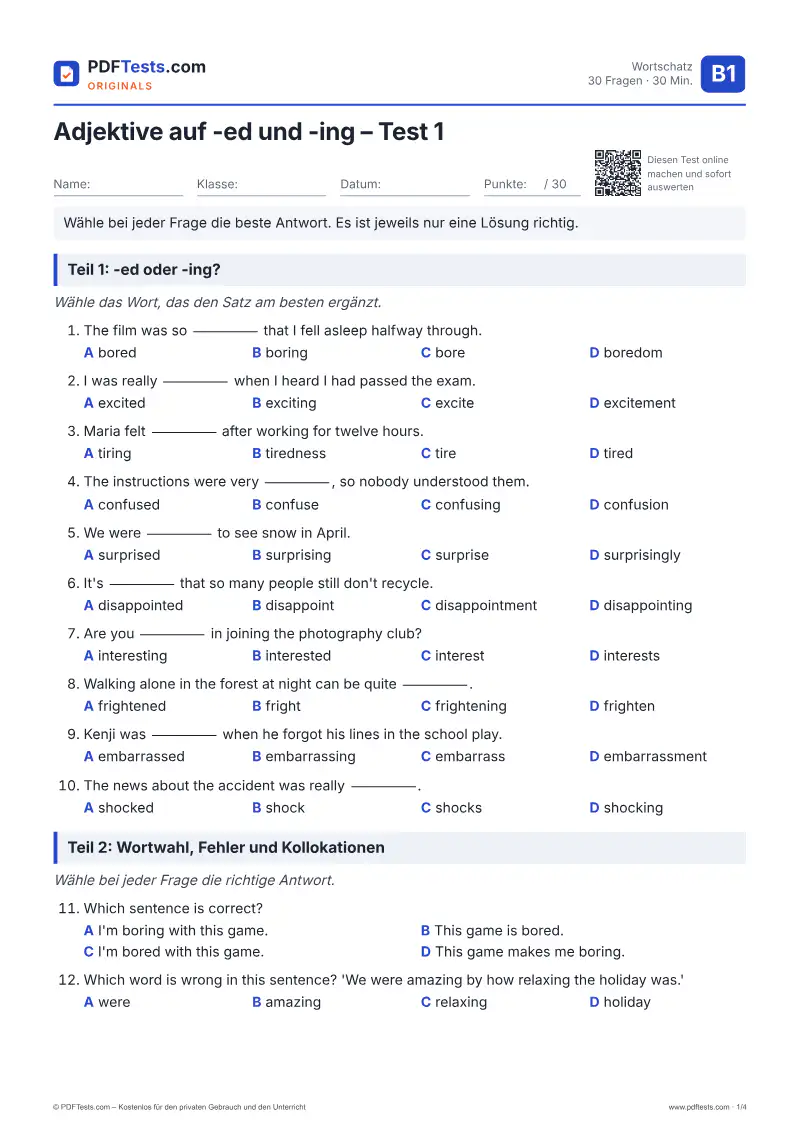
  3. A: How was the football match? B: _____

  4. Amira's speech was so _____ that everyone in the room stood up and clapped.

  5. 'After the marathon, I was exhausted.' What does 'exhausted' mean?

  6. Which sentence is correct?

  7. My little brother is terrified _____ spiders.

  8. We were _____ with the hotel. The room was dirty and the staff were rude.

  9. The view from the top of the mountain was _____. (AMAZE)

  10. Which sentence has a mistake?

  11. The most _____ thing about the trip was that it rained every single day.

  12. Ahmed felt very _____ when he couldn't find his passport at the airport.

Teil 3: Lesetext – Sofia's first solo trip

Lies den Text und wähle bei jeder Frage die beste Antwort.

Last summer, Sofia travelled abroad alone for the first time. Before she left, she was quite nervous. Her friends kept telling her stories about lost luggage and missed trains, which wasn't very encouraging.

The flight was long and tiring, and when she arrived, the city felt confusing. The street signs were in a language she didn't understand, and she got lost twice on the way to her hostel. By the evening she was exhausted, but the hostel staff were friendly and gave her a map with the most interesting places marked on it.

The next morning, everything changed. She joined a walking tour and was amazed by the old buildings and the colourful markets. The guide told some fascinating stories about the history of the city. Sofia also tried the local food. Some dishes were surprising – she never expected to love spicy soup for breakfast!

The only disappointing part of the trip was the weather on the last day. It rained so much that her boat trip was cancelled. Still, Sofia came home feeling relaxed and proud of herself. 'Travelling alone was a little frightening at first,' she says, 'but it was the most satisfying experience of my life.'

  1. How did her friends' stories make Sofia feel before the trip?

  2. In paragraph 2, 'the city felt confusing' means that _____.

  3. Which word in paragraph 2 means 'extremely tired'?

  4. How did Sofia feel on the walking tour?

  5. The guide's stories were _____.

  6. Why were some dishes 'surprising'?

  7. What was disappointing about the trip?

  8. When Sofia came home, she felt _____.

Vorschau

Über diesen Test

Dieser Wortschatztest auf Niveau B1 übt den Unterschied zwischen Adjektiven auf -ed (wie sich jemand fühlt) und Adjektiven auf -ing (was das Gefühl auslöst), etwa bored/boring und excited/exciting. Er enthält Lückensätze, Fehlersuche, Kollokationen, Wortbildung und einen kurzen Lesetext. Ideal für Lernende auf mittlerem Niveau, zur Wiederholung im Unterricht und zum Selbstlernen.

Themen

-ed- vs. -ing-AdjektiveGefühle und EmotionenWortbildungKollokationen: Adjektiv + PräpositionBedeutung im KontextWortschatz im Lesetext

So nutzen Sie diesen Test

  1. Laden Sie das PDF herunter und drucken Sie es aus – oder machen Sie den Test unten online.
  2. Beantworten Sie alle Fragen ohne Wörterbuch und ohne Zeitdruck.
  3. Prüfen Sie Ihre Antworten und notieren Sie, was Sie wiederholen sollten.

Hinweise für Lehrkräfte

Der Test zielt auf einen sehr häufigen Fehler ab: -ing-Adjektive werden verwendet, um Gefühle zu beschreiben (z. B. 'I am boring' statt 'I am bored'). Teil 1 prüft grundlegende Form und Bedeutung, Teil 2 ergänzt Fehlersuche, Kollokationen und Wortbildung, und Teil 3 überprüft die Adjektive in einem längeren Lesetext. Als Anschlussaufgabe können die Schülerinnen und Schüler fünf Sätze über eine kürzliche Reise oder ein Ereignis schreiben und dabei in jedem Satz ein -ed- und ein -ing-Adjektiv derselben Wortfamilie verwenden.