PDFTests Originals

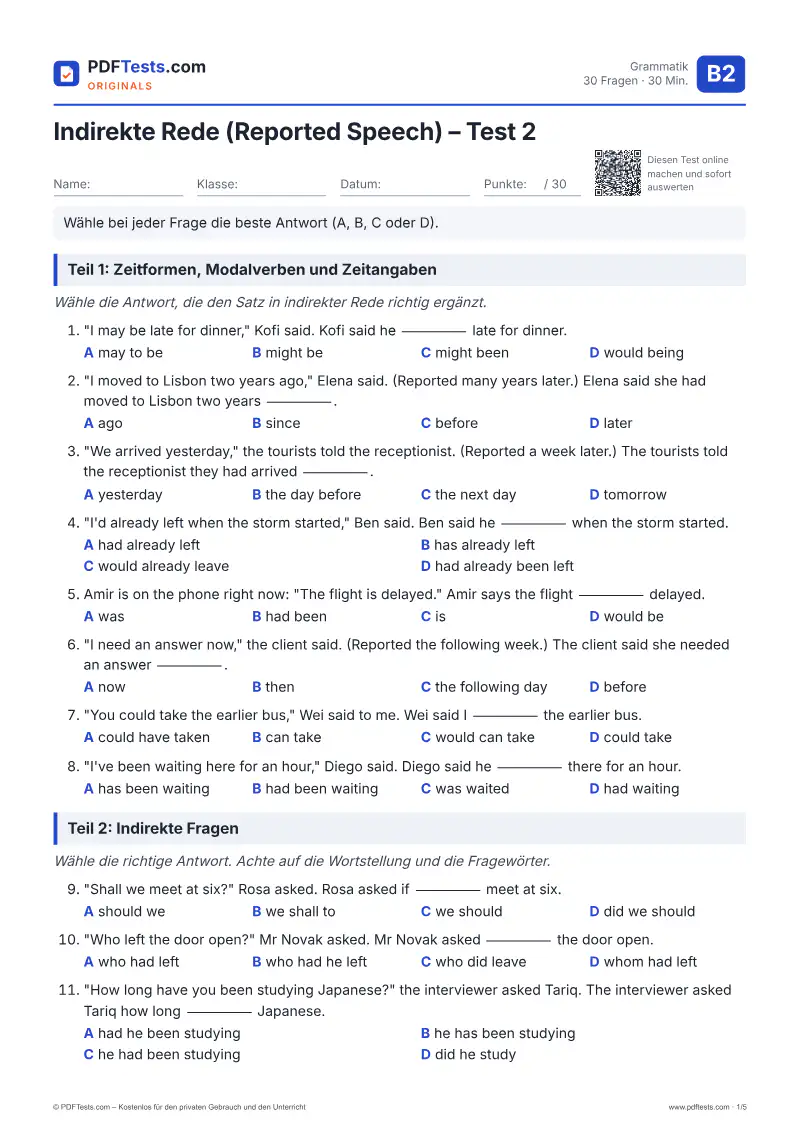
Indirekte Rede (Reported Speech) – Test 2

B2 Gute Mittelstufe GrammatikEnglisch

Dieser B2-Grammatiktest behandelt die indirekte Rede (Reported Speech) ausführlich: Zeitenverschiebung (Backshift), Zeit- und Ortsangaben, indirekte Fragen und die Satzmuster nach einleitenden Verben (Reporting Verbs). Zum Abschluss wird eine kurze E-Mail vervollständigt. Der Test eignet sich für Lernende auf fortgeschrittenem Mittelstufenniveau und für Lehrkräfte, die Form, Bedeutung und Gebrauch schnell und ausdruckbar überprüfen möchten.
Fragen
30
Zeit
30 Min.
PDF
5 Seiten
Lösungen
Enthalten
  • 100 % kostenlos
  • Ohne Anmeldung
  • Druckfertiges A4-PDF
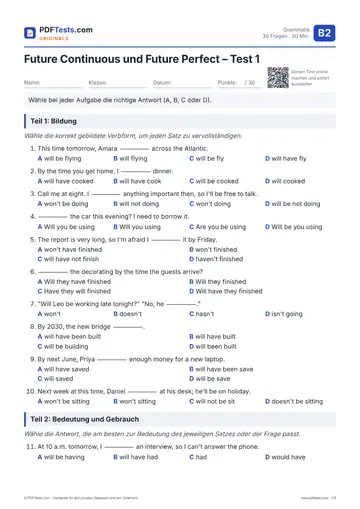
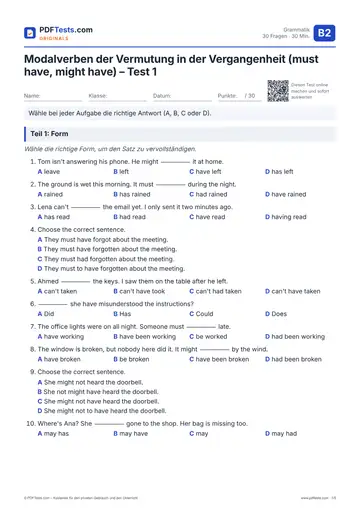
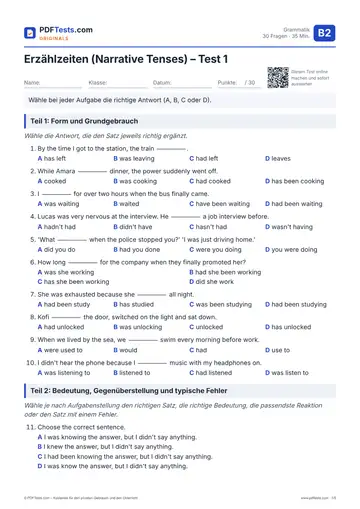
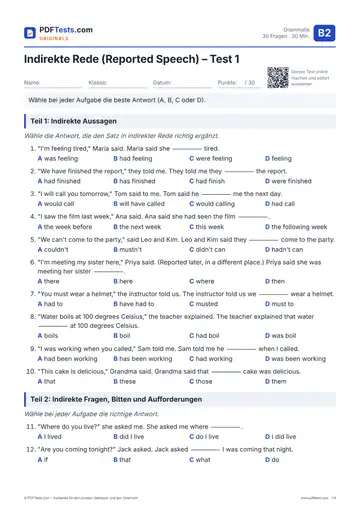
Vorschau von Seite 1: Indirekte Rede (Reported Speech) – Test 2 PDF öffnen

Test online machen

Wähle bei jeder Frage die beste Antwort (A, B, C oder D). Wählen Sie Ihre Antworten und klicken Sie auf „Antworten prüfen“.

Teil 1: Zeitformen, Modalverben und Zeitangaben

Wähle die Antwort, die den Satz in indirekter Rede richtig ergänzt.

  1. "I may be late for dinner," Kofi said. Kofi said he _____ late for dinner.

  2. "I moved to Lisbon two years ago," Elena said. (Reported many years later.) Elena said she had moved to Lisbon two years _____.

  3. "We arrived yesterday," the tourists told the receptionist. (Reported a week later.) The tourists told the receptionist they had arrived _____.

  4. "I'd already left when the storm started," Ben said. Ben said he _____ when the storm started.

  5. Amir is on the phone right now: "The flight is delayed." Amir says the flight _____ delayed.

  6. "I need an answer now," the client said. (Reported the following week.) The client said she needed an answer _____.

  7. "You could take the earlier bus," Wei said to me. Wei said I _____ the earlier bus.

  8. "I've been waiting here for an hour," Diego said. Diego said he _____ there for an hour.

Teil 2: Indirekte Fragen

Wähle die richtige Antwort. Achte auf die Wortstellung und die Fragewörter.

  1. "Shall we meet at six?" Rosa asked. Rosa asked if _____ meet at six.

  2. "Who left the door open?" Mr Novak asked. Mr Novak asked _____ the door open.

  3. "How long have you been studying Japanese?" the interviewer asked Tariq. The interviewer asked Tariq how long _____ Japanese.

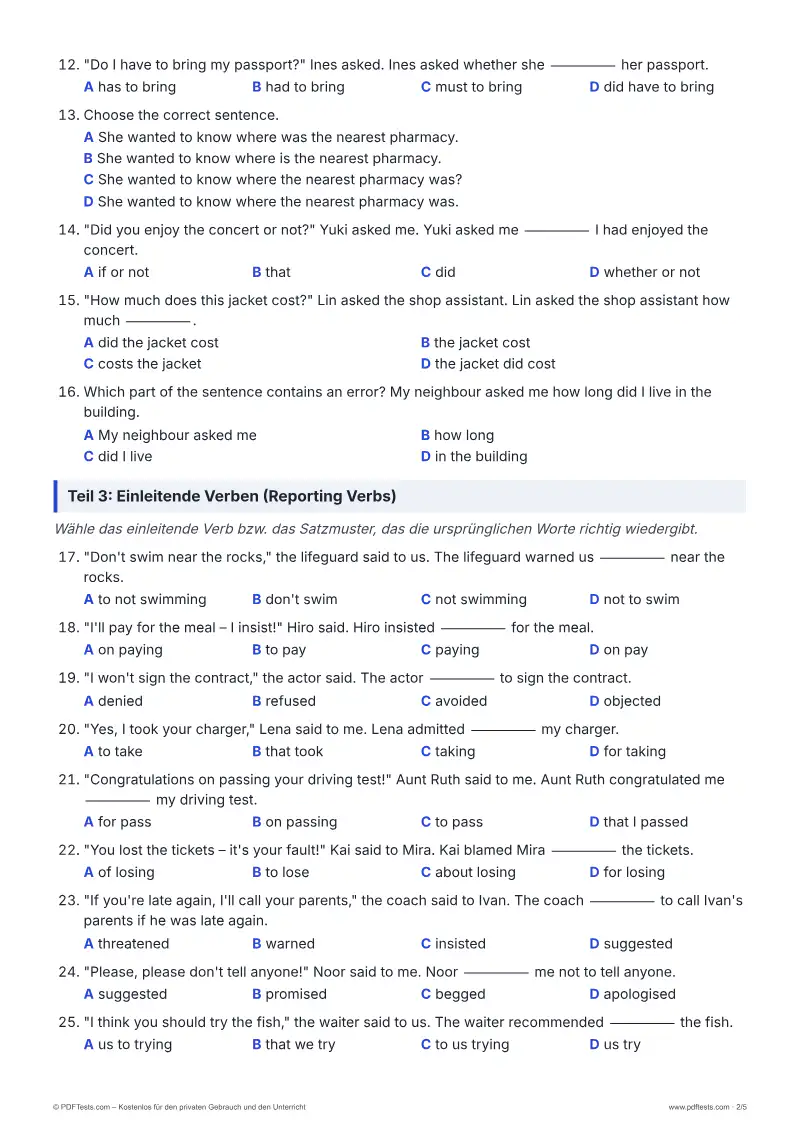
  4. "Do I have to bring my passport?" Ines asked. Ines asked whether she _____ her passport.

  5. Choose the correct sentence.

  6. "Did you enjoy the concert or not?" Yuki asked me. Yuki asked me _____ I had enjoyed the concert.

  7. "How much does this jacket cost?" Lin asked the shop assistant. Lin asked the shop assistant how much _____.

  8. Which part of the sentence contains an error? My neighbour asked me how long did I live in the building.

Teil 3: Einleitende Verben (Reporting Verbs)

Wähle das einleitende Verb bzw. das Satzmuster, das die ursprünglichen Worte richtig wiedergibt.

  1. "Don't swim near the rocks," the lifeguard said to us. The lifeguard warned us _____ near the rocks.

  2. "I'll pay for the meal – I insist!" Hiro said. Hiro insisted _____ for the meal.

  3. "I won't sign the contract," the actor said. The actor _____ to sign the contract.

  4. "Yes, I took your charger," Lena said to me. Lena admitted _____ my charger.

  5. "Congratulations on passing your driving test!" Aunt Ruth said to me. Aunt Ruth congratulated me _____ my driving test.

  6. "You lost the tickets – it's your fault!" Kai said to Mira. Kai blamed Mira _____ the tickets.

  7. "If you're late again, I'll call your parents," the coach said to Ivan. The coach _____ to call Ivan's parents if he was late again.

  8. "Please, please don't tell anyone!" Noor said to me. Noor _____ me not to tell anyone.

  9. "I think you should try the fish," the waiter said to us. The waiter recommended _____ the fish.

Teil 4: Indirekte Rede im Kontext

Lies die E-Mail und wähle für jede Lücke die beste Antwort. Beantworte anschließend die letzte Frage.

Hi Sam,

You asked me how my job interview went, so here's the full story. When I arrived, the receptionist asked me (1) ___ an appointment. I explained that I was there to see Ms Okafor at ten. After a few minutes, Ms Okafor came out. She said that she was sorry and that the previous interview (2) ___ longer than expected.

The interview itself was friendly. Ms Okafor asked me what I enjoyed most about my work and why I (3) ___ to leave my current job. At the end, she told me she (4) ___ me a decision by the end of the week. Fingers crossed!

Best wishes,

Julia

  1. Gap (1): The receptionist asked me _____ an appointment.

  2. Gap (2): She said that the previous interview _____ longer than expected.

  3. Gap (3): She asked me why I _____ to leave my current job.

  4. Gap (4): She told me she _____ me a decision by the end of the week.

  5. What were Ms Okafor's exact words at the end of the interview?

War diese Seite hilfreich?

Fehler melden

Falsche Lösung, Tippfehler oder unklare Erklärung? Schreiben Sie uns, wir korrigieren es.

Mit einem Arbeitsblatt üben: Indirekte Rede (Reported Speech) – Arbeitsblatt 1

Vorschau

Über diesen Test

Dieser B2-Grammatiktest behandelt die indirekte Rede (Reported Speech) ausführlich: Zeitenverschiebung (Backshift), Zeit- und Ortsangaben, indirekte Fragen und die Satzmuster nach einleitenden Verben (Reporting Verbs). Zum Abschluss wird eine kurze E-Mail vervollständigt. Der Test eignet sich für Lernende auf fortgeschrittenem Mittelstufenniveau und für Lehrkräfte, die Form, Bedeutung und Gebrauch schnell und ausdruckbar überprüfen möchten.

Themen

Zeitenverschiebung (Backshift)Zeit- und OrtsangabenModalverben in der indirekten RedeIndirekte Fragen und WortstellungEinleitende Verben und ihre Satzmuster (Reporting Verbs)Fehlerkorrektur

So nutzen Sie diesen Test

  1. Laden Sie das PDF herunter und drucken Sie es aus – oder machen Sie den Test unten online.
  2. Beantworten Sie alle Fragen ohne Wörterbuch und ohne Zeitdruck.
  3. Prüfen Sie Ihre Antworten und notieren Sie, was Sie wiederholen sollten.

Hinweise für Lehrkräfte

Setzen Sie diesen Test ein, nachdem Sie Zeitenverschiebung, indirekte Fragen und die Satzmuster nach Reporting Verbs behandelt haben. Er zielt auf typische B2-Fehler ab: Fragewortstellung in indirekten Fragen, „if or not“ statt „whether or not“, falsche Muster nach Verben wie insist, admit, blame und refuse sowie nicht angepasste Zeitangaben wie „yesterday“ oder „now“. Als Anschlussaufgabe geben die Lernenden in Partnerarbeit ein echtes Gespräch in indirekter Rede wieder und verwenden dabei mindestens fünf verschiedene Reporting Verbs.