PDFTests Originals

Le discours indirect (Reported Speech) – Test 2

B2 Intermédiaire avancé GrammaireAnglais

Ce test de grammaire anglaise de niveau B2 approfondit le discours indirect (reported speech) : concordance des temps (backshift), repères de temps et de lieu, questions indirectes et constructions après les verbes introducteurs. Il se termine par un court e-mail à compléter. Il s'adresse aux apprenants de niveau intermédiaire avancé et aux enseignants qui souhaitent vérifier rapidement, sur papier, la forme, le sens et l'emploi de ces structures.
Questions
30
Durée
30 min
PDF
5 pages
Corrigé
Inclus
  • 100 % gratuit
  • Sans inscription
  • PDF A4 prêt à imprimer
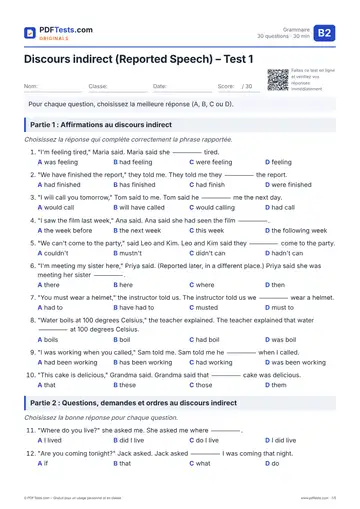
Aperçu de la page 1 : Le discours indirect (Reported Speech) – Test 2 Ouvrir le PDF

Faire le test en ligne

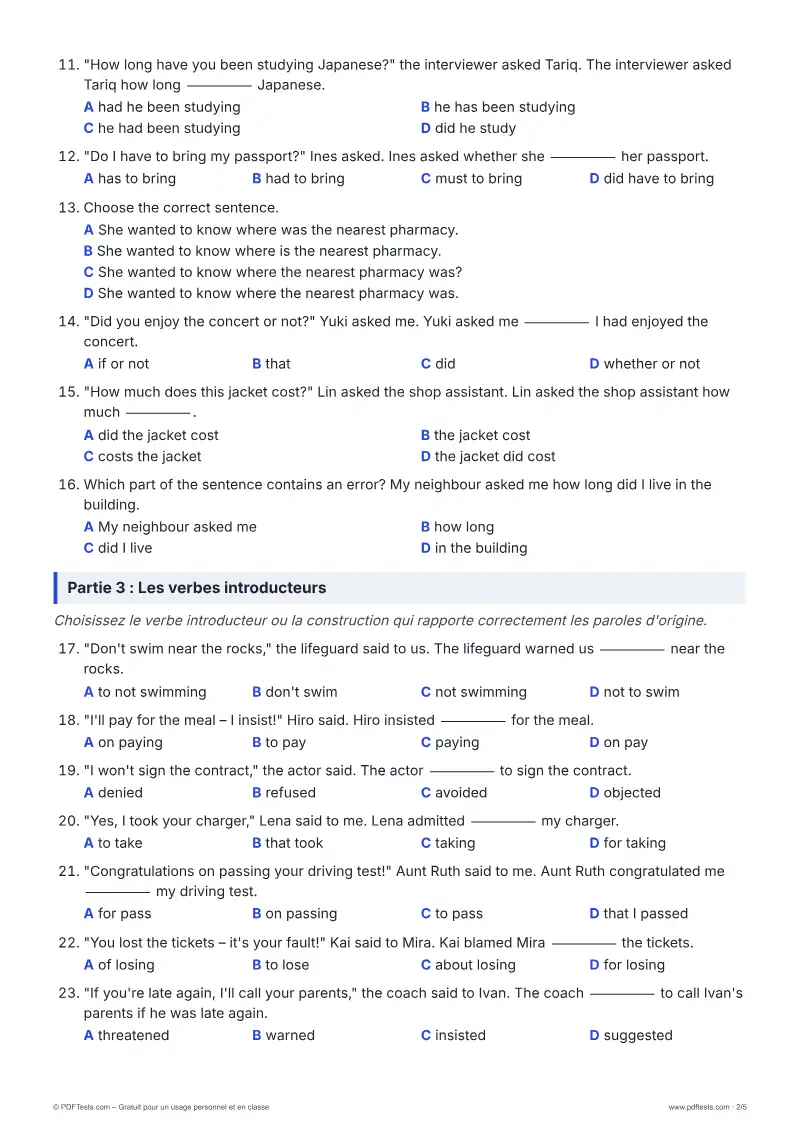
Pour chaque question, choisissez la meilleure réponse (A, B, C ou D). Choisissez vos réponses, puis cliquez sur « Vérifier mes réponses ».

Partie 1 : Temps, modaux et repères temporels

Choisissez la réponse qui complète correctement la phrase au discours indirect.

  1. "I may be late for dinner," Kofi said. Kofi said he _____ late for dinner.

  2. "I moved to Lisbon two years ago," Elena said. (Reported many years later.) Elena said she had moved to Lisbon two years _____.

  3. "We arrived yesterday," the tourists told the receptionist. (Reported a week later.) The tourists told the receptionist they had arrived _____.

  4. "I'd already left when the storm started," Ben said. Ben said he _____ when the storm started.

  5. Amir is on the phone right now: "The flight is delayed." Amir says the flight _____ delayed.

  6. "I need an answer now," the client said. (Reported the following week.) The client said she needed an answer _____.

  7. "You could take the earlier bus," Wei said to me. Wei said I _____ the earlier bus.

  8. "I've been waiting here for an hour," Diego said. Diego said he _____ there for an hour.

Partie 2 : Les questions indirectes

Choisissez la bonne réponse. Faites attention à l'ordre des mots et aux mots interrogatifs.

  1. "Shall we meet at six?" Rosa asked. Rosa asked if _____ meet at six.

  2. "Who left the door open?" Mr Novak asked. Mr Novak asked _____ the door open.

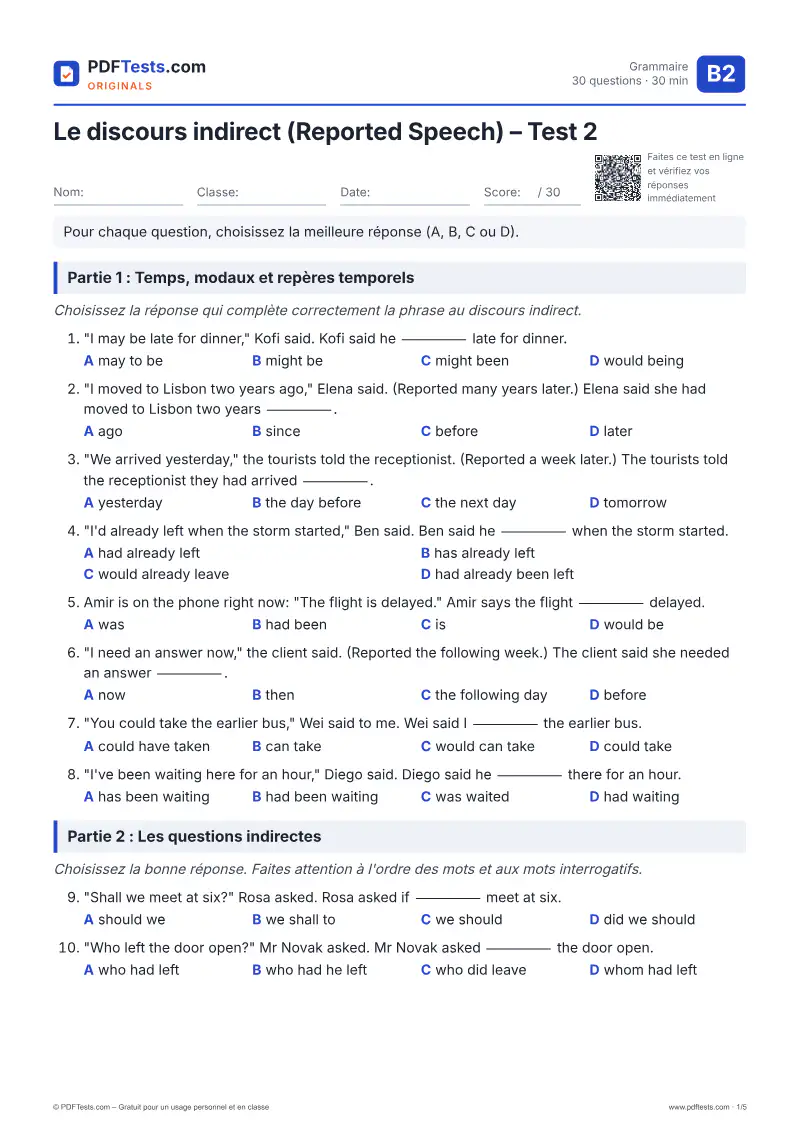
  3. "How long have you been studying Japanese?" the interviewer asked Tariq. The interviewer asked Tariq how long _____ Japanese.

  4. "Do I have to bring my passport?" Ines asked. Ines asked whether she _____ her passport.

  5. Choose the correct sentence.

  6. "Did you enjoy the concert or not?" Yuki asked me. Yuki asked me _____ I had enjoyed the concert.

  7. "How much does this jacket cost?" Lin asked the shop assistant. Lin asked the shop assistant how much _____.

  8. Which part of the sentence contains an error? My neighbour asked me how long did I live in the building.

Partie 3 : Les verbes introducteurs

Choisissez le verbe introducteur ou la construction qui rapporte correctement les paroles d'origine.

  1. "Don't swim near the rocks," the lifeguard said to us. The lifeguard warned us _____ near the rocks.

  2. "I'll pay for the meal – I insist!" Hiro said. Hiro insisted _____ for the meal.

  3. "I won't sign the contract," the actor said. The actor _____ to sign the contract.

  4. "Yes, I took your charger," Lena said to me. Lena admitted _____ my charger.

  5. "Congratulations on passing your driving test!" Aunt Ruth said to me. Aunt Ruth congratulated me _____ my driving test.

  6. "You lost the tickets – it's your fault!" Kai said to Mira. Kai blamed Mira _____ the tickets.

  7. "If you're late again, I'll call your parents," the coach said to Ivan. The coach _____ to call Ivan's parents if he was late again.

  8. "Please, please don't tell anyone!" Noor said to me. Noor _____ me not to tell anyone.

  9. "I think you should try the fish," the waiter said to us. The waiter recommended _____ the fish.

Partie 4 : Le discours indirect en contexte

Lisez l'e-mail et choisissez la meilleure réponse pour chaque blanc. Répondez ensuite à la dernière question.

Hi Sam,

You asked me how my job interview went, so here's the full story. When I arrived, the receptionist asked me (1) ___ an appointment. I explained that I was there to see Ms Okafor at ten. After a few minutes, Ms Okafor came out. She said that she was sorry and that the previous interview (2) ___ longer than expected.

The interview itself was friendly. Ms Okafor asked me what I enjoyed most about my work and why I (3) ___ to leave my current job. At the end, she told me she (4) ___ me a decision by the end of the week. Fingers crossed!

Best wishes,

Julia

  1. Gap (1): The receptionist asked me _____ an appointment.

  2. Gap (2): She said that the previous interview _____ longer than expected.

  3. Gap (3): She asked me why I _____ to leave my current job.

  4. Gap (4): She told me she _____ me a decision by the end of the week.

  5. What were Ms Okafor's exact words at the end of the interview?

Cette page vous a-t-elle été utile ?

Signaler une erreur

Une mauvaise réponse, une faute de frappe ou une explication peu claire ? Dites-le-nous, nous corrigerons.

S’entraîner avec une fiche: Le discours indirect (reported speech) – Fiche 1

Aperçu

À propos de ce test

Ce test de grammaire anglaise de niveau B2 approfondit le discours indirect (reported speech) : concordance des temps (backshift), repères de temps et de lieu, questions indirectes et constructions après les verbes introducteurs. Il se termine par un court e-mail à compléter. Il s'adresse aux apprenants de niveau intermédiaire avancé et aux enseignants qui souhaitent vérifier rapidement, sur papier, la forme, le sens et l'emploi de ces structures.

Thèmes abordés

Concordance des temps (backshift)Repères de temps et de lieuLes modaux au discours indirectQuestions indirectes et ordre des motsVerbes introducteurs et leurs constructionsCorrection d'erreurs

Comment utiliser ce test

  1. Téléchargez le PDF et imprimez-le, ou faites le test en ligne ci-dessous.
  2. Répondez à toutes les questions sans dictionnaire et sans vous presser.
  3. Vérifiez vos réponses et notez les points à revoir.

Notes pour l’enseignant

Proposez ce test après avoir travaillé la concordance des temps, les questions indirectes et les constructions des verbes introducteurs. Il cible les erreurs typiques du niveau B2 : ordre des mots interrogatif conservé dans les questions indirectes, « if or not » au lieu de « whether or not », mauvaises constructions après des verbes comme insist, admit, blame et refuse, et repères temporels non transformés comme « yesterday » ou « now ». En prolongement, demandez aux élèves de rapporter, par deux, une conversation réelle en utilisant au moins cinq verbes introducteurs différents.