PDFTests Originals

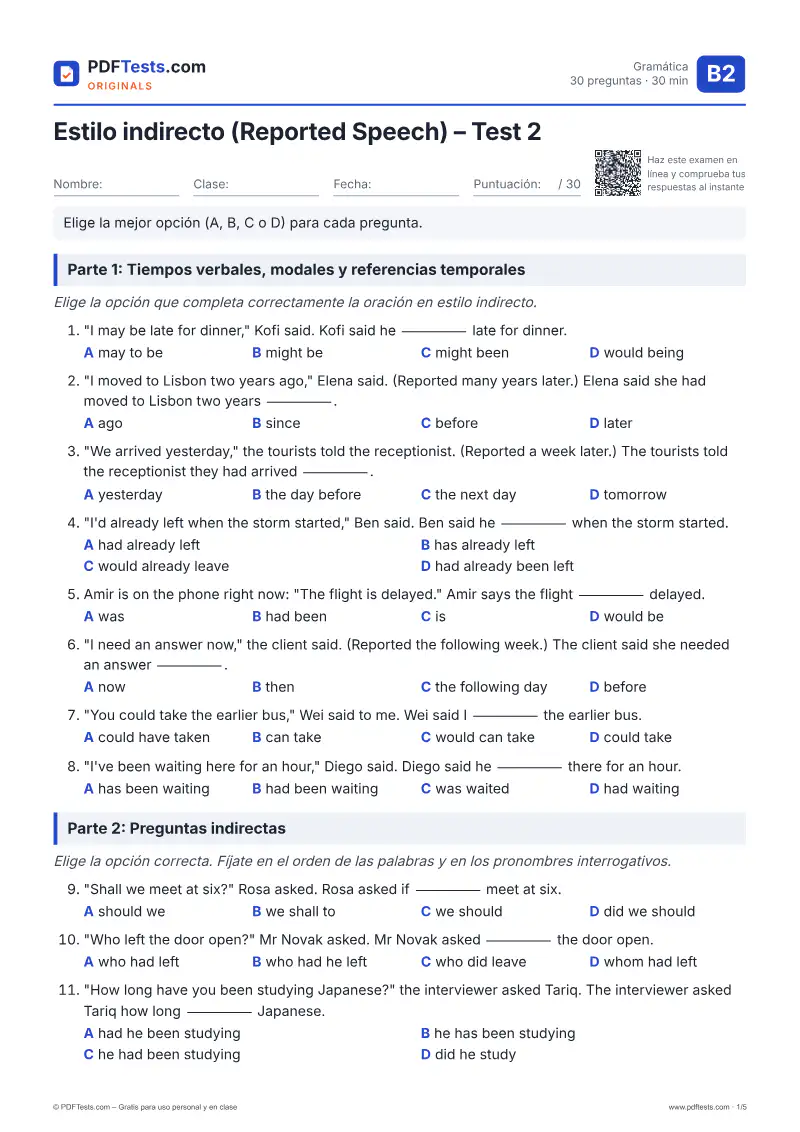
Estilo indirecto (Reported Speech) – Test 2

B2 Intermedio alto GramáticaInglés

Este test de gramática inglesa de nivel B2 trabaja a fondo el estilo indirecto (reported speech): el cambio de tiempos verbales (backshift), las referencias de tiempo y lugar, las preguntas indirectas y las estructuras que siguen a los verbos introductorios. Termina con un breve correo electrónico para completar. Es ideal para alumnos de nivel intermedio alto y para profesores que buscan una forma rápida e imprimible de comprobar la forma, el significado y el uso.
Preguntas
30
Tiempo
30 min
PDF
5 páginas
Soluciones
Incluidas
  • 100 % gratis
  • Sin registro
  • PDF A4 listo para imprimir
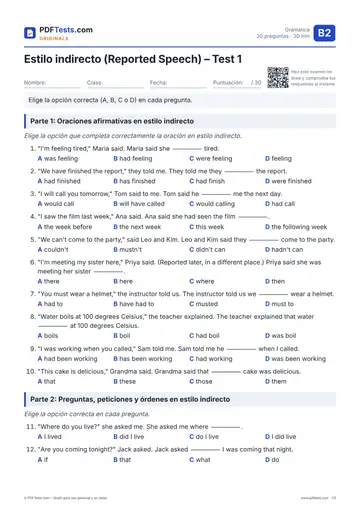
Vista previa de la página 1: Estilo indirecto (Reported Speech) – Test 2 Abrir PDF

Haz el examen en línea

Elige la mejor opción (A, B, C o D) para cada pregunta. Elige tus respuestas y pulsa «Comprobar respuestas».

Parte 1: Tiempos verbales, modales y referencias temporales

Elige la opción que completa correctamente la oración en estilo indirecto.

  1. "I may be late for dinner," Kofi said. Kofi said he _____ late for dinner.

  2. "I moved to Lisbon two years ago," Elena said. (Reported many years later.) Elena said she had moved to Lisbon two years _____.

  3. "We arrived yesterday," the tourists told the receptionist. (Reported a week later.) The tourists told the receptionist they had arrived _____.

  4. "I'd already left when the storm started," Ben said. Ben said he _____ when the storm started.

  5. Amir is on the phone right now: "The flight is delayed." Amir says the flight _____ delayed.

  6. "I need an answer now," the client said. (Reported the following week.) The client said she needed an answer _____.

  7. "You could take the earlier bus," Wei said to me. Wei said I _____ the earlier bus.

  8. "I've been waiting here for an hour," Diego said. Diego said he _____ there for an hour.

Parte 2: Preguntas indirectas

Elige la opción correcta. Fíjate en el orden de las palabras y en los pronombres interrogativos.

  1. "Shall we meet at six?" Rosa asked. Rosa asked if _____ meet at six.

  2. "Who left the door open?" Mr Novak asked. Mr Novak asked _____ the door open.

  3. "How long have you been studying Japanese?" the interviewer asked Tariq. The interviewer asked Tariq how long _____ Japanese.

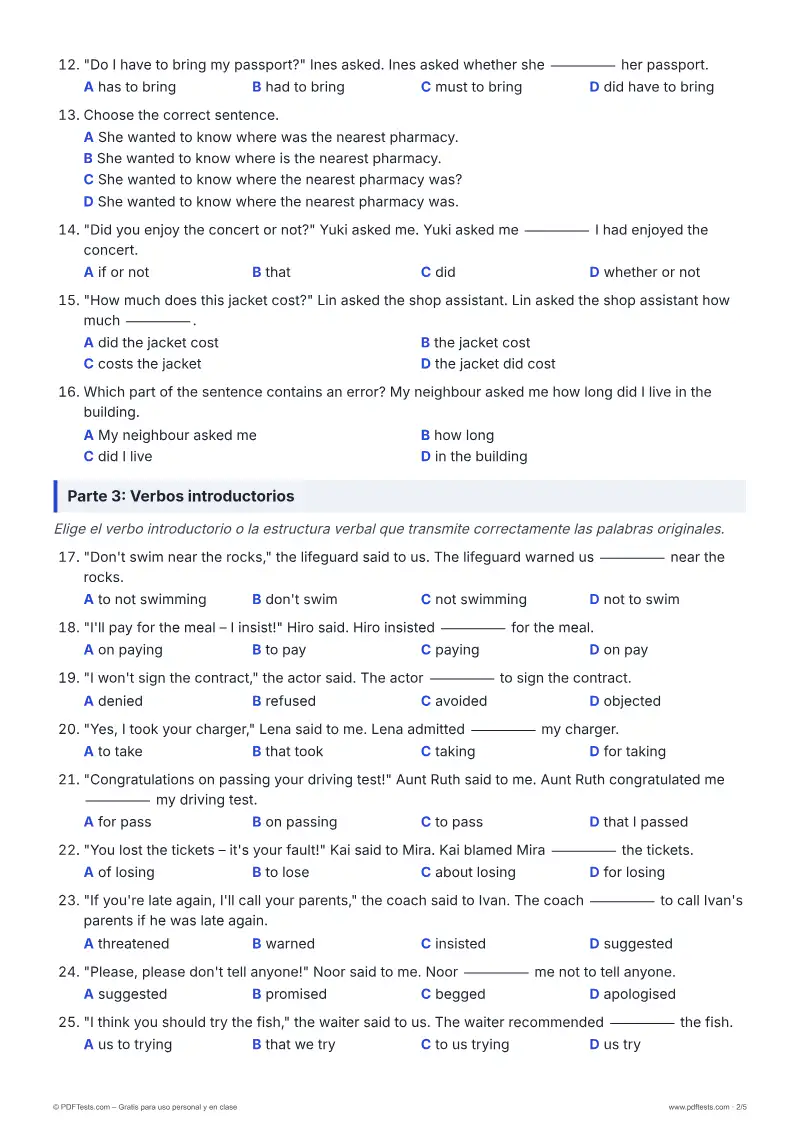
  4. "Do I have to bring my passport?" Ines asked. Ines asked whether she _____ her passport.

  5. Choose the correct sentence.

  6. "Did you enjoy the concert or not?" Yuki asked me. Yuki asked me _____ I had enjoyed the concert.

  7. "How much does this jacket cost?" Lin asked the shop assistant. Lin asked the shop assistant how much _____.

  8. Which part of the sentence contains an error? My neighbour asked me how long did I live in the building.

Parte 3: Verbos introductorios

Elige el verbo introductorio o la estructura verbal que transmite correctamente las palabras originales.

  1. "Don't swim near the rocks," the lifeguard said to us. The lifeguard warned us _____ near the rocks.

  2. "I'll pay for the meal – I insist!" Hiro said. Hiro insisted _____ for the meal.

  3. "I won't sign the contract," the actor said. The actor _____ to sign the contract.

  4. "Yes, I took your charger," Lena said to me. Lena admitted _____ my charger.

  5. "Congratulations on passing your driving test!" Aunt Ruth said to me. Aunt Ruth congratulated me _____ my driving test.

  6. "You lost the tickets – it's your fault!" Kai said to Mira. Kai blamed Mira _____ the tickets.

  7. "If you're late again, I'll call your parents," the coach said to Ivan. The coach _____ to call Ivan's parents if he was late again.

  8. "Please, please don't tell anyone!" Noor said to me. Noor _____ me not to tell anyone.

  9. "I think you should try the fish," the waiter said to us. The waiter recommended _____ the fish.

Parte 4: El estilo indirecto en contexto

Lee el correo electrónico y elige la mejor opción para cada hueco. Después, responde a la última pregunta.

Hi Sam,

You asked me how my job interview went, so here's the full story. When I arrived, the receptionist asked me (1) ___ an appointment. I explained that I was there to see Ms Okafor at ten. After a few minutes, Ms Okafor came out. She said that she was sorry and that the previous interview (2) ___ longer than expected.

The interview itself was friendly. Ms Okafor asked me what I enjoyed most about my work and why I (3) ___ to leave my current job. At the end, she told me she (4) ___ me a decision by the end of the week. Fingers crossed!

Best wishes,

Julia

  1. Gap (1): The receptionist asked me _____ an appointment.

  2. Gap (2): She said that the previous interview _____ longer than expected.

  3. Gap (3): She asked me why I _____ to leave my current job.

  4. Gap (4): She told me she _____ me a decision by the end of the week.

  5. What were Ms Okafor's exact words at the end of the interview?

¿Te ha resultado útil esta página?

Informar de un error

¿Has visto una respuesta incorrecta, una errata o una explicación poco clara? Avísanos y lo corregiremos.

Practica con una ficha: Estilo indirecto (Reported Speech) – Ficha 1

Vista previa

Sobre este examen

Este test de gramática inglesa de nivel B2 trabaja a fondo el estilo indirecto (reported speech): el cambio de tiempos verbales (backshift), las referencias de tiempo y lugar, las preguntas indirectas y las estructuras que siguen a los verbos introductorios. Termina con un breve correo electrónico para completar. Es ideal para alumnos de nivel intermedio alto y para profesores que buscan una forma rápida e imprimible de comprobar la forma, el significado y el uso.

Temas

Cambio de tiempos verbales (backshift)Referencias de tiempo y lugarVerbos modales en estilo indirectoPreguntas indirectas y orden de palabrasVerbos introductorios y sus estructurasCorrección de errores

Cómo usar este examen

  1. Descarga el PDF e imprímelo, o haz el examen en línea más abajo.
  2. Responde todas las preguntas sin diccionario y sin prisas.
  3. Comprueba tus respuestas y apunta los temas que debes repasar.

Notas para el profesor

Utiliza este test después de haber trabajado el cambio de tiempos, las preguntas indirectas y las estructuras de los verbos introductorios. Se centra en errores típicos del nivel B2: el orden de palabras de pregunta en las preguntas indirectas, el uso de 'if or not' en lugar de 'whether or not', las estructuras incorrectas tras verbos como insist, admit, blame y refuse, y los marcadores temporales sin cambiar, como 'yesterday' o 'now'. Como actividad de seguimiento, pide a los alumnos que, en parejas, transmitan en estilo indirecto una conversación real usando al menos cinco verbos introductorios distintos.