PDFTests Originals

Wissenschaft und Technik – Test 1

B2 Gute Mittelstufe WortschatzEnglisch

Dieser Wortschatztest auf Niveau B2 behandelt das Thema Wissenschaft und Technik: zentrale Wortbedeutungen, typische Kollokationen, Wortbildung und Wortschatz in einem Lesetext. Er eignet sich für Lernende der oberen Mittelstufe, die sich auf Prüfungen vorbereiten, und für Lehrkräfte, die eine fertige Wiederholung zum Thema suchen.
Fragen
30
Zeit
35 Min.
PDF
4 Seiten
Lösungen
Enthalten
  • 100 % kostenlos
  • Ohne Anmeldung
  • Druckfertiges A4-PDF
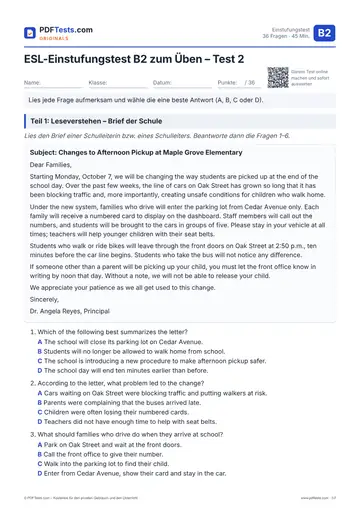
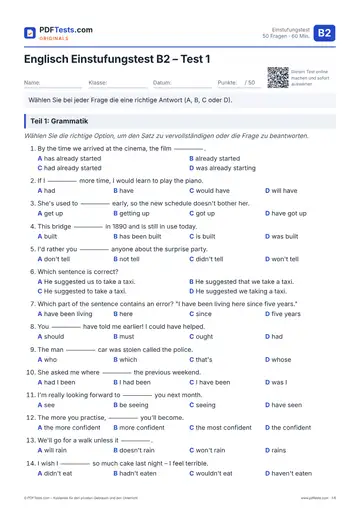
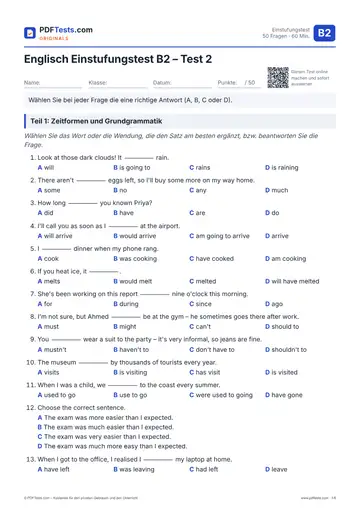
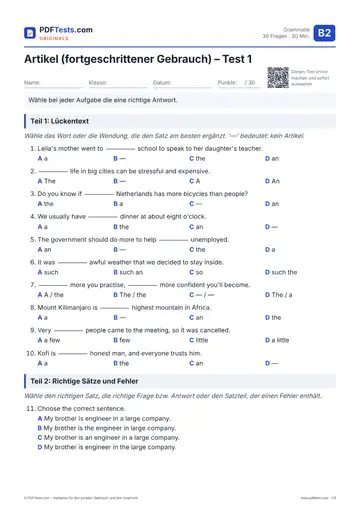
Vorschau von Seite 1: Wissenschaft und Technik – Test 1 PDF öffnen

Test online machen

Wähle bei jeder Aufgabe die beste Antwort (A, B, C oder D). Wählen Sie Ihre Antworten und klicken Sie auf „Antworten prüfen“.

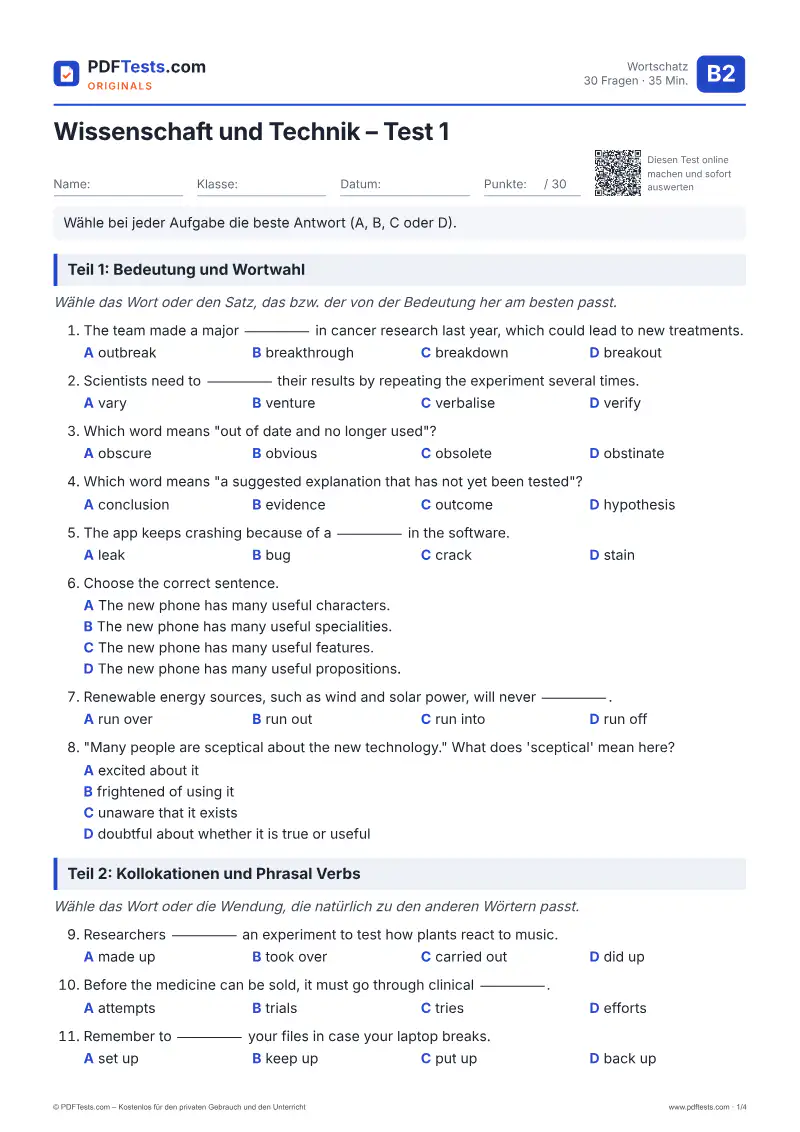
Teil 1: Bedeutung und Wortwahl

Wähle das Wort oder den Satz, das bzw. der von der Bedeutung her am besten passt.

  1. The team made a major _____ in cancer research last year, which could lead to new treatments.

  2. Scientists need to _____ their results by repeating the experiment several times.

  3. Which word means "out of date and no longer used"?

  4. Which word means "a suggested explanation that has not yet been tested"?

  5. The app keeps crashing because of a _____ in the software.

  6. Choose the correct sentence.

  7. Renewable energy sources, such as wind and solar power, will never _____.

  8. "Many people are sceptical about the new technology." What does 'sceptical' mean here?

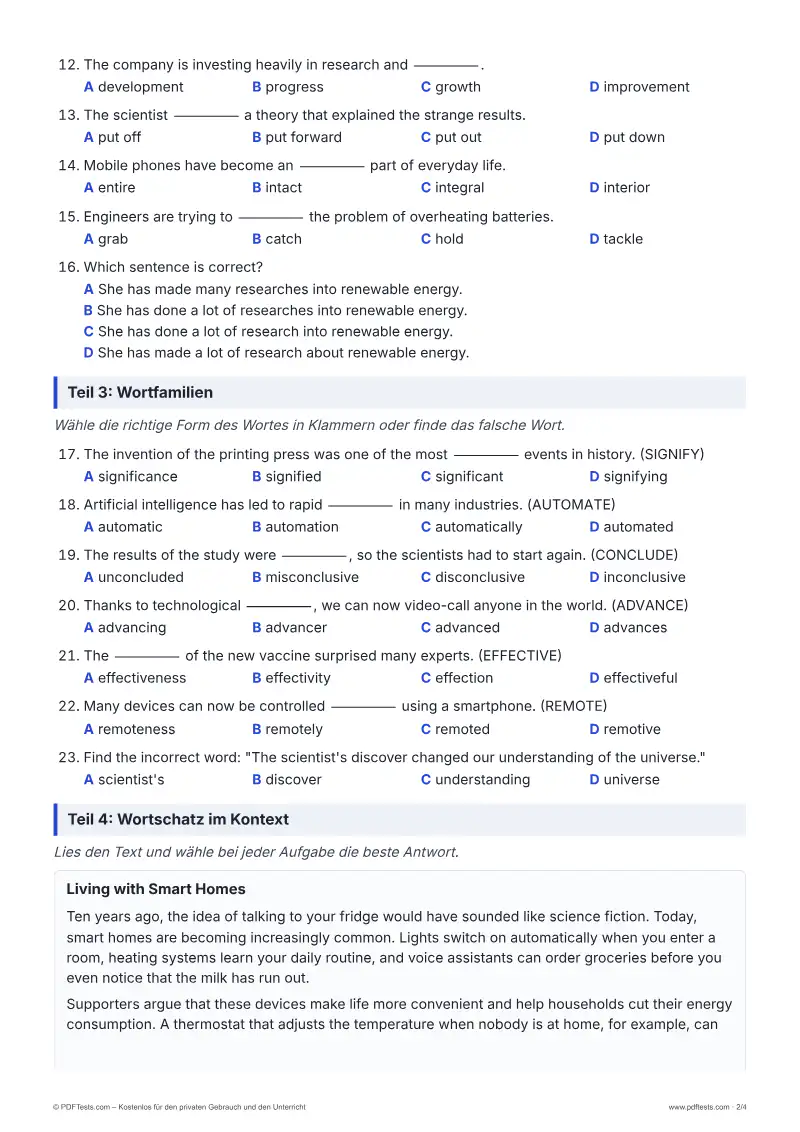
Teil 2: Kollokationen und Phrasal Verbs

Wähle das Wort oder die Wendung, die natürlich zu den anderen Wörtern passt.

  1. Researchers _____ an experiment to test how plants react to music.

  2. Before the medicine can be sold, it must go through clinical _____.

  3. Remember to _____ your files in case your laptop breaks.

  4. The company is investing heavily in research and _____.

  5. The scientist _____ a theory that explained the strange results.

  6. Mobile phones have become an _____ part of everyday life.

  7. Engineers are trying to _____ the problem of overheating batteries.

  8. Which sentence is correct?

Teil 3: Wortfamilien

Wähle die richtige Form des Wortes in Klammern oder finde das falsche Wort.

  1. The invention of the printing press was one of the most _____ events in history. (SIGNIFY)

  2. Artificial intelligence has led to rapid _____ in many industries. (AUTOMATE)

  3. The results of the study were _____, so the scientists had to start again. (CONCLUDE)

  4. Thanks to technological _____, we can now video-call anyone in the world. (ADVANCE)

  5. The _____ of the new vaccine surprised many experts. (EFFECTIVE)

  6. Many devices can now be controlled _____ using a smartphone. (REMOTE)

  7. Find the incorrect word: "The scientist's discover changed our understanding of the universe."

Teil 4: Wortschatz im Kontext

Lies den Text und wähle bei jeder Aufgabe die beste Antwort.

Living with Smart Homes

Ten years ago, the idea of talking to your fridge would have sounded like science fiction. Today, smart homes are becoming increasingly common. Lights switch on automatically when you enter a room, heating systems learn your daily routine, and voice assistants can order groceries before you even notice that the milk has run out.

Supporters argue that these devices make life more convenient and help households cut their energy consumption. A thermostat that adjusts the temperature when nobody is at home, for example, can significantly reduce electricity bills. For elderly people living alone, sensors that detect a fall and alert a relative could be life-saving.

However, critics point out several drawbacks. Smart devices constantly collect data about their users, and many people are unaware of how this information is stored or shared. Security experts warn that poorly protected devices are vulnerable to hackers, who could, in theory, unlock a front door from the other side of the world. There is also the question of what happens when the technology fails: a power cut or a faulty update can leave residents unable to control basic functions in their own homes.

Dr Amara Osei, who studies the impact of technology on daily life, believes the solution is not to reject innovation but to use it wisely. 'The key,' she says, 'is to stay informed, update your devices regularly, and never assume that something is safe just because it is convenient.'

  1. In paragraph 2, the word 'cut' in "cut their energy consumption" is closest in meaning to:

  2. In paragraph 2, 'consumption' refers to:

  3. In paragraph 3, 'drawbacks' is closest in meaning to:

  4. If devices are 'vulnerable to hackers', they are:

  5. A 'faulty update' (paragraph 3) is one that is:

  6. In paragraph 4, 'reject innovation' means to:

  7. Which word from the text means "the usual order in which you do things every day"?

War diese Seite hilfreich?

Fehler melden

Falsche Lösung, Tippfehler oder unklare Erklärung? Schreiben Sie uns, wir korrigieren es.

Mit einem Arbeitsblatt üben: Wissenschaft und Technik – Arbeitsblatt 1

Vorschau

Über diesen Test

Dieser Wortschatztest auf Niveau B2 behandelt das Thema Wissenschaft und Technik: zentrale Wortbedeutungen, typische Kollokationen, Wortbildung und Wortschatz in einem Lesetext. Er eignet sich für Lernende der oberen Mittelstufe, die sich auf Prüfungen vorbereiten, und für Lehrkräfte, die eine fertige Wiederholung zum Thema suchen.

Themen

Wortschatz WissenschaftWortschatz TechnikKollokationenPhrasal VerbsWortbildungBedeutung im Kontext

So nutzen Sie diesen Test

  1. Laden Sie das PDF herunter und drucken Sie es aus – oder machen Sie den Test unten online.
  2. Beantworten Sie alle Fragen ohne Wörterbuch und ohne Zeitdruck.
  3. Prüfen Sie Ihre Antworten und notieren Sie, was Sie wiederholen sollten.

Hinweise für Lehrkräfte

Setzen Sie den Test nach einer Unterrichtseinheit zu Wissenschaft und Technik ein oder als Einstufung vor der Prüfungsvorbereitung. Er greift typische Fehler auf B2-Niveau auf, etwa 'make an experiment', 'researches' als zählbares Nomen, die Verwechslung ähnlich aussehender Wörter (obsolete/obscure, integral/entire) sowie falsche Präfixe oder Suffixe. Als Anschlussaufgabe können die Lernenden einen kurzen Meinungstext über Smart Homes schreiben und dabei mindestens acht Wörter aus dem Test verwenden.