PDFTests Originals

Ciencia y tecnología – Test 1

B2 Intermedio alto VocabularioInglés

Este test de vocabulario de nivel B2 trata sobre ciencia y tecnología: significado de palabras clave, colocaciones frecuentes, formación de palabras y vocabulario en un texto de lectura. Es ideal para alumnos de nivel intermedio-alto que preparan exámenes oficiales y para profesores que buscan un repaso temático listo para usar.
Preguntas
30
Tiempo
35 min
PDF
4 páginas
Soluciones
Incluidas
  • 100 % gratis
  • Sin registro
  • PDF A4 listo para imprimir
Vista previa de la página 1: Ciencia y tecnología – Test 1 Abrir PDF

Haz el examen en línea

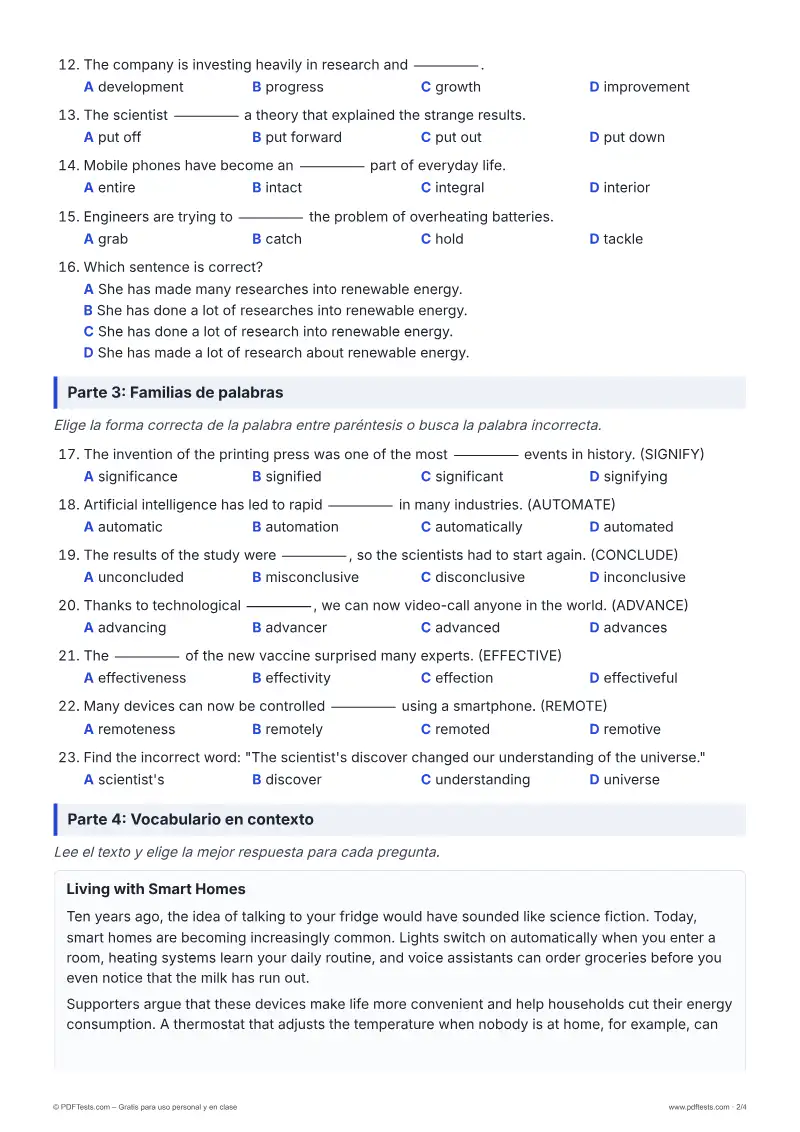
Elige la mejor opción (A, B, C o D) en cada pregunta. Elige tus respuestas y pulsa «Comprobar respuestas».

Parte 1: Significado y elección de palabras

Elige la palabra o la oración que mejor se ajuste al significado.

  1. The team made a major _____ in cancer research last year, which could lead to new treatments.

  2. Scientists need to _____ their results by repeating the experiment several times.

  3. Which word means "out of date and no longer used"?

  4. Which word means "a suggested explanation that has not yet been tested"?

  5. The app keeps crashing because of a _____ in the software.

  6. Choose the correct sentence.

  7. Renewable energy sources, such as wind and solar power, will never _____.

  8. "Many people are sceptical about the new technology." What does 'sceptical' mean here?

Parte 2: Colocaciones y verbos frasales

Elige la palabra o expresión que se combina de forma natural con las demás.

  1. Researchers _____ an experiment to test how plants react to music.

  2. Before the medicine can be sold, it must go through clinical _____.

  3. Remember to _____ your files in case your laptop breaks.

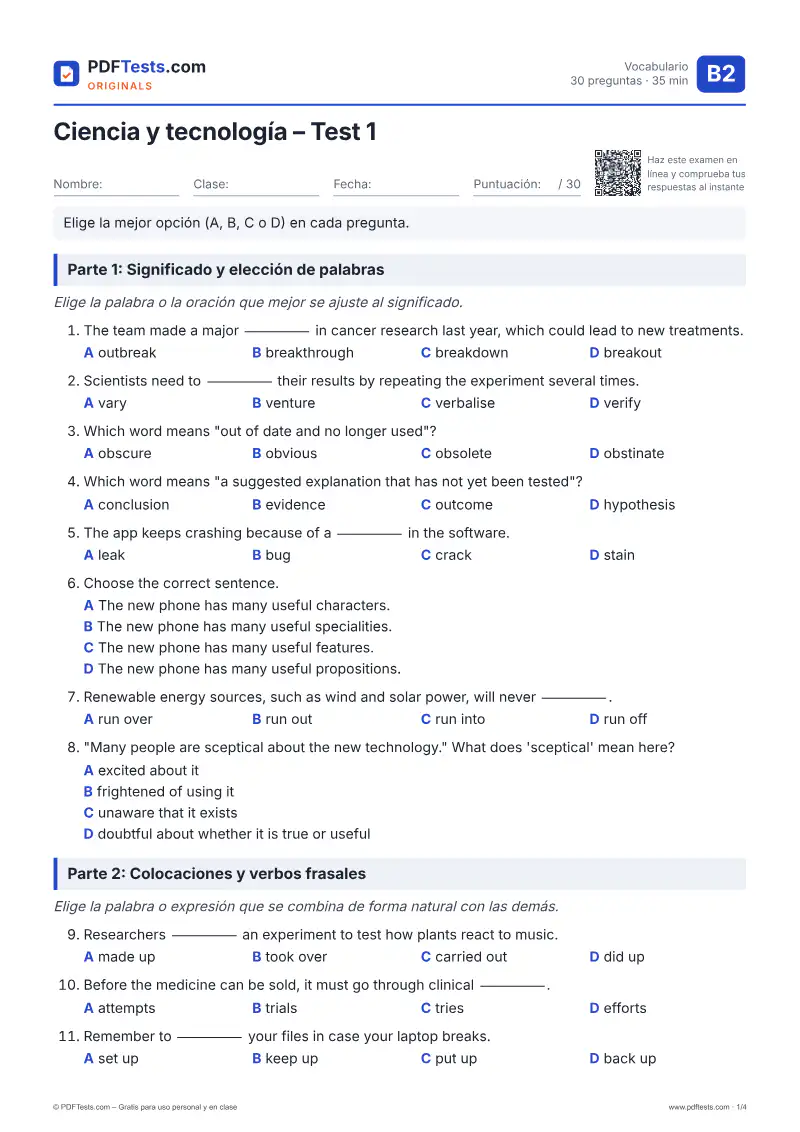
  4. The company is investing heavily in research and _____.

  5. The scientist _____ a theory that explained the strange results.

  6. Mobile phones have become an _____ part of everyday life.

  7. Engineers are trying to _____ the problem of overheating batteries.

  8. Which sentence is correct?

Parte 3: Familias de palabras

Elige la forma correcta de la palabra entre paréntesis o busca la palabra incorrecta.

  1. The invention of the printing press was one of the most _____ events in history. (SIGNIFY)

  2. Artificial intelligence has led to rapid _____ in many industries. (AUTOMATE)

  3. The results of the study were _____, so the scientists had to start again. (CONCLUDE)

  4. Thanks to technological _____, we can now video-call anyone in the world. (ADVANCE)

  5. The _____ of the new vaccine surprised many experts. (EFFECTIVE)

  6. Many devices can now be controlled _____ using a smartphone. (REMOTE)

  7. Find the incorrect word: "The scientist's discover changed our understanding of the universe."

Parte 4: Vocabulario en contexto

Lee el texto y elige la mejor respuesta para cada pregunta.

Living with Smart Homes

Ten years ago, the idea of talking to your fridge would have sounded like science fiction. Today, smart homes are becoming increasingly common. Lights switch on automatically when you enter a room, heating systems learn your daily routine, and voice assistants can order groceries before you even notice that the milk has run out.

Supporters argue that these devices make life more convenient and help households cut their energy consumption. A thermostat that adjusts the temperature when nobody is at home, for example, can significantly reduce electricity bills. For elderly people living alone, sensors that detect a fall and alert a relative could be life-saving.

However, critics point out several drawbacks. Smart devices constantly collect data about their users, and many people are unaware of how this information is stored or shared. Security experts warn that poorly protected devices are vulnerable to hackers, who could, in theory, unlock a front door from the other side of the world. There is also the question of what happens when the technology fails: a power cut or a faulty update can leave residents unable to control basic functions in their own homes.

Dr Amara Osei, who studies the impact of technology on daily life, believes the solution is not to reject innovation but to use it wisely. 'The key,' she says, 'is to stay informed, update your devices regularly, and never assume that something is safe just because it is convenient.'

  1. In paragraph 2, the word 'cut' in "cut their energy consumption" is closest in meaning to:

  2. In paragraph 2, 'consumption' refers to:

  3. In paragraph 3, 'drawbacks' is closest in meaning to:

  4. If devices are 'vulnerable to hackers', they are:

  5. A 'faulty update' (paragraph 3) is one that is:

  6. In paragraph 4, 'reject innovation' means to:

  7. Which word from the text means "the usual order in which you do things every day"?

¿Te ha resultado útil esta página?

Informar de un error

¿Has visto una respuesta incorrecta, una errata o una explicación poco clara? Avísanos y lo corregiremos.

Practica con una ficha: Ciencia y tecnología – Ficha 1

Vista previa

Sobre este examen

Este test de vocabulario de nivel B2 trata sobre ciencia y tecnología: significado de palabras clave, colocaciones frecuentes, formación de palabras y vocabulario en un texto de lectura. Es ideal para alumnos de nivel intermedio-alto que preparan exámenes oficiales y para profesores que buscan un repaso temático listo para usar.

Temas

Vocabulario de cienciaVocabulario de tecnologíaColocaciones (collocations)Verbos frasales (phrasal verbs)Formación de palabras (word formation)Significado en contexto

Cómo usar este examen

  1. Descarga el PDF e imprímelo, o haz el examen en línea más abajo.
  2. Responde todas las preguntas sin diccionario y sin prisas.
  3. Comprueba tus respuestas y apunta los temas que debes repasar.

Notas para el profesor

Utiliza este test después de una unidad sobre ciencia y tecnología o como prueba diagnóstica antes de preparar un examen. Se centra en errores típicos del nivel B2, como decir 'make an experiment', usar 'researches' como sustantivo contable, confundir palabras de forma parecida (obsolete/obscure, integral/entire) o elegir prefijos y sufijos incorrectos. Como actividad de seguimiento, pide a los alumnos que escriban un breve párrafo de opinión sobre las casas inteligentes (smart homes) usando al menos ocho palabras del test.