A gerund is the -ing form of a verb used like a noun: Swimming is good exercise. An infinitive is the base form of a verb, usually with to: I want to swim. Which one you need depends mostly on the word before it (a verb, a preposition or an adjective), so the key is learning the common patterns.
If you need a simpler introduction first, read our A2 guide to verb + -ing or to-infinitive. This B1 guide goes further, with more verbs, more patterns and the verbs that change meaning.
The forms at a glance
| Form | Affirmative | Negative |
|---|---|---|
| Gerund (-ing) | I’m thinking of going. | I’m thinking of not going. |
| To-infinitive | She decided to leave. | She decided not to leave. |
| Bare infinitive (no to) | You should leave. | You shouldn’t leave. |
Notice the negative: put not before the -ing form or before to. The standard form is not to do, although you will sometimes hear to not do in informal speech.
When to use the gerund (-ing)
1. As the subject of a sentence
When an action is the subject, use the -ing form.
- Learning a language takes time.
- Eating too much sugar is bad for you.
- Working from home suits me.
You can often say the same idea with It + infinitive: It takes time to learn a language.
2. After prepositions
After a preposition (at, in, of, for, about, without, before, after), the verb is always -ing.
- She’s really good at drawing.
- I’m interested in joining the club.
- Thanks for helping me.
- He left without saying goodbye.
- How about getting a pizza tonight?
3. After certain verbs
Some verbs are followed only by -ing. The most common are: enjoy, finish, mind, avoid, suggest, consider, keep, practise, miss, imagine, admit, deny, give up, carry on.
- I enjoy cooking for friends.
- Have you finished writing your report?
- Would you mind waiting a moment?
- She suggested taking the train.
- He kept checking his phone during the meeting.
4. After some fixed expressions
- I can’t stand waiting in queues.
- I couldn’t help laughing.
- It’s no use complaining now.
- The museum is worth visiting.
- There’s no point (in) arguing about it.
- Sorry, I’m busy packing.
When to use the to-infinitive
1. To express purpose (why)
Use to + verb to say why someone does something.
- I went to the shop to buy some milk.
- She’s saving money to travel around Asia.
2. After certain verbs
Common verbs followed by to + verb: want, would like, decide, hope, plan, agree, refuse, promise, offer, manage, learn, seem, afford, expect, need, choose, pretend.
- We decided to stay at home.
- He refused to answer the question.
- Did you manage to find a parking space?
- I can’t afford to go on holiday this year.
- She seems to be tired.
3. After verb + object
Many verbs use the pattern verb + person + to + verb: want, ask, tell, advise, allow, expect, remind, teach, encourage, invite.
- My parents want me to study medicine.
- The doctor advised him to rest.
- Can you remind me to call the bank?
4. After adjectives
Many adjectives are followed by to + verb: happy, sorry, surprised, pleased, easy, difficult, important, possible, nice.
- It’s difficult to understand his accent.
- I was surprised to see her there.
- Nice to meet you.
This also happens with too and enough: It’s too cold to swim. She’s old enough to drive.
5. After question words
- I don’t know what to say.
- Can you show me how to use this app?
- We can’t decide where to go this summer.
The bare infinitive (without to)
Some words are followed by the base form with no to:
- Modal verbs: can, could, will, would, must, should, might, may → You should try it.
- make and let + object → My boss made me work late. They let us leave early.
- had better and would rather → You’d better hurry. I’d rather stay in.
Help can take both: Can you help me (to) carry this box?
Quick reference: common verbs
| Verb + -ing | Verb + to-infinitive | Both (little or no change) |
|---|---|---|
| enjoy | want | like |
| finish | decide | love |
| mind | hope | hate |
| avoid | plan | prefer |
| suggest | agree | start |
| consider | refuse | begin |
| keep | promise | continue |
| practise | manage | |
| miss | afford | |
| give up | expect |
Verbs that take both with little change
With like, love, hate, prefer, start, begin and continue, both forms are usually correct.
- It started raining / It started to rain.
- I love walking / I love to walk in the mountains.
But with would, always use to: I*’d like to come**. I**’d love to see** you.* (Not I’d like coming.)
Verbs that change meaning
These verbs can take both forms, but the meaning is different. They appear often in B1 tests.
remember and forget
-
remember / forget + -ing = a memory of something you did in the past.
-
remember / forget + to = an action you need to do (not forget a task).
-
I remember meeting her at a party years ago. (I have a memory of it.)
-
Remember to lock the door when you leave. (Don’t forget this task.)
-
I’ll never forget seeing the sea for the first time.
-
I forgot to send the email. (I didn’t send it.)
stop
- He stopped smoking last year. (He doesn’t smoke now.)
- He stopped to smoke a cigarette. (He stopped another activity in order to smoke.)
try
- try + to = make an effort to do something difficult: I tried to open the window, but it was stuck.
- try + -ing = do something as an experiment to see if it works: If you can’t sleep, try drinking warm milk.
regret
- regret + -ing = be sorry about something in the past: I regret not studying harder at school.
- regret + to = formal, used to give bad news: We regret to inform you that your flight has been cancelled.
Watch out: when to is a preposition
In some expressions, to is a preposition, not part of an infinitive, so it is followed by -ing (or a noun).
- I’m looking forward to seeing you.
- I’m used to getting up early.
- You’ll soon get used to living here.
- I object to paying for the bags.
A useful test: if you can put a noun after to (I’m looking forward to the weekend), then it’s a preposition and the verb needs -ing.
Don’t confuse be used to + -ing (be familiar with) with used to + verb (a past habit): I used to live in Paris. Our guide to used to and would explains the difference in detail.
Spelling of the -ing form
| Rule | Examples |
|---|---|
| Most verbs: add -ing | read → reading, play → playing |
| Verb ends in silent -e: drop the -e | make → making, write → writing |
| But keep -ee, and be/see | see → seeing, agree → agreeing, be → being |
| One syllable, consonant-vowel-consonant: double the last letter | stop → stopping, swim → swimming, run → running |
| Two syllables, stress on the end: double | begin → beginning, prefer → preferring |
| Verb ends in -ie: change to -y | lie → lying, die → dying |
| British English doubles final -l | travel → travelling (US: traveling) |
Common mistakes
- ✗ I enjoy to read before bed. → ✓ I enjoy reading before bed. Enjoy is always followed by -ing.
- ✗ I want going home. → ✓ I want to go home. Want takes the to-infinitive.
- ✗ I’m looking forward to see you. → ✓ I’m looking forward to seeing you. Here to is a preposition.
- ✗ She’s good at cook. → ✓ She’s good at cooking. After a preposition, use -ing.
- ✗ I came here for learn English. → ✓ I came here to learn English. Use to + verb for purpose.
- ✗ My boss made me to stay late. → ✓ My boss made me stay late. Make + object takes the bare infinitive.
- ✗ He wants that I help him. → ✓ He wants me to help him. Use want + object + to, not a that clause.
- ✗ She suggested me to take a taxi. → ✓ She suggested taking a taxi. Suggest doesn’t use the object + to pattern.
- ✗ I’d like going with you. → ✓ I’d like to go with you. Would like always takes to.
Quick check
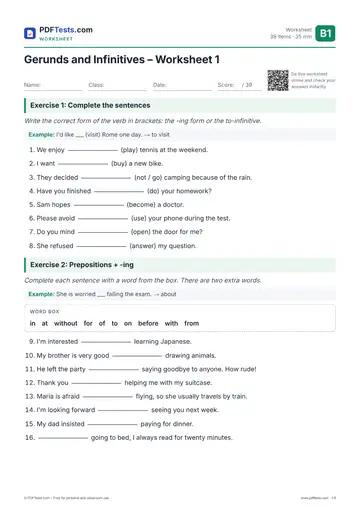
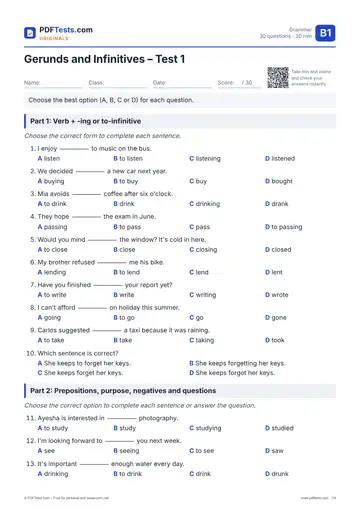
Put the verb in brackets into the correct form.
- I can’t afford ___ (buy) a new laptop right now.
- Would you mind ___ (close) the window?
- Don’t forget ___ (send) me the photos from the trip.
- She’s thinking of ___ (move) to Spain next year.
- My parents let me ___ (stay) out late on Saturdays.
Answers: 1. to buy 2. closing 3. to send 4. moving 5. stay
Next step
Now put the rules into practice: test yourself with our B1 Gerunds and Infinitives test, and pay special attention to verbs like remember, stop and try. If you find the basic verb lists difficult, warm up first with the A2 Verb + -ing or To-infinitive test. When you feel confident, explore more grammar and vocabulary practice in our English B1 tests.
Was this page helpful?
What was the problem?
Thank you for your feedback!