PDFTests Originals

Use of English B2 – Test 1

B2 Intermédiaire avancé GrammaireAnglais

Ce test B2 de Use of English, conçu sur le modèle des examens, comporte 36 questions à choix multiples réparties en quatre parties : collocations et verbes à particule (phrasal verbs) en contexte, mots grammaticaux dans un texte, formation des mots et transformations de phrases à partir d'un mot clé. Il s'adresse aux apprenants de niveau intermédiaire avancé qui préparent un examen de niveau B2, ainsi qu'aux enseignants à la recherche d'un test d'entraînement ou de positionnement prêt à l'emploi.
Questions
36
Durée
45 min
PDF
6 pages
Corrigé
Inclus
  • 100 % gratuit
  • Sans inscription
  • PDF A4 prêt à imprimer
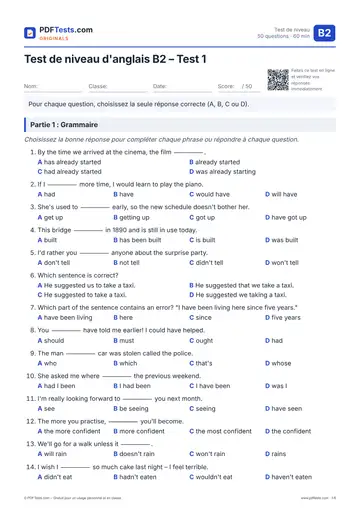
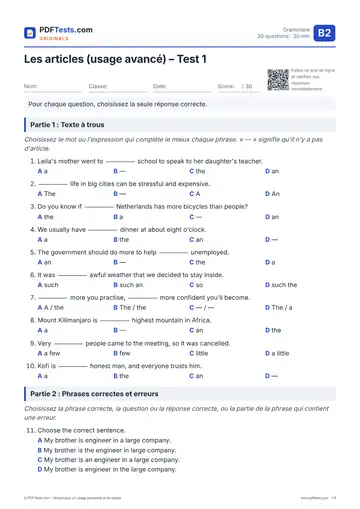
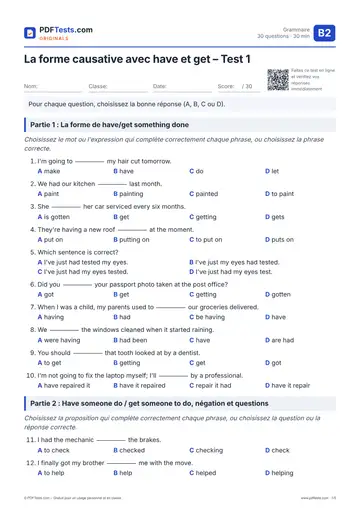
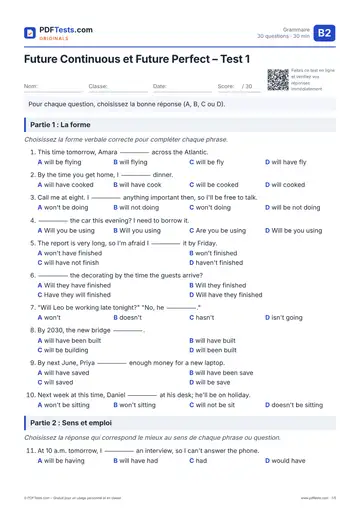
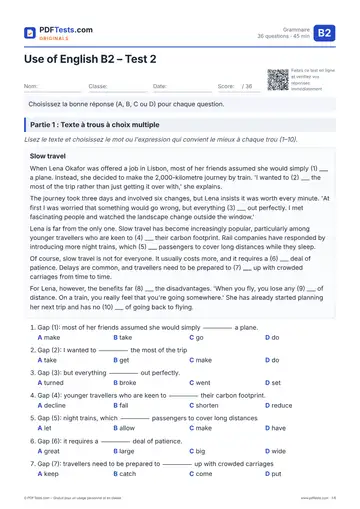
Aperçu de la page 1 : Use of English B2 – Test 1 Ouvrir le PDF
Use of English B1–C2 · tous les tests au format examen, types de tâches et conseils

Faire le test en ligne

Lisez attentivement chaque partie et choisissez la bonne réponse (A, B, C ou D) pour chaque question. Choisissez vos réponses, puis cliquez sur « Vérifier mes réponses ».

Partie 1 : Texte à trous à choix multiples

Lisez le texte et choisissez le mot ou l'expression qui convient le mieux à chaque blanc numéroté.

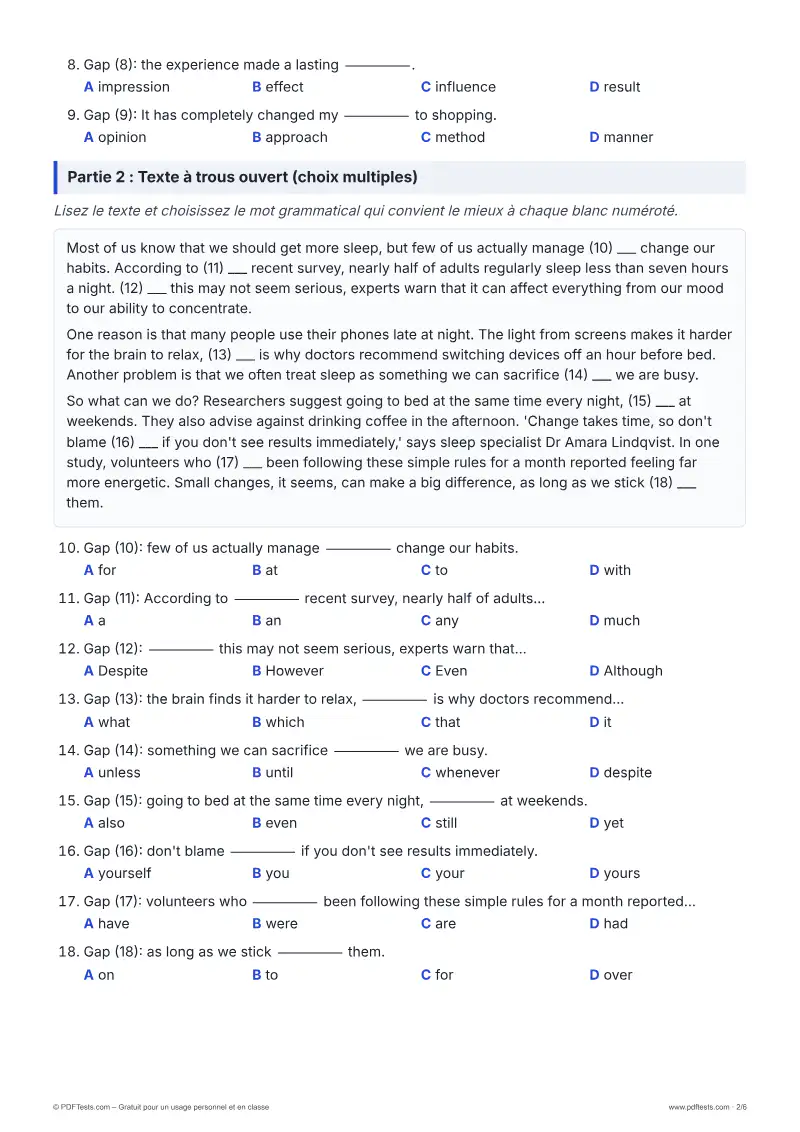
When Lena Okafor's coffee machine broke down last spring, her first thought was to (1) ___ it away and buy a new one. Instead, a neighbour suggested she (2) ___ a visit to the local repair café, a monthly event where volunteers help people fix everyday items for free.

'I didn't expect much,' Lena admits. 'But within twenty minutes, a retired engineer had (3) ___ out what the problem was and showed me how to replace a tiny part.' The idea of repair cafés has (4) ___ on in many towns over the past decade, partly because people are becoming more (5) ___ of how much waste they produce.

Volunteers say the events are about more than saving money. 'People come in with a broken lamp and end up staying for hours,' explains organiser Tomás Reyes. 'It's a great way to (6) ___ contact with neighbours you might otherwise never meet.' Not every repair is successful, of course, but even when an item can't be saved, visitors usually leave with a better (7) ___ of how things work.

For Lena, the experience made a lasting (8) ___. She now volunteers herself, and she says she thinks twice before buying anything that can't be fixed. 'It has completely changed my (9) ___ to shopping,' she says.

  1. Gap (1): her first thought was to _____ it away and buy a new one.

  2. Gap (2): a neighbour suggested she _____ a visit to the local repair café.

  3. Gap (3): a retired engineer had _____ out what the problem was.

  4. Gap (4): The idea of repair cafés has _____ on in many towns.

  5. Gap (5): people are becoming more _____ of how much waste they produce.

  6. Gap (6): It's a great way to _____ contact with neighbours.

  7. Gap (7): visitors usually leave with a better _____ of how things work.

  8. Gap (8): the experience made a lasting _____.

  9. Gap (9): It has completely changed my _____ to shopping.

Partie 2 : Texte à trous ouvert (choix multiples)

Lisez le texte et choisissez le mot grammatical qui convient le mieux à chaque blanc numéroté.

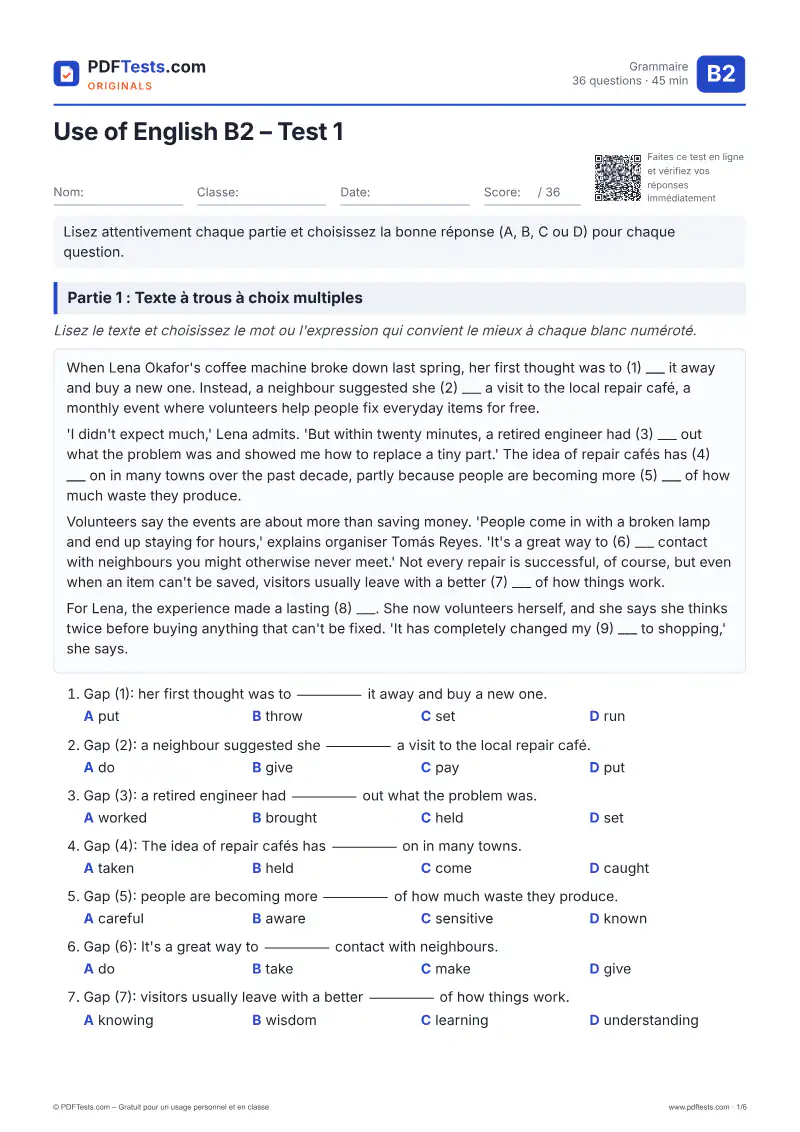
Most of us know that we should get more sleep, but few of us actually manage (10) ___ change our habits. According to (11) ___ recent survey, nearly half of adults regularly sleep less than seven hours a night. (12) ___ this may not seem serious, experts warn that it can affect everything from our mood to our ability to concentrate.

One reason is that many people use their phones late at night. The light from screens makes it harder for the brain to relax, (13) ___ is why doctors recommend switching devices off an hour before bed. Another problem is that we often treat sleep as something we can sacrifice (14) ___ we are busy.

So what can we do? Researchers suggest going to bed at the same time every night, (15) ___ at weekends. They also advise against drinking coffee in the afternoon. 'Change takes time, so don't blame (16) ___ if you don't see results immediately,' says sleep specialist Dr Amara Lindqvist. In one study, volunteers who (17) ___ been following these simple rules for a month reported feeling far more energetic. Small changes, it seems, can make a big difference, as long as we stick (18) ___ them.

  1. Gap (10): few of us actually manage _____ change our habits.

  2. Gap (11): According to _____ recent survey, nearly half of adults...

  3. Gap (12): _____ this may not seem serious, experts warn that...

  4. Gap (13): the brain finds it harder to relax, _____ is why doctors recommend...

  5. Gap (14): something we can sacrifice _____ we are busy.

  6. Gap (15): going to bed at the same time every night, _____ at weekends.

  7. Gap (16): don't blame _____ if you don't see results immediately.

  8. Gap (17): volunteers who _____ been following these simple rules for a month reported...

  9. Gap (18): as long as we stick _____ them.

Partie 3 : Formation des mots

Choisissez la forme correcte du mot en majuscules pour compléter chaque phrase.

  1. The new manager has made some _____ changes to the way the office is run. (SIGNIFY)

  2. Several customers complained about the _____ of the staff. (RUDE)

  3. It's completely _____ to expect everyone to finish the work by Friday. (REASON)

  4. The museum is closed for _____ until the end of June. (RENOVATE)

  5. She spoke so _____ that everyone in the room was convinced. (PERSUADE)

  6. There has been a _____ increase in the number of people cycling to work. (DRAMA)

  7. The _____ of the new bridge took nearly three years. (CONSTRUCT)

  8. I'm afraid your answer is _____, so please try again. (CORRECT)

  9. Having a pet can give children a sense of _____. (RESPONSIBLE)

Partie 4 : Transformations de phrases avec mot clé

Lisez la première phrase et le mot clé en majuscules. Choisissez la reformulation qui garde le même sens, contient le mot clé et est grammaticalement correcte.

  1. I'm sure Daniel didn't take your keys. (CAN'T)

  2. It was the first time Priya had flown in a plane. (NEVER)

  3. People say the castle is over 800 years old. (SAID)

  4. I regret not studying harder for the exam. (WISH)

  5. Although it rained heavily, the match continued. (DESPITE)

  6. Someone is going to repair my laptop tomorrow. (HAVING)

  7. 'Did you lock the door?' Maria asked me. (WHETHER)

  8. It isn't necessary for you to bring any food. (HAVE)

  9. If you don't leave now, you'll miss the train. (UNLESS)

Cette page vous a-t-elle été utile ?

Signaler une erreur

Une mauvaise réponse, une faute de frappe ou une explication peu claire ? Dites-le-nous, nous corrigerons.

S’entraîner avec une fiche: Use of English B2 – Fiche 1

Aperçu

À propos de ce test

Ce test B2 de Use of English, conçu sur le modèle des examens, comporte 36 questions à choix multiples réparties en quatre parties : collocations et verbes à particule (phrasal verbs) en contexte, mots grammaticaux dans un texte, formation des mots et transformations de phrases à partir d'un mot clé. Il s'adresse aux apprenants de niveau intermédiaire avancé qui préparent un examen de niveau B2, ainsi qu'aux enseignants à la recherche d'un test d'entraînement ou de positionnement prêt à l'emploi.

Thèmes abordés

Collocations et expressions figéesVerbes à particule (phrasal verbs)Articles, prépositions et connecteursPronoms relatifs et réfléchisFormation des motsModaux de déductionVoix passive et forme causativeDiscours indirect et souhaits (wish)

Comment utiliser ce test

  1. Téléchargez le PDF et imprimez-le, ou faites le test en ligne ci-dessous.
  2. Répondez à toutes les questions sans dictionnaire et sans vous presser.
  3. Vérifiez vos réponses et notez les points à revoir.

Notes pour l’enseignant

Utilisez ce test comme entraînement chronométré aux conditions d'examen ou comme test de positionnement en début de cours B2. Il cible des erreurs fréquentes au niveau intermédiaire avancé : mauvaises collocations verbe + nom (do/make/pay), « despite » suivi d'une proposition, préfixes oubliés en formation des mots et concordance des temps incorrecte au discours indirect. Après la correction, demandez aux élèves d'expliquer pourquoi chaque distracteur est faux, puis faites-leur rédiger leurs propres transformations avec les mêmes mots clés.