French adjectives change their form to match the noun they describe. They agree in gender (masculine or feminine) and number (singular or plural), so one adjective can have up to four forms: petit, petite, petits, petites. You need agreement every time you describe a person, place or thing, whether the adjective sits next to the noun or comes after être.
The basic rule
Start with the masculine singular form. This is the form you find in a dictionary. Then:
- add -e for the feminine
- add -s for the plural
- add -es for the feminine plural
| Singular | Plural | |
|---|---|---|
| Masculine | petit | petits |
| Feminine | petite | petites |
- Un petit chat. A small cat.
- Une petite maison. A small house.
- Des chats noirs. Black cats.
- Des voitures noires. Black cars.
Here are some common regular adjectives:
| Masc. sing. | Fem. sing. | Masc. plural | Fem. plural | Meaning |
|---|---|---|---|---|
| grand | grande | grands | grandes | big, tall |
| vert | verte | verts | vertes | green |
| content | contente | contents | contentes | happy, pleased |
| fatigué | fatiguée | fatigués | fatiguées | tired |
| joli | jolie | jolis | jolies | pretty |
The adjective always follows the gender of the noun, not the gender of the speaker or the owner. Mon père a une voiture rouge uses the feminine because voiture is feminine. If you are not sure of a noun’s gender, check its article: see our guide to French articles.
Adjectives that already end in -e
If the masculine form already ends in -e, do not add another one. The masculine and feminine are identical.
| Masc. sing. | Fem. sing. | Masc. plural | Fem. plural | Meaning |
|---|---|---|---|---|
| jeune | jeune | jeunes | jeunes | young |
| rouge | rouge | rouges | rouges | red |
| facile | facile | faciles | faciles | easy |
| timide | timide | timides | timides | shy |
- Un garçon timide, une fille timide. A shy boy, a shy girl.
Careful: -é is not the same as -e. Adjectives ending in -é still add -e: fatigué → fatiguée, marié → mariée.
Adjectives that already end in -s or -x
If the masculine singular ends in -s or -x, the masculine plural does not change.
- Un étudiant français, des étudiants français. A French student, French students.
- Un homme heureux, des hommes heureux. A happy man, happy men.
The feminine forms still follow their own rules: française, françaises; heureuse, heureuses.
Irregular feminine forms
Many adjectives change more than just adding -e. Most follow patterns based on their ending, so learn the patterns rather than every word.
| Ending | Masculine | Feminine | Meaning |
|---|---|---|---|
| -eux → -euse | heureux | heureuse | happy |
| -if → -ive | sportif | sportive | sporty |
| -er → -ère | cher | chère | expensive, dear |
| -ien → -ienne | italien | italienne | Italian |
| -on → -onne | bon | bonne | good |
| -el → -elle | naturel | naturelle | natural |
| -il → -ille | gentil | gentille | kind |
| -et → -ette | violet | violette | purple |
A few common adjectives are simply irregular:
| Masculine | Feminine | Meaning |
|---|---|---|
| blanc | blanche | white |
| long | longue | long |
| gros | grosse | big, fat |
| doux | douce | soft, gentle |
| faux | fausse | false, wrong |
- Ma sœur est très sportive. My sister is very sporty.
- Une chemise blanche. A white shirt.
Irregular masculine plurals
Two endings change in the masculine plural only:
- -al → -aux: normal → normaux, génial → géniaux
- -eau → -eaux: beau → beaux, nouveau → nouveaux
The feminine plural stays regular: normales, belles, nouvelles.
- Des prix normaux. Normal prices.
- Des idées géniales. Brilliant ideas.
Colours that never change
Most colours agree normally (vert, verte, verts, vertes). However, orange and marron (brown) never change, because they come from nouns (an orange, a chestnut).
- Des chaussures marron. Brown shoes.
- Une jupe orange. An orange skirt.
Pronunciation
Agreement is often silent, but not always.
- Plural -s is silent. Grand and grands sound the same.
- Feminine -e after a consonant makes that consonant heard. Petit ends in an “ee” sound, but in petite you hear the final t. Likewise grand / grande (you hear the d) and français / française (you hear a z sound).
- Feminine -e after a vowel is silent. Joli / jolie and fatigué / fatiguée sound identical.
- Nasal sounds disappear in the feminine. Bon has a nasal vowel; bonne rhymes with English “sun” plus n. The same happens with italien / italienne.
- Liaison. A plural adjective before a noun starting with a vowel links with a z sound: de grands amis sounds like “grand-z-amis”.
When listening, a clearly pronounced final consonant is often your best clue that the adjective is feminine.
Where the adjective goes
Most French adjectives come after the noun. Colours and nationalities always do.
- Un film intéressant. An interesting film.
- Une voiture allemande. A German car.
A small group of short, common adjectives usually come before the noun. A handy way to remember them is BAGS:
-
Beauty: beau, joli
-
Age: jeune, vieux, nouveau
-
Goodness: bon, mauvais
-
Size: petit, grand, gros
-
Une jolie robe. A pretty dress.
-
Un bon restaurant. A good restaurant.
-
Une jolie robe rouge. A pretty red dress.
The agreement rules are exactly the same in both positions.
Beau, nouveau and vieux
These three have a special masculine form before a vowel or silent h, which makes them easier to pronounce.
| Masc. sing. | Masc. before vowel/h | Fem. sing. | Masc. plural | Fem. plural |
|---|---|---|---|---|
| beau | bel | belle | beaux | belles |
| nouveau | nouvel | nouvelle | nouveaux | nouvelles |
| vieux | vieil | vieille | vieux | vieilles |
- Un bel appartement. A beautiful flat.
- Un nouvel ami. A new friend.
- Un vieil homme. An old man.
Des becomes de before an adjective
In standard written French, des becomes de when a plural adjective comes before the noun: de jolies fleurs (pretty flowers). You will hear des in casual speech, but use de in tests and writing.
Agreement after être
Adjectives also agree when they come after être (and verbs like sembler or devenir). They match the subject.
- Elle est contente. She is happy.
- Nous sommes fatigués. We are tired.
- Les fenêtres sont ouvertes. The windows are open.
With je, tu, nous and vous, the form depends on who is actually speaking or being addressed:
- Je suis prêt. / Je suis prête. I am ready. (a man / a woman speaking)
- Vous êtes prêt ? Are you ready? (polite, to one man)
- Vous êtes prêtes ? Are you ready? (to a group of women)
If you need to review the verb itself, see the être and avoir guide.
Mixed groups: masculine wins
When an adjective describes a mix of masculine and feminine nouns, use the masculine plural.
- Paul et Marie sont contents. Paul and Marie are happy.
- Une jupe et un pull noirs. A black skirt and jumper.
Only use the feminine plural when every noun is feminine: Léa et Chloé sont contentes.
Il est / elle est vs c’est
Learners often confuse these two structures with adjectives.
-
Il/Elle est + adjective describes a specific noun, so the adjective agrees with it.
-
C’est + adjective comments on a thing or situation in general, and the adjective is always masculine singular.
-
La pizza est bonne. The pizza is good. (this pizza)
-
La pizza, c’est bon. Pizza is good. (pizza in general)
-
Ta robe ? Elle est belle. Your dress? It is beautiful.
-
Paris, c’est beau. Paris is beautiful.
Common mistakes
- ✗ Une voiture noir → ✓ Une voiture noire. Voiture is feminine, so add -e.
- ✗ Elle est heureux → ✓ Elle est heureuse. Adjectives ending in -eux become -euse in the feminine.
- ✗ Des livres rouge → ✓ Des livres rouges. Plural nouns need plural adjectives, even when you cannot hear the -s.
- ✗ Une robe jolie rouge → ✓ Une jolie robe rouge. Joli is a BAGS adjective and goes before the noun; colours go after.
- ✗ Un beau homme → ✓ Un bel homme. Use bel before a masculine noun starting with a vowel or silent h.
- ✗ Marc et Julie sont contentes → ✓ Marc et Julie sont contents. A mixed group takes the masculine plural.
- ✗ Je suis fatigué (said by a woman) → ✓ Je suis fatiguée. The adjective matches the real person behind je.
- ✗ Des repas normals → ✓ Des repas normaux. Most adjectives in -al have a masculine plural in -aux.
- ✗ Des chaussures marrons → ✓ Des chaussures marron. Marron and orange never change.
Quick check
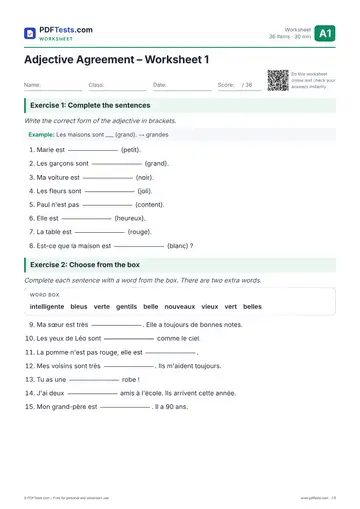
Write the correct form of the adjective in brackets.
- Une chemise ___ (blanc).
- Mes sœurs sont très ___ (sportif).
- C’est mon ___ ami (nouveau).
- Ces chaussures sont ___ (cher).
- Lucas et Emma sont ___ (fatigué).
Answers
- blanche: Une chemise blanche. A white shirt.
- sportives: Mes sœurs sont très sportives. My sisters are very sporty.
- nouvel: C’est mon nouvel ami. This is my new friend.
- chères: Ces chaussures sont chères. These shoes are expensive.
- fatigués: Lucas et Emma sont fatigués. Lucas and Emma are tired.
Next step
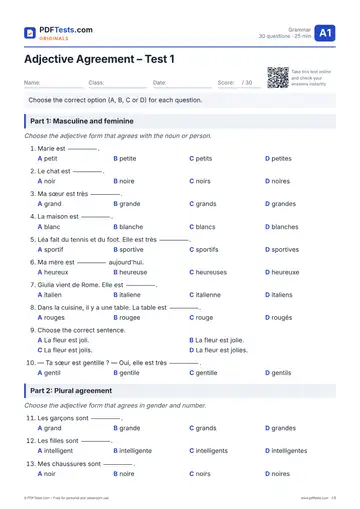
Now put the rules into practice with our French A1 Adjective Agreement test, which mixes regular endings, irregular feminines, BAGS adjectives and agreement after être. Since agreement depends on knowing each noun’s gender, pair it with the A1 articles test. When you feel confident, explore the full range of French A1 tests to build your grammar step by step.
Was this page helpful?
What was the problem?
Thank you for your feedback!