Être (to be) and avoir (to have) are the two most important verbs in French. You use them to say who you are, how old you are, how you feel and where things are. Both are irregular, so learn their forms by heart early.
This guide covers the present tense of both verbs, their main uses, negatives and questions, pronunciation traps, and the places where French uses avoir but English uses to be.
Être: present tense forms
| Subject | Être | English |
|---|---|---|
| je | suis | I am |
| tu | es | you are (informal, one person) |
| il / elle / on | est | he / she / one is, we are (informal) |
| nous | sommes | we are |
| vous | êtes | you are (formal or plural) |
| ils / elles | sont | they are |
Note that tu es and il est sound the same: both are pronounced like è. The spelling is different, so watch the written forms.
Uses of être
1. Identity, profession and nationality
Use être to say who or what someone is.
- Je suis Marie. — I am Marie.
- Il est professeur. — He is a teacher.
- Nous sommes canadiens. — We are Canadian.
With professions and nationalities after être, French usually drops the article: Elle est médecin, not Elle est une médecin. Nationalities also take a small letter: français, italienne.
2. Description with adjectives
Être links the subject to an adjective. The adjective agrees with the subject in gender and number.
- Elle est fatiguée. — She is tired.
- Les enfants sont contents. — The children are happy.
- Vous êtes très gentils. — You are very kind.
For the agreement rules, see our guide to French adjective agreement.
3. Location
- Je suis à Paris. — I am in Paris.
- Le téléphone est sur la table. — The phone is on the table.
- Où est la gare ? — Where is the station?
4. Telling the time
French uses il est for the time.
- Il est huit heures. — It is eight o’clock.
- Quelle heure est-il ? — What time is it?
5. C’est
C’est (ce + est) means it is or this is. Use it before a noun with an article, a name or a stressed pronoun.
- C’est mon frère. — This is my brother.
- C’est un bon restaurant. — It’s a good restaurant.
- C’est moi. — It’s me.
Compare: Il est médecin (no article) but C’est un médecin (with article). Both mean He is a doctor.
Avoir: present tense forms
| Subject | Avoir | English |
|---|---|---|
| j’ | ai | I have |
| tu | as | you have (informal, one person) |
| il / elle / on | a | he / she / one has, we have (informal) |
| nous | avons | we have |
| vous | avez | you have (formal or plural) |
| ils / elles | ont | they have |
Je becomes j’ before a vowel, so always write j’ai, never je ai. Also note il a has no accent: à with an accent is the preposition to / at.
Uses of avoir
1. Possession and relationships
- J’ai une voiture. — I have a car.
- Elle a deux frères. — She has two brothers.
- Vous avez un stylo ? — Do you have a pen?
2. Age
French says how many years you have, not how old you are.
- J’ai vingt ans. — I am twenty (years old).
- Tu as quel âge ? — How old are you?
- Mon grand-père a quatre-vingts ans. — My grandfather is eighty.
Always include ans: J’ai vingt ans, not J’ai vingt.
3. Physical feelings and states
Many everyday feelings use avoir + noun.
| French | Literal meaning | English |
|---|---|---|
| avoir faim | to have hunger | to be hungry |
| avoir soif | to have thirst | to be thirsty |
| avoir chaud | to have heat | to be hot |
| avoir froid | to have cold | to be cold |
| avoir peur (de) | to have fear | to be afraid (of) |
| avoir sommeil | to have sleepiness | to be sleepy |
| avoir raison | to have reason | to be right |
| avoir tort | to have wrong | to be wrong |
| avoir besoin de | to have need of | to need |
| avoir envie de | to have desire for | to want, to feel like |
- J’ai faim. On mange ? — I’m hungry. Shall we eat?
- Les enfants ont peur du chien. — The children are afraid of the dog.
- Tu as raison. — You’re right.
- Nous avons besoin d’un taxi. — We need a taxi.
4. Il y a
Il y a means there is or there are. It never changes for plural.
- Il y a un café près d’ici. — There is a café near here.
- Il y a trois chambres. — There are three bedrooms.
Negatives and questions
Put ne … pas around the verb. Ne becomes n’ before a vowel, so with avoir you always get n’.
| Être | Avoir | |
|---|---|---|
| Affirmative | Je suis prêt. — I am ready. | J’ai un chat. — I have a cat. |
| Negative | Je ne suis pas prêt. — I’m not ready. | Je **n’**ai pas de chat. — I don’t have a cat. |
| Question (intonation) | Tu es prêt ? — Are you ready? | Tu as un chat ? — Do you have a cat? |
| Question (est-ce que) | Est-ce que tu es prêt ? | Est-ce que tu as un chat ? |
| Question (inversion) | Es-tu prêt ? | As-tu un chat ? |
Two things to notice:
- After a negative avoir, un, une, des usually become de / d’: Il n’a pas de voiture (He doesn’t have a car), Il n’y a pas d’eau (There is no water). This does not happen with être: Ce n’est pas un problème (It’s not a problem).
- In inversion with il / elle / on, add -t- between two vowels: A-t-il un frère ? (Does he have a brother?). With être you don’t need it: Est-il là ? (Is he there?)
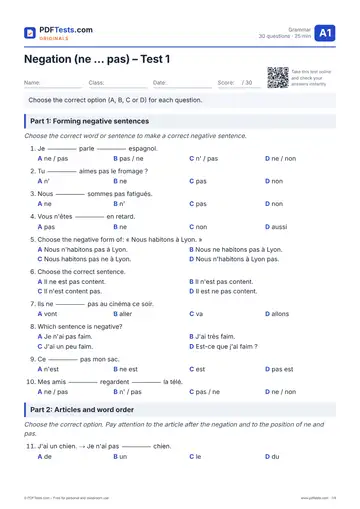
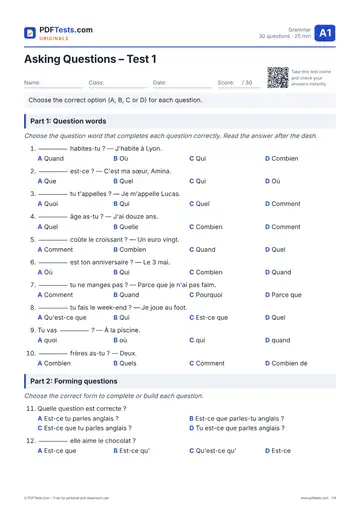
For more practice, read our guides to negation with ne … pas and asking questions in French.
Pronunciation notes
Ils sont vs ils ont
This is the most important sound difference between the two verbs.
- ils sont — s sound: [il sɔ̃] — they are
- ils ont — z sound, because of liaison: [il zɔ̃] — they have
Ils sont contents (They are happy) and Ils ont des enfants (They have children) sound clearly different if you make the s / z contrast.
Liaison with nous and vous
The final s of nous and vous is pronounced as z before a vowel:
- nous‿avons, vous‿avez, vous‿êtes
There is no liaison with nous sommes, because sommes starts with a consonant.
Silent endings
The letters at the end of suis, es, est, as and ont are not pronounced on their own. Il est sounds like il è, and tu as sounds like tu a.
Être or avoir? Where French and English differ
English uses to be in many expressions where French uses avoir. Learn these as fixed pairs.
| English | ✗ Not | ✓ French |
|---|---|---|
| I am 15. | Je suis 15. | J’ai quinze ans. |
| I’m hungry. | Je suis faim. | J’ai faim. |
| I’m cold. | Je suis froid. | J’ai froid. |
| You’re right. | Tu es raison. | Tu as raison. |
| She’s scared. | Elle est peur. | Elle a peur. |
A simple test: if the word after the verb is a noun (faim, peur, ans), French usually uses avoir. If it is an adjective (fatigué, content, malade), use être: Je suis malade (I am ill).
Be careful with froid and chaud. J’ai froid means I feel cold. Je suis froid would describe your personality (I am a cold person). For weather, French uses a third verb: Il fait froid (It’s cold outside).
Looking ahead: helper verbs in the past
At A2 you will meet être and avoir again as helper verbs in the passé composé: J’ai mangé (I ate), Je suis allé(e) (I went). Knowing their present forms perfectly now makes that step much easier. See our passé composé guide when you are ready.
Common mistakes
- ✗ Je suis vingt ans. → ✓ J’ai vingt ans. — Age uses avoir + number + ans.
- ✗ Je suis faim. → ✓ J’ai faim. — Hunger, thirst, fear, cold and heat use avoir + noun.
- ✗ Je ai un frère. → ✓ J’ai un frère. — Je always becomes j’ before a vowel.
- ✗ Je n’ai pas une voiture. → ✓ Je n’ai pas de voiture. — After a negative, un / une / des usually become de.
- ✗ Elle est une étudiante. → ✓ Elle est étudiante. — No article with a profession or role after il / elle est.
- ✗ Il a dix heures. → ✓ Il est dix heures. — Time uses il est.
- ✗ Ils sont deux chiens. → ✓ Ils ont deux chiens. — Ont (have), not sont (are); listen for the z sound.
- ✗ Il à un chat. → ✓ Il a un chat. — The verb a has no accent; à is a preposition.
Quick check
Complete with the correct form of être or avoir.
- Nous ___ français.
- Ma sœur ___ douze ans.
- Tu ___ soif ?
- Il ___ midi.
- Make it negative: J’ai un chat.
Answers
- sommes — nationality uses être.
- a — age uses avoir.
- as — avoir soif = to be thirsty.
- est — time uses il est.
- Je n’ai pas de chat. — ne becomes n’, and un becomes de.
Next step
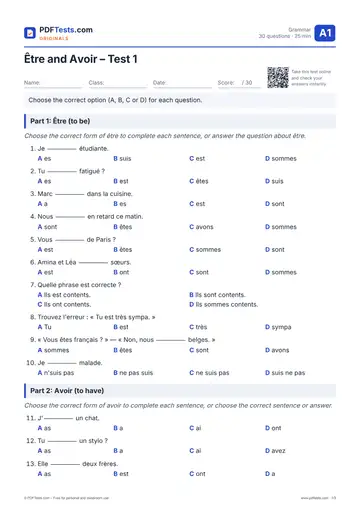
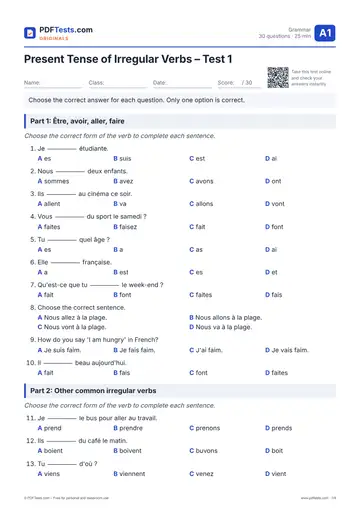
Now put these forms into practice: test yourself with our A1 Être and Avoir test, which mixes forms, age and feeling expressions, and negatives. If you score well, move on to other common irregular verbs such as aller, faire and prendre in our guide to the present tense of irregular verbs.
Was this page helpful?
What was the problem?
Thank you for your feedback!