French has three ways to turn a statement into a question. You can raise your voice at the end, put est-ce que in front, or swap the subject and the verb (inversion). You use the same three patterns with question words like où, quand and pourquoi when you want information, not just yes or no.
Yes/no questions: three patterns
Start with a simple statement: Tu parles français. (You speak French.) You can make it a question in three ways.
| Pattern | Example | Register |
|---|---|---|
| Intonation | Tu parles français ? | Informal, spoken |
| Est-ce que + statement | Est-ce que tu parles français ? | Neutral, spoken and written |
| Inversion (verb + subject) | Parles-tu français ? | Formal, mostly written |
All three mean Do you speak French? French has no helper verb like English do or does. You never add an extra verb to make a question.
1. Intonation
Keep the normal word order and raise your voice at the end. In writing, just add a question mark. This is the most common pattern in everyday conversation.
- Vous êtes étudiant ? — Are you a student?
- Elle aime le café ? — Does she like coffee?
- On va au cinéma ce soir ? — Shall we go to the cinema tonight?
2. Est-ce que
Put est-ce que at the start of a normal statement. The word order after it does not change. Before a vowel or a silent h, que becomes qu’.
- Est-ce que tu as faim ? — Are you hungry?
- Est-ce qu’il habite à Paris ? — Does he live in Paris?
- Est-ce qu’elles travaillent le samedi ? — Do they work on Saturdays?
Est-ce que has no meaning of its own. It simply signals that a question is coming. It is a safe choice in almost any situation, from a café to a job interview.
3. Inversion
Put the verb before the subject pronoun and join them with a hyphen.
| Statement | Inversion question | Translation |
|---|---|---|
| Vous parlez anglais. | Parlez-vous anglais ? | Do you speak English? |
| Tu es prêt. | Es-tu prêt ? | Are you ready? |
| Ils ont une voiture. | Ont-ils une voiture ? | Do they have a car? |
| Il a un chien. | A-t-il un chien ? | Does he have a dog? |
| Elle parle italien. | Parle-t-elle italien ? | Does she speak Italian? |
When the verb ends in a vowel and the pronoun is il, elle or on, add -t- between them so that two vowel sounds don’t meet: a-t-il, va-t-elle, parle-t-on. Verbs that already end in -t or -d don’t need it: Est-il là ? (Is he there?), Prend-elle le bus ? (Does she take the bus?). The -d of prend is pronounced like a t here.
At A1, use inversion mainly with vous and tu, and in fixed phrases such as Comment allez-vous ? (How are you?) and Quelle heure est-il ? (What time is it?). Avoid inversion with je; use est-ce que instead. Inversion also requires you to know your verb forms well, so review the present tense of irregular verbs for forms like vas-tu, fais-tu and veux-tu.
With a noun subject, intonation or est-ce que is easiest: Est-ce que ton frère parle anglais ? (Does your brother speak English?). You may also see the formal version Ton frère parle-t-il anglais ?, where the noun stays first and a pronoun is added after the verb.
Question words
To ask for information, use a question word (un mot interrogatif).
| Question word | Meaning | Example |
|---|---|---|
| qui | who | Qui est-ce ? — Who is it? |
| que / qu’est-ce que / quoi | what | Qu’est-ce que tu fais ? — What are you doing? |
| où | where | Où est la gare ? — Where is the station? |
| quand | when | Quand est-ce que tu pars ? — When are you leaving? |
| comment | how | Comment tu t’appelles ? — What’s your name? |
| pourquoi | why | Pourquoi tu ris ? — Why are you laughing? |
| combien (de) | how much / how many | Ça coûte combien ? — How much does it cost? |
| quel / quelle | which / what | Quel âge as-tu ? — How old are you? |
Answer pourquoi with parce que (because): Pourquoi tu apprends le français ? — Parce que j’aime voyager. (Why are you learning French? — Because I love travelling.)
Use combien de before a noun: Combien de frères as-tu ? (How many brothers do you have?)
Word order with question words
The same three patterns work with question words. Here is one question in four styles:
| Pattern | Example |
|---|---|
| Intonation, word at the end | Tu habites où ? |
| Intonation, word at the start | Où tu habites ? |
| Question word + est-ce que | Où est-ce que tu habites ? |
| Question word + inversion | Où habites-tu ? |
All four mean Where do you live? The first two are informal, the third is neutral and the last is more formal. Notice that the question word always comes before est-ce que.
Que, qu’est-ce que or quoi?
The word for what changes depending on the pattern:
- Qu’est-ce que at the start, with normal word order: Qu’est-ce que tu manges ? — What are you eating?
- Que with inversion: Que manges-tu ? — What are you eating?
- Quoi at the end of an informal question or after a preposition: Tu manges quoi ? — What are you eating? / De quoi tu parles ? — What are you talking about?
Don’t start a question with quoi followed by a subject: say Qu’est-ce que tu veux ?, not Quoi tu veux ?
Quel agrees with its noun
Quel means which or what and behaves like an adjective: it agrees with the noun in gender and number. All four forms are pronounced the same, so the difference only shows in writing.
| Singular | Plural | |
|---|---|---|
| Masculine | quel | quels |
| Feminine | quelle | quelles |
- Quel jour sommes-nous ? — What day is it?
- Quelle est ton adresse ? — What is your address?
- Tu fais quels sports ? — What sports do you do?
- Quelles langues parlez-vous ? — What languages do you speak?
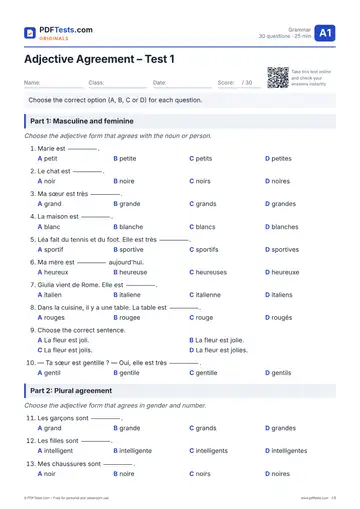
Use quel + être to ask What is …? for names, numbers and addresses: Quel est ton numéro de téléphone ? (What’s your phone number?). Here quel agrees with the noun after être: quelle est ton adresse because adresse is feminine. If agreement is still new to you, see our guide to adjective agreement.
Est-ce que vs qu’est-ce que
Learners often mix these up because they look so similar.
- Est-ce que asks a yes/no question. The answer is oui or non. Est-ce que tu aimes le sport ? — Oui. (Do you like sport? — Yes.)
- Qu’est-ce que means what. The answer gives information. Qu’est-ce que tu aimes ? — Le tennis. (What do you like? — Tennis.)
An easy way to remember: qu’est-ce que = que (what) + est-ce que.
Negative questions and the answer si
To ask a negative question, place ne … pas around the verb as usual (see our guide to negation with ne … pas):
- Tu ne viens pas ? — Aren’t you coming?
- Est-ce que tu n’as pas faim ? — Aren’t you hungry?
- N’aimez-vous pas le fromage ? — Don’t you like cheese?
To contradict a negative question and say yes, French uses si instead of oui:
- Tu ne viens pas ? — Si, je viens. — Aren’t you coming? — Yes, I am.
- Tu ne viens pas ? — Non, je ne viens pas. — Aren’t you coming? — No, I’m not.
Common mistakes
- ✗ Est-ce que il parle anglais ? → ✓ Est-ce qu’il parle anglais ? Que becomes qu’ before a vowel.
- ✗ Parle-il français ? → ✓ Parle-t-il français ? Add -t- between a verb ending in a vowel and il/elle/on.
- ✗ Parlez vous anglais ? → ✓ Parlez-vous anglais ? Inversion always needs a hyphen.
- ✗ Qu’est-ce que tu aimes le chocolat ? → ✓ Est-ce que tu aimes le chocolat ? A yes/no question uses est-ce que, not qu’est-ce que.
- ✗ Quoi tu fais ? → ✓ Qu’est-ce que tu fais ? / Tu fais quoi ? Quoi goes at the end or after a preposition.
- ✗ Est-ce que où tu vas ? → ✓ Où est-ce que tu vas ? The question word comes before est-ce que.
- ✗ Quel heure est-il ? → ✓ Quelle heure est-il ? Heure is feminine, so quel takes the feminine form.
- ✗ Combien frères as-tu ? → ✓ Combien de frères as-tu ? Use combien de before a noun.
- ✗ Tu n’as pas faim ? — Oui, j’ai faim. → ✓ Si, j’ai faim. Use si to say yes to a negative question.
Quick check
- Choose: ___ tu parles anglais ? (Est-ce que / Qu’est-ce que)
- Make an inversion question: Il a un chien.
- Complete: ___ heure est-il ? (quel / quelle)
- Tu ne viens pas ? Say yes: ___, je viens.
- Complete: ___ tu habites ? — À Lyon.
Answers
- Est-ce que tu parles anglais ? (a yes/no question)
- A-t-il un chien ? (add -t- between two vowels)
- Quelle heure est-il ? (heure is feminine)
- Si, je viens. (yes to a negative question)
- Où tu habites ? (the answer is a place)
Next step
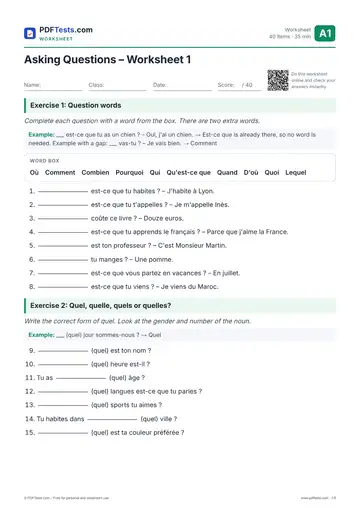
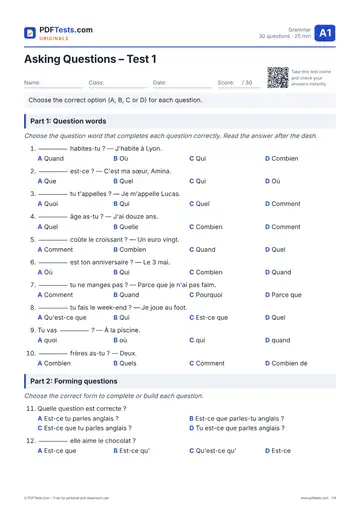
Now put the three patterns into practice: test yourself with our A1 Asking Questions test and check whether you can choose between est-ce que and qu’est-ce que, form inversion with -t-, and pick the right form of quel. If you score well, keep building your basics with the other French A1 tests, where questions appear alongside verbs, articles and negation.
Was this page helpful?
What was the problem?
Thank you for your feedback!