To make a sentence negative in French, you put ne before the conjugated verb and pas after it: Je ne parle pas allemand (I don’t speak German). You use ne … pas whenever you want to say that something is not true, not happening or not wanted. It is one of the first structures you need at A1, and it follows a few clear rules.
How negation works in French
In English you usually add not or don’t. French does not need an extra verb like do. Instead, two small words surround the conjugated verb like a sandwich.
- Je travaille le lundi. → Je ne travaille pas le lundi. I work on Mondays. → I don’t work on Mondays.
- Elle est française. → Elle **n’**est pas française. She is French. → She isn’t French.
- Nous regardons la télé. → Nous ne regardons pas la télé. We watch TV. → We don’t watch TV.
The subject stays first, and the rest of the sentence stays in the same order.
Ne becomes n’ before a vowel or mute h
When the verb starts with a vowel (a, e, i, o, u, y) or a silent h, ne shortens to n’.
| Affirmative | Negative | English |
|---|---|---|
| J’aime le sport. | Je **n’**aime pas le sport. | I don’t like sport. |
| Tu habites ici. | Tu **n’**habites pas ici. | You don’t live here. |
| Il a faim. | Il **n’**a pas faim. | He isn’t hungry. |
| Vous êtes en retard. | Vous **n’**êtes pas en retard. | You aren’t late. |
Form: ne … pas in the present tense
Here are three key verbs in the negative. Notice how ne changes to n’ with some forms of être and all forms of avoir.
| Subject | parler (to speak) | être (to be) | avoir (to have) |
|---|---|---|---|
| je | je ne parle pas | je ne suis pas | je n’ai pas |
| tu | tu ne parles pas | tu n’es pas | tu n’as pas |
| il / elle / on | il ne parle pas | il n’est pas | il n’a pas |
| nous | nous ne parlons pas | nous ne sommes pas | nous n’avons pas |
| vous | vous ne parlez pas | vous n’êtes pas | vous n’avez pas |
| ils / elles | ils ne parlent pas | ils ne sont pas | ils n’ont pas |
I don’t speak / I am not / I don’t have, and so on.
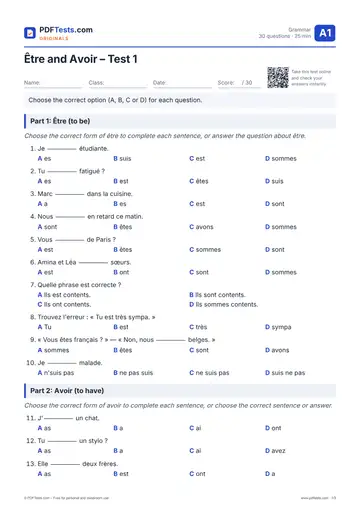
If you need to revise the forms of these two verbs, see our guide to être and avoir.
Word order: where ne and pas go
The basic rule is simple: ne and pas go around the conjugated verb. A few common patterns need extra attention.
With two verbs (verb + infinitive)
With verbs like vouloir, pouvoir, aimer or aller followed by an infinitive, ne … pas goes around the first verb only. The infinitive comes after pas.
- Je ne veux pas sortir ce soir. I don’t want to go out tonight.
- Elle ne peut pas venir demain. She can’t come tomorrow.
- Nous **n’**allons pas travailler samedi. We aren’t going to work on Saturday.
- Ils **n’**aiment pas cuisiner. They don’t like cooking.
With reflexive and object pronouns
Pronouns like me, te, se, le, la stay directly before the verb. Ne goes in front of the pronoun, and pas goes after the verb.
- Je ne m’appelle pas Thomas. My name isn’t Thomas.
- Tu ne te lèves pas tôt. You don’t get up early.
- Je ne le connais pas. I don’t know him.
Think of the pronoun and the verb as one block: ne + [pronoun + verb] + pas.
In questions
You can ask a negative question with rising intonation or with est-ce que. The negative part does not change.
- Tu ne viens pas ? Aren’t you coming?
- Est-ce que vous **n’**aimez pas le fromage ? Don’t you like cheese?
To answer yes to a negative question, French uses si, not oui.
- Tu ne viens pas ? — Si, je viens. Aren’t you coming? — Yes, I am.
- Tu ne viens pas ? — Non, je ne viens pas. Aren’t you coming? — No, I’m not.
For more on question patterns, read our guide to asking questions in French.
Articles after negation: pas de
This is the rule that surprises most beginners. After a negative verb, the indefinite articles (un, une, des) and the partitive articles (du, de la, de l’) usually become de, or d’ before a vowel.
| Affirmative | Negative | English |
|---|---|---|
| J’ai un chien. | Je n’ai pas de chien. | I don’t have a dog. |
| Elle a une voiture. | Elle n’a pas de voiture. | She doesn’t have a car. |
| Nous avons des enfants. | Nous n’avons pas **d’**enfants. | We don’t have children. |
| Je bois du café. | Je ne bois pas de café. | I don’t drink coffee. |
| Il mange de la viande. | Il ne mange pas de viande. | He doesn’t eat meat. |
| Il y a **de l’**eau. | Il n’y a pas **d’**eau. | There’s no water. |
The expression il y a (there is / there are) becomes il n’y a pas de: Il n’y a pas de pain (There’s no bread).
Exception 1: definite articles do not change
Le, la, l’ and les stay the same after a negative verb. This happens a lot with verbs of liking and disliking, such as aimer, adorer and détester.
- J’aime le thé. → Je n’aime pas le thé. I don’t like tea.
- Il regarde les photos. → Il ne regarde pas les photos. He isn’t looking at the photos.
Exception 2: after être, the article stays
With être, you are saying what something is not, so un, une, des do not change.
- C’est un chat. → Ce n’est pas un chat. It isn’t a cat.
- Je ne suis pas un robot. I’m not a robot.
Our guide to definite, indefinite and partitive articles explains these articles in more detail.
Other negative words: jamais, plus, rien, personne
Once you know ne … pas, you can replace pas with other words to change the meaning. The word order is the same: ne before the verb, the second word after it.
| Structure | Meaning | Example | English |
|---|---|---|---|
| ne … pas | not | Je ne fume pas. | I don’t smoke. |
| ne … jamais | never | Je ne fume jamais. | I never smoke. |
| ne … plus | no longer, not any more | Je ne fume plus. | I don’t smoke any more. |
| ne … rien | nothing, not anything | Je ne vois rien. | I can’t see anything. |
| ne … personne | nobody, not anyone | Je ne connais personne ici. | I don’t know anyone here. |
Two points to remember:
- Do not add pas to these structures. Jamais, plus, rien and personne take its place.
- Pas de also applies after jamais and plus: Je ne mange jamais de viande (I never eat meat), Il n’y a plus de lait (There’s no more milk).
Non, pas and ne … pas: what’s the difference
Learners often mix up these three. Each has its own job.
- Non is a full answer on its own. Tu as faim ? — Non. (Are you hungry? — No.) You can also say Non, merci (No, thank you).
- Pas without ne is used in short phrases with no verb: Pas moi (Not me), Pas maintenant (Not now), Pas du tout (Not at all), Pourquoi pas ? (Why not?).
- Ne … pas is used with a conjugated verb in a complete sentence: Je ne sais pas. (I don’t know.)
Spoken French often drops ne
In everyday conversation, French speakers often leave out ne and keep only pas.
- Je sais pas. I don’t know.
- C’est pas grave. It doesn’t matter.
- J’ai pas le temps. I don’t have time.
You should recognise this when you listen, but in writing and in tests, always use both ne and pas. Pas is never dropped: it carries the negative meaning in speech.
A preview: negation in the past
In the passé composé, ne … pas goes around the auxiliary verb (avoir or être), not the past participle: Je n’ai pas mangé (I didn’t eat). You will practise this at A2.
Common mistakes
- ✗ Je pas parle français. → ✓ Je ne parle pas français. (Pas goes after the verb, and ne is needed in writing.)
- ✗ Je ne aime pas le thé. → ✓ Je n’aime pas le thé. (Ne becomes n’ before a vowel.)
- ✗ Je n’ai pas une voiture. → ✓ Je n’ai pas de voiture. (Un / une become de after a negative verb.)
- ✗ Je ne bois pas du lait. → ✓ Je ne bois pas de lait. (Partitive du becomes de after negation.)
- ✗ Je n’aime pas de chocolat. → ✓ Je n’aime pas le chocolat. (Definite articles do not change.)
- ✗ Ce n’est pas de livre. → ✓ Ce n’est pas un livre. (After être, the article stays.)
- ✗ Je ne veux sortir pas. → ✓ Je ne veux pas sortir. (Ne … pas goes around the conjugated verb, not the infinitive.)
- ✗ Je ne pas m’appelle Léa. → ✓ Je ne m’appelle pas Léa. (The pronoun stays next to the verb, inside the negation.)
- ✗ Je ne mange pas jamais de viande. → ✓ Je ne mange jamais de viande. (Jamais replaces pas.)
- ✗ Tu ne viens pas ? — Oui, je viens. → ✓ Si, je viens. (Use si to say yes to a negative question.)
Quick check
- Make the sentence negative: Je suis fatigué.
- Complete: Il ___ habite ___ à Paris. (He doesn’t live in Paris.)
- Make the sentence negative: Nous avons des enfants.
- Correct the mistake: Je n’aime pas de chocolat.
- Contradict the question: Tu ne parles pas anglais ? — ___, je parle anglais.
Answers
- Je ne suis pas fatigué. I’m not tired.
- Il **n’**habite pas à Paris. He doesn’t live in Paris. (n’ before a mute h)
- Nous n’avons pas **d’**enfants. We don’t have children. (des becomes d’)
- Je n’aime pas le chocolat. I don’t like chocolate. (le does not change)
- Si, je parle anglais. Yes, I do speak English.
Next step
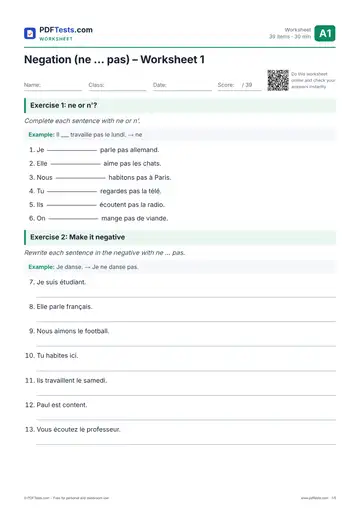
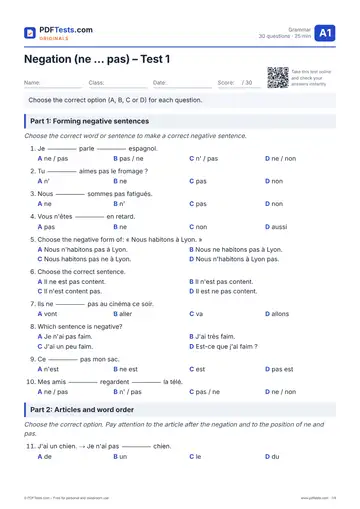
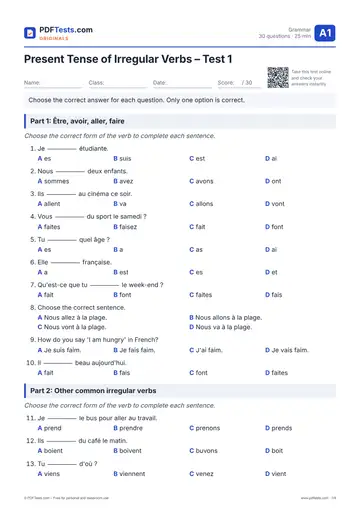
Now put the rules into practice: test yourself with our A1 Negation (ne … pas) test, which checks word order, n’ before vowels and pas de. Because negation works with every verb, it also helps to revise the present tense of irregular verbs such as aller, faire and vouloir, so you can make any sentence negative with confidence.
Was this page helpful?
What was the problem?
Thank you for your feedback!